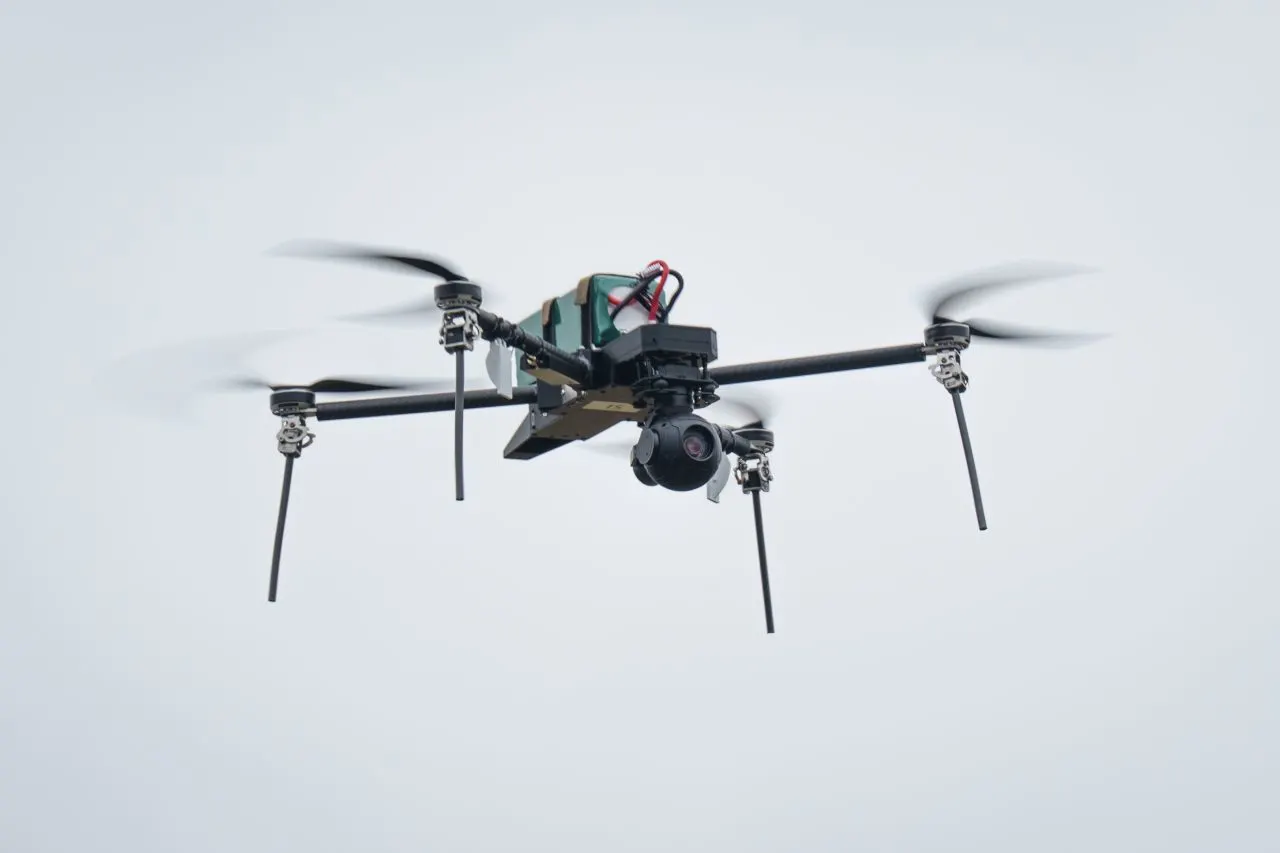
Ukraine’s Ministry of Defence and the government-backed Brave1 defense technology cluster have moved a group of domestically built reconnaissance drones into procurement after field-testing Mavic-class quadcopters from nine Ukrainian manufacturers, Brave1 announced on November 12, 2026. Systems that “proved effective on the testing ground and met military requirements” are advancing to the procurement stage, while the remaining manufacturers received detailed feedback to refine their designs.
The effort targets the most ubiquitous aircraft at Ukraine’s tactical edge. The DJI Mavic, a folding Chinese consumer quadcopter designed for aerial photography, has served both Ukrainian and Russian units since 2022 as the default tool for target spotting, artillery adjustment and front-line surveillance. That dependence has become a strategic liability: DJI suspended business in Ukraine and Russia in April 2022, and Beijing has tightened export controls on drones and drone components since September 2023. Brave1 did not name the companies tested, disclose how many of the nine passed, or give a quantity or value for the follow-on contracts.
Brave1 Requirements Set the Bar for Mavic Replacement Drones
Brave1 framed the program as a requirements-driven replacement rather than a cloning exercise. “The goal, therefore, is not to create a copy of the Mavic, but to develop a capable Ukrainian solution adapted to the realities of modern warfare,” the cluster said. It set four baseline criteria: resistance to electronic warfare (EW) and the ability to operate without GPS; a flight endurance of at least 60 minutes; remote control allowing operators to work from a safer standoff distance; and a familiar interface that limits retraining for crews already qualified on the Mavic.
Each criterion maps to a known Mavic limitation. Publicly available specifications indicate the Mavic 3T thermal variant, bought in bulk by Ukraine’s Defence Procurement Agency in 2024, offers a maximum flight time of 45 minutes in no-wind conditions and a 15 km transmission range under FCC settings, dropping to 8 km under CE settings. The current Mavic 4 Pro, released in May 2025, is rated at 51 minutes under ideal test conditions. A 60-minute floor therefore places the Ukrainian requirement above every Mavic variant in frontline use. Navigation is the sharper gap: the Mavic relies on GPS, Galileo and BeiDou positioning and on commercial datalinks never hardened against military jamming.
Brave1 tied the requirements to the expanding kill zone, the band of territory under persistent drone observation on both sides of the line of contact. As that zone deepens, units need aircraft that stay airborne longer, reach farther and remain usable under Russian jamming. “Civilian drones are increasingly unable to meet these requirements,” Brave1 said.
From 2024 Demonstrations to Ukrainian Recon Drone Procurement
The current round builds on two years of development. In November 2024, the Ministry of Strategic Industries staged a demonstration of eight Ukrainian Mavic-class quadcopters for the General Staff, the Unmanned Systems Forces Command, the Logistics Forces Command and state procurement officials. Six teams completed a mission consisting of a 10 km (6.2 mile) flight at an altitude above 250 m (820 ft) followed by a target search. Two designs, Shmavik and Ptakh-S, had already been codified for military use, and other types shown included the Griffon Roksolana X30 and ZOOM.
Procurement data show the scale any replacement must absorb. Since April 2024, the Defence Procurement Agency has contracted Mavic 3E and Mavic 3T drones worth about UAH 2.5 billion, including a first order of 3,000 Mavic 3E and 1,000 Mavic 3T airframes valued at UAH 575.2 million.
Brave1 supplies the industrial channel. The cluster links more than 2,500 Ukrainian defense technology companies, and its Brave1 Market platform has delivered more than 774,000 drones and other items worth $1.15 billion to units, according to the Ministry of Defence, with 955 manufacturers and 486 ordering units as of November 2026.
Analysis: Replacing the Mavic is less about matching a camera drone than about removing a single point of failure from Ukraine’s reconnaissance-strike complex. A foreign commercial supplier whose government controls exports, firmware and component flows holds latent leverage over the tempo of Ukrainian fires. A domestic platform built to military requirements returns that control to Kyiv and allows hardware and software to iterate on wartime timelines, the same dynamic that has driven Ukraine’s FPV and interceptor drone sectors. The harder test is cost and volume: the Mavic’s commercial economies of scale set a price benchmark that Ukrainian producers may struggle to match, and selected manufacturers must scale without reintroducing Chinese-sourced motors, cameras and batteries. For NATO armies, the trial offers a template for qualifying small tactical UAS against EW-first requirements rather than commercial specifications.
Key unknowns remain the identities of the selected manufacturers, the size and value of the first contracts, and whether purchases will run through centralized Defence Procurement Agency tenders, Brave1 Market listings, or both. Brave1 said it wants technologies that “can quickly adapt to changes on the battlefield and can be scaled up.” Codification of the newly selected types, delivery timelines and feedback from the first receiving units will determine how quickly Ukrainian brigades can retire the Mavic from routine reconnaissance.