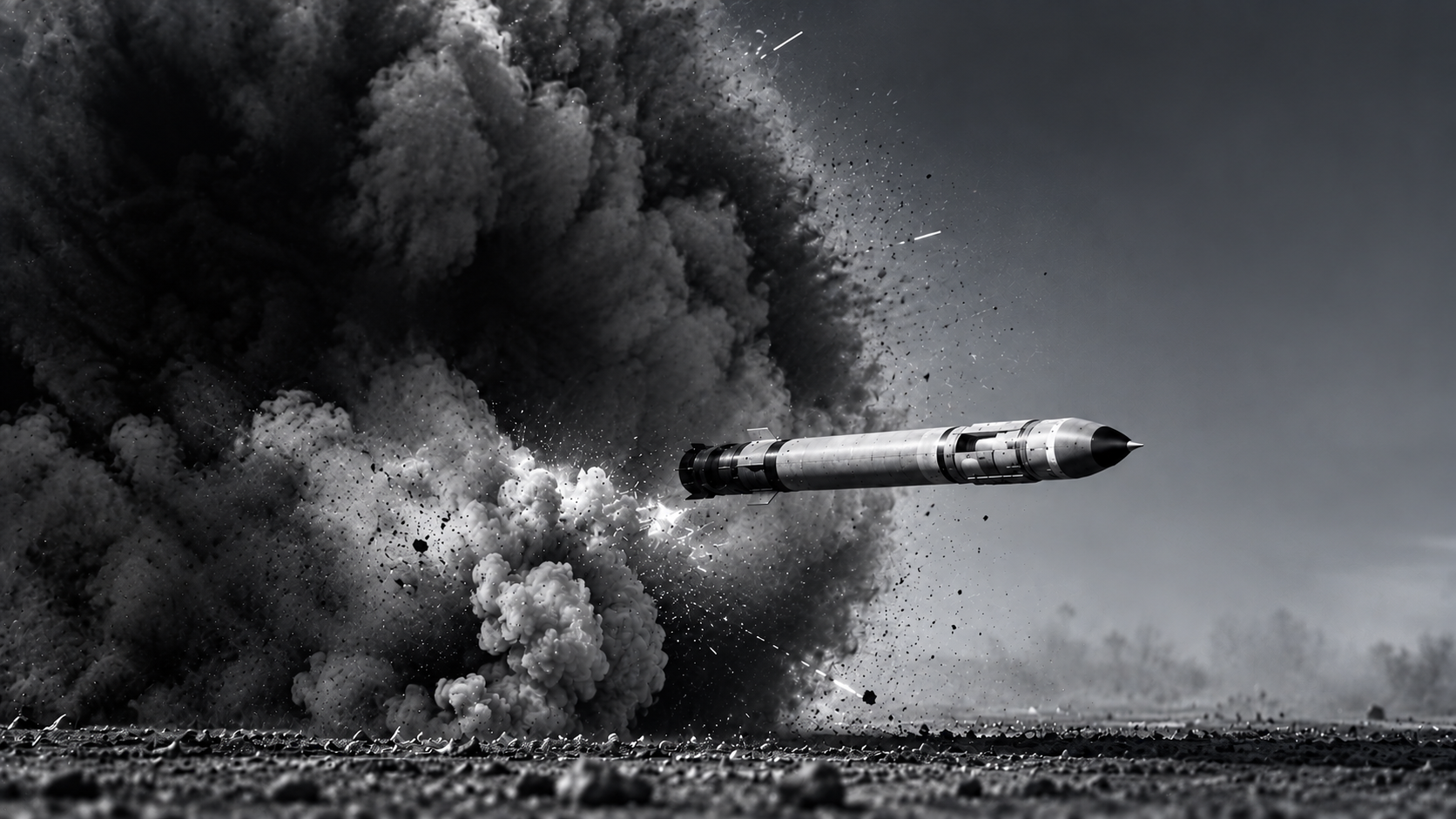
Tiberius Aerospace announced on October 1, 2026, a $500 million contract to manufacture, license and distribute Sceptre, its ramjet-powered 155mm precision-guided munition, in what the Newport Beach, California, company calls the first scaled deployment of its Defense-as-a-Service model. The arrangement rests on an International Traffic in Arms Regulations (ITAR) Technical Assistance Agreement (TAA) between Tiberius and a consortium of U.K. technology partners that the company has not named.
The deal lands as NATO governments rebuild 155mm stocks drawn down by deliveries to Ukraine and look for cheaper ways to push cannon artillery into ranges once reserved for rockets. Founded in 2022 by Chad Steelberg and Andy Baynes, Tiberius unveiled Sceptre, also designated TRBM 155HG, in London on May 19, 2025. The U.K. Ministry of Defence (MoD) became launch customer through a trials and development contract that ran from February to October 2025, according to the MoD, with the U.S. Defense Innovation Unit (DIU) facilitating independent verification and validation. Tiberius also holds a Cooperative Research and Development Agreement (CRADA) with the U.S. Army Combat Capabilities Development Command (DEVCOM) Armaments Center. The company has not disclosed the paying party, quantities, unit price or period of performance.
Sceptre Ramjet Design: Range, Speed, and Guidance Claims
Sceptre is a liquid-fueled, air-breathing ramjet projectile fired from standard NATO 155mm tubes. Ignition requires a muzzle velocity above Mach 2, so crews will normally fire it at maximum charge. Per Tiberius launch data, the ramjet accelerates the round to Mach 3.5, shuts down for a glide phase above 65,000 ft (19,812 m), then reignites for a terminal sprint. That altitude places the round above most ground-based jammers and lets it reacquire GPS, which an inertial measurement unit (IMU) and AI-assisted error correction use to steer it. The company claims a circular error probable (CEP) of about 3.5 m, including in GPS-denied conditions.
Tiberius advertised a range of up to 150 km with a maximum payload of 5.2 kg; its product page now claims more than 140 km and Mach 3 and withholds payload. Publicly available specifications put the fill of a standard M795 high-explosive shell at roughly 10.8 kg, which makes Sceptre a tool for point targets such as air defense radars, command posts and electronic warfare systems, not area suppression.
A titanium body and a 7-liter tank accepting diesel, JP-4 or JP-8 allow fuel and payload to be added at the point of use, which Tiberius says removes in-transit hazards and extends shelf life beyond 20 years. The trade-off is a 1,550 mm length the company indicated is incompatible with autoloaders, tying 2025 trials to manually loaded guns such as the BAE Systems M777. That matters for the British Army, whose in-service Archer and future RCH 155 are both autoloaded. Tiberius cites a unit cost of $52,000 without payload and puts an M982 Excalibur at roughly $380,000; neither figure has been independently confirmed. The closest rival, the Boeing and Nammo Ramjet 155 developed under the U.S. Army’s XM1155 effort, carries a stated range goal of more than 70 km.
How Defense-as-a-Service and GRAIL Restructure Munitions Licensing
The contract’s larger significance lies in its commercial structure. Under traditional acquisition, each government funds its own research, development, test and evaluation, and allies with similar requirements end up running parallel programs and separate supply chains. Tiberius instead develops and validates the technology centrally, then licenses it to qualified manufacturers and partner nations that build sovereign production lines from a common technical baseline.
The connective layer is GRAIL, an AI-enabled platform linking requirements, engineering, suppliers, compliance and manufacturing against a controlled engineering baseline. Tiberius markets it as an outcome-based acquisition tool that scores munitions on the total cost to destroy a target with a 90 percent success rate. Sceptre’s open architecture is meant to let qualified suppliers insert new warheads, guidance sections and other subsystems as the design evolves.
The TAA is the enabling instrument. ITAR licensing has long slowed allied co-production of U.S.-origin munitions, and a standing agreement authorizing engineering work and industrial participation gives British firms a lawful path to build a U.S.-designed round. “The West’s greatest strategic advantage is the freedom to invent, compete and build,” said Steelberg, the chief executive. General Sir Roly Walker, Chief of the General Staff of the British Army, said the collaboration showed the value of combining U.K. and U.S. expertise to explore advanced artillery technologies and mature future concepts, language that points to experimentation rather than a procurement decision. Retired Admiral Gary Roughead, the 29th U.S. Chief of Naval Operations, tied allied capacity to produce interoperable munitions at scale to readiness and deterrence.
Analysis: The $500 million figure describes a commercial manufacturing and licensing framework, not a disclosed government buy. Its weight lies in the model: if an ITAR TAA lets British firms produce a U.S.-designed precision round from a shared baseline, it offers a template for separating design authority from production location, which allied capitals need after Ukraine exposed how thin Western 155mm capacity had become. The technical case remains unproven in public: no independent data on 150 km shots, CEP or terminal effects has been released, and a 5.2 kg payload narrows the target set.
The next milestones are identification of the U.K. consortium members and a first licensed producer, release of the DIU-facilitated verification results, certification on autoloaded guns such as Archer, and any MoD decision to move Sceptre from trials into procurement.