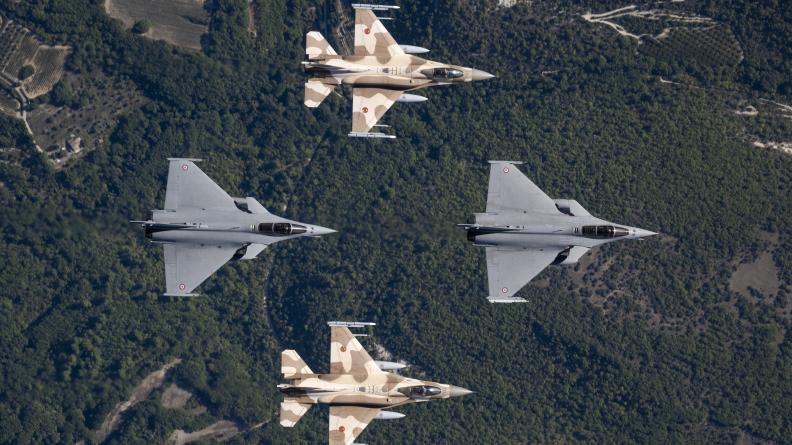
Four F-16 fighters of the Royal Moroccan Air Force (RMAF) deployed to French Air Base 115 (BA 115) Orange-Caritat from September 23 to October 2, 2026, flying alongside Dassault Rafale jets of the French Air and Space Force’s 5th Fighter Wing in the bilateral exercise ORYX. The French Air and Space Force said it was the first time Moroccan F-16s had operated from the base, with a program built around air-to-air refueling, formation flying, air combat and electronic warfare.
ORYX extends MARATHON 25, held in Morocco from June 23 to July 4, 2025, when five Rafale B jets from the 4th Fighter Wing and an Airbus A330 Multi-Role Tanker Transport (MRTT) Phénix worked with eight RMAF F-16s between Marrakech and Guelmim. This year the host role reversed. The exercise comes as Paris reshapes its military partnerships in Africa after withdrawing forces from Mali, Burkina Faso, Niger and Chad between 2022 and 2025, and the French ministry describes Morocco as a strategic partner for security in the Sahel-Saharan region and the Mediterranean.
Moroccan F-16 Detachment Meets the Rafale Wing at Orange-Caritat
The RMAF detachment numbered about 50 personnel, including 12 pilots, according to figures reported during the exercise. The four jets reportedly self-deployed along the Spanish coast without tanker support, each carrying close to seven metric tons of fuel, while two RMAF C-130H transports moved personnel and spares.
The French release did not specify the aircraft configuration. Morocco’s fighters descend from 24 F-16C/D Block 52+ jets ordered in 2008. Publicly available specifications indicate a single Pratt & Whitney F100-PW-229 engine rated at about 29,000 lbf (129 kN) in afterburner and the mechanically scanned AN/APG-68(V)9 radar. In 2019, Washington cleared 23 of these airframes for a $985.2 million upgrade to the F-16V standard and approved the sale of 25 new F-16C/D Block 72 jets valued at $3.787 billion, bringing the Northrop Grumman AN/APG-83 active electronically scanned array (AESA) radar and the L3Harris AN/ALQ-254 Viper Shield electronic warfare suite. Open-source reporting indicates no Block 72 had reached Rabat by late summer 2026.
The 5th Fighter Wing was re-formed at Orange on July 18, 2024, with Fighter Squadron 1/5 “Vendée” flying Rafale B and C jets; a second Rafale squadron is expected around 2028. Publicly available specifications credit the Rafale with two Safran M88-2 turbofans rated at 75 kN each with reheat, the Thales RBE2-AA AESA radar, the SPECTRA integrated self-protection suite and MICA and Meteor air-to-air missiles. Pairing an AESA-equipped Rafale with a mechanically scanned F-16 shapes how a combined formation splits sensor and shooter roles.
Refueling, Air Combat and Electronic Warfare in the ORYX Program
Crews first completed a familiarization phase covering BA 115 procedures and local airspace before the training intensified. Missions were planned and debriefed jointly. Regional reporting described air defense scenarios combining generic air-to-air and surface-to-air threats, which French officers framed as preparation for high-intensity combat. On October 1, for example, two Rafales of the 1/5 “Vendée” launched with two Moroccan F-16s.
Air-to-air refueling is the most technically demanding interoperability item. The Rafale receives fuel through a probe and drogue, while the F-16 uses a dorsal boom receptacle, so Rafale buddy tanking cannot service the Moroccan jets. The French release did not identify the tanker used during ORYX. The French A330 MRTT Phénix fleet carries both a refueling boom and underwing hose-and-drogue pods, the configuration that refueled RMAF F-16s by day and night during MARATHON 25. Any combined Rafale and F-16 package would depend on boom-capable tankers, since the RMAF’s own KC-130H fleet refuels only probe-equipped aircraft.
Neither air force released details of the electronic warfare serials. Interoperability also extended beyond the cockpit: according to the French Air and Space Force, air traffic controllers, mechanics, firefighters and mission planners adapted their procedures to work with their Moroccan counterparts.
From Bilateral Exercise to France-Morocco Strategic Air Cooperation
The French ministry frames the objective as understanding each partner’s capabilities, procedures and modes of action well enough to share a common operational language, then moving beyond flying together toward shared reflexes in demanding tactical environments. The exercise director, Lieutenant Colonel Jérémy, who commands the 5th Fighter Wing and is identified by first name only under French military practice, described the bilateral relationship as a close friendship that joint training sustains while improving interoperability. Gen. Alexis Rougier, chief of staff of the French Air Defense and Air Operations Command, has set joint missions as the long-term goal, according to remarks reported during the exercise.
Morocco, a US Major Non-NATO Ally since 2004, operates a mixed fleet of American F-16s and French-origin Mirage F1 and Alpha Jet aircraft. In 2007, Rabat set aside Dassault’s offer of 18 Rafales and ordered 24 F-16s the following year. Press reports in 2026 claimed Morocco was discussing 12 to 18 Rafale F4 jets; neither government has confirmed talks, and the French release presents ORYX strictly as an interoperability event.
Analysis: ORYX matters less as a Rafale versus F-16 comparison than as a test of the connective tissue between a French force and a partner built to US standards: boom tanking, shared procedures, joint mission planning and ground support away from home. For Paris, an air force on the Maghreb coast that can train inside French airspace adds depth to a southern posture that no longer rests on Sahel basing. For Rabat, repeated work with a European Rafale operator keeps its F-16 community current while Block 72 deliveries remain pending, and preserves a second supplier relationship without forcing a procurement decision.
The next markers are concrete. A follow-on iteration hosting French crews in Morocco has been discussed for 2027, the first Block 72 deliveries and the F-16V upgrade will change what the RMAF brings to future serials, and Orange expects its second Rafale squadron around 2028. Whether ORYX matures into planning for combined operations, as French commanders say they intend, remains the open question.