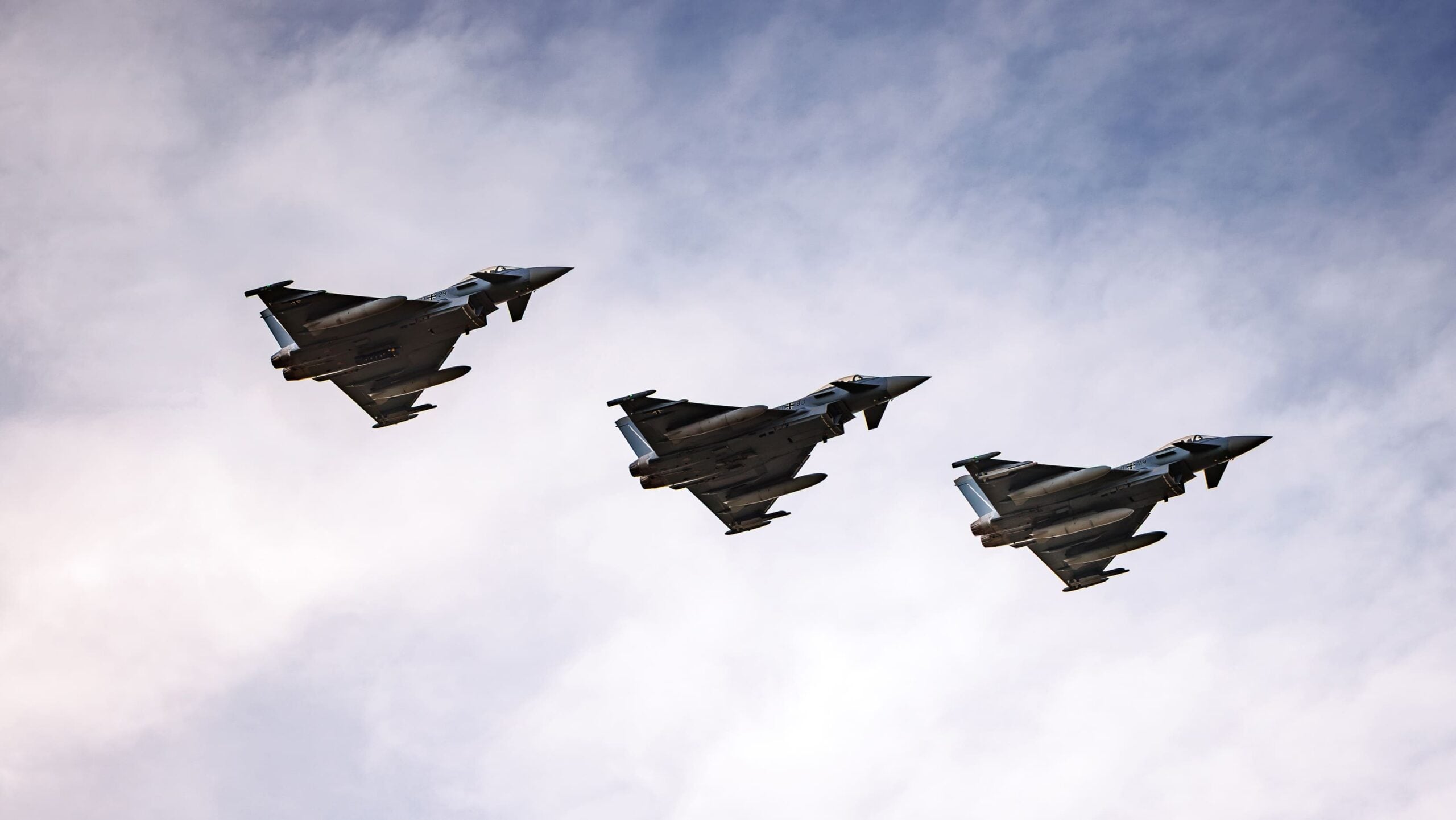
The Royal Air Force (RAF) has concluded Exercise Cobra Warrior 26-2 after generating 942 sorties and more than 2,500 flying hours across 14 large-force missions, the service announced on October 6, 2026. Around 1,800 personnel from the United Kingdom, Germany, Italy, the Netherlands and the United States took part in the exercise, which ran from September 14 to October 2 under directing staff at RAF Waddington in Lincolnshire.
The autumn iteration carried a sharper mandate than earlier editions. The RAF billed Cobra Warrior 26-2 as the largest test of UK homeland defense, built around the service’s “Warfighting Ready” and “NATO First” priorities. At its launch, Chief of the Air Staff Air Chief Marshal Sir Harv Smyth cited the growing threat posed by Russia and described the current period as “by far, the most dangerous” of his 35-year career. The scale also marks a step change within 2026: the spring event, Cobra Warrior 26, ran from March 16 to 27 with British, German and Polish aircraft and logged more than 80 flights and about 195 flying hours, according to the RAF.
Exercise Cobra Warrior 26-2 Order of Battle and Sortie Generation
The Air and Space Warfare Centre (ASWC) delivered the exercise under the sponsorship of No. 11 Group, combining combat air, intelligence, surveillance and reconnaissance (ISR), air mobility, support helicopters, force protection, cyber and command-and-control (C2) elements in a single scenario. RAF assets included Typhoon FGR4 and F-35B Lightning fighters, P-8A Poseidon maritime patrol aircraft and Voyager tankers. NATO E-3A Airborne Warning and Control System (AWACS) aircraft also flew in support, adding an Alliance-level airborne battle management layer to the national packages.
Germany supplied the only foreign contingent the RAF quantified: 11 Eurofighter Typhoons and about 200 personnel from Tactical Air Wing 31 “Boelcke” (TaktLwG 31), normally based at Nörvenich and hosted at RAF Cranwell for the exercise. The wing leads development of Eurofighter air-to-ground procedures for the Luftwaffe, including employment of the laser-guided GBU-48. Detachment commander Lieutenant Colonel Mike Schill said the deployment allowed the wing to sharpen tactics and readiness alongside NATO partners. Italy’s Aeronautica Militare operated Eurofighters from RAF Waddington, although the RAF did not publish the Italian aircraft count or parent unit. Reported US Air Force participation included F-15, F-16 and F-35 fighters and KC-135 tankers. The Dutch contribution and the total aircraft count have not been disclosed.
The headline figures work out to roughly 67 sorties per mission and more than 2.6 flying hours per sortie on average. Those ratios are consistent with composite air operations (COMAO) built around large strike and escort packages, airborne refueling and extended time on station, rather than short-cycle fighter training.
Typhoon QWIC Final Phase and Air C2 Force Integration
For the RAF, Cobra Warrior 26-2 served as the culmination of the Typhoon Qualified Weapons Instructor Course (QWIC), run by No. 29 Squadron, the Typhoon operational conversion unit at RAF Coningsby. Candidates for the service’s top postgraduate warfighting qualification had to plan and lead missions inside a multinational force and make decisions under realistic operational pressure, according to the course’s officer commanding.
The Typhoon was the common denominator, flown by three of the five participating air forces. Publicly available specifications indicate the canard-delta fighter is powered by two Eurojet EJ200 turbofans rated at about 60 kN dry and 90 kN with reheat each, giving a top speed near Mach 2. Weapons fits diverge by nation: RAF Typhoon FGR4s carry the Meteor beyond-visual-range missile, ASRAAM, Paveway IV and Brimstone, while German and Italian jets field the IRIS-T short-range missile in place of ASRAAM. All three fleets exchange tactical data over Link 16, the network the F-35 and E-3A also use, which makes it the practical backbone of fourth- and fifth-generation integration in a mixed package.
The Air C2 Force, commanded by Group Captain Chris Misiak, folded UK and allied participants into a single coordinated air operation, from mission planning through execution. On the ground, RAF Global Enablement, the Tactical Medical Wing, the RAF Regiment and allied support units sustained deployed operations and protected personnel, reflecting the exercise’s focus on generating and defending sorties from home bases.
Analysis: The mandate matters more than the sortie count. By framing Cobra Warrior 26-2 as a homeland defense test rather than an expeditionary rehearsal, the RAF is treating UK airfields as part of the contested battlespace instead of a secure rear area. The jump from about 195 flying hours in March to more than 2,500 in the autumn shows the service can surge collective training when allies commit fighters at scale, but it also shows how much of that mass comes from partners. For NATO, the exercise was a working test of how quickly a mixed fleet of fourth- and fifth-generation fighters, enablers and C2 nodes can be fused over the UK in the opening phase of a conflict.
The RAF has not released mission-level outcomes, the Dutch and US orders of battle or a total aircraft count. The next markers are the 2027 Cobra Warrior cycle, normally held twice a year, and the return of newly qualified weapons instructors to frontline Typhoon squadrons, where they will carry the integration lessons of 26-2 into unit training. Whether the homeland defense framing becomes a fixed design feature of future iterations will show how deeply the Warfighting Ready priority is reshaping RAF collective training.