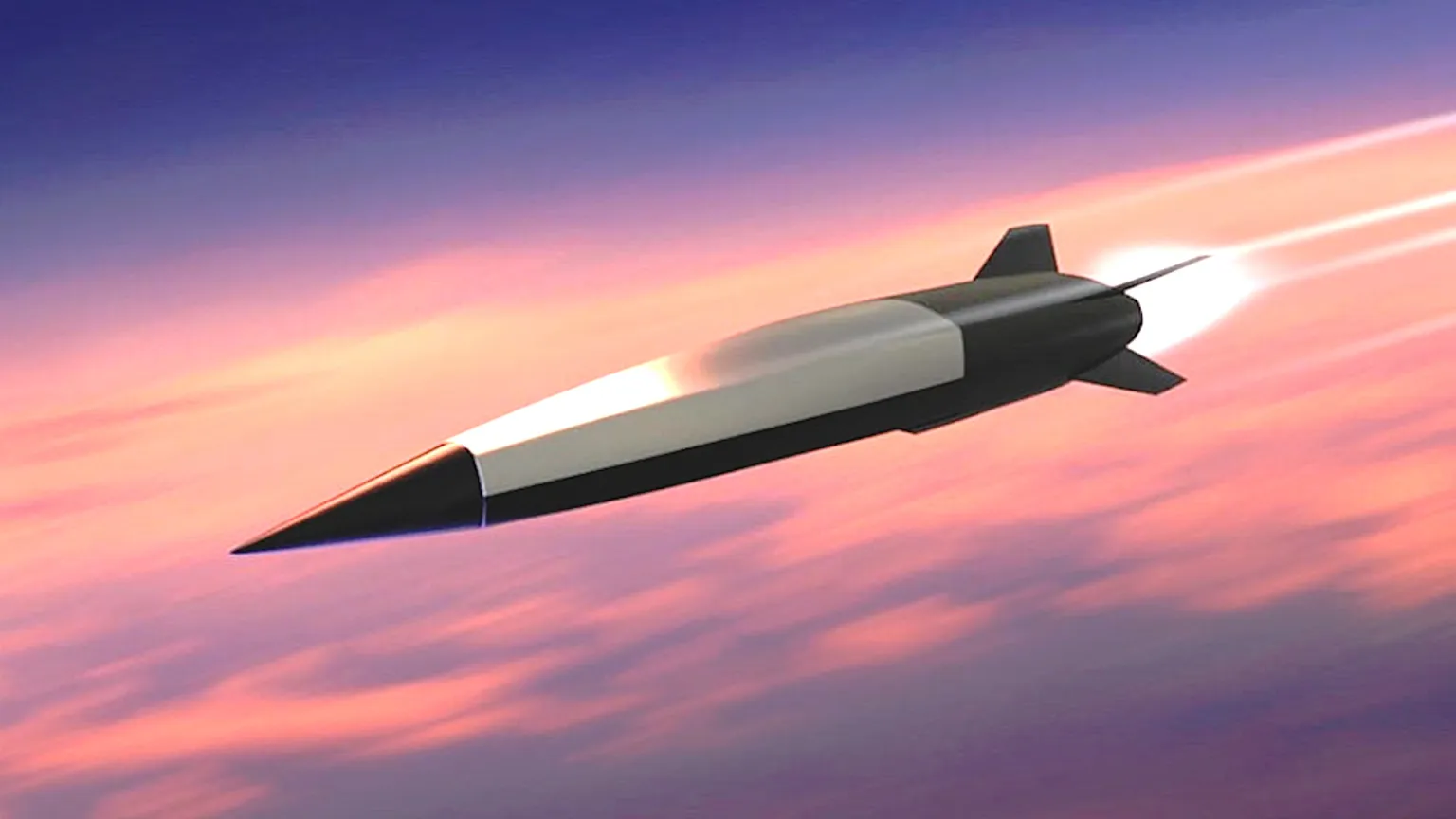
The US Air Force’s Hypersonic Attack Cruise Missile (HACM) has entered flight testing. The Royal Australian Air Force (RAAF) released a HACM flight test unit over a designated Australian test range, an Air Force spokesperson confirmed to The War Zone (TWZ) on October 5, 2026. The service did not say when the release took place, which range or launch aircraft was used, or whether the missile flew under its own power after separation.
The event was conducted under the Southern Cross Integrated Flight Research Experiment (SCIFiRE), the bilateral hypersonics arrangement Washington and Canberra launched in 2020. It follows repeated schedule slips: first flight was originally planned for 2024, then moved to 2025 and again to 2026. A Government Accountability Office (GAO) report published in July 2026 found “effectively zero margin left in the schedule,” while the Air Force aims to begin procurement in fiscal year 2027.
HACM Hypersonic Cruise Missile Design: Booster, Scramjet, and Launch Platforms
Raytheon, now part of RTX, won the HACM development task order on September 22, 2022. The $985.3 million award, issued by the Air Force Life Cycle Management Center’s Armament Directorate at Eglin Air Force Base, Florida, beat bids led by Boeing and Lockheed Martin and runs through March 2027. Northrop Grumman supplies the scramjet engine. The design descends from the Defense Advanced Research Projects Agency (DARPA) Hypersonic Air-breathing Weapon Concept (HAWC), whose Raytheon and Northrop Grumman vehicle exceeded Mach 5 on hydrocarbon fuel during its first free flight in September 2021. HACM has reportedly been designated AHM-4A.
GAO describes a two-stage configuration. A rocket booster accelerates the missile to the speed a scramjet needs to operate, after which the scramjet-powered cruiser separates, sustains hypersonic flight and eventually dives toward its target. This sets HACM apart from boost-glide weapons such as the AGM-183A Air-Launched Rapid Response Weapon (ARRW): powered cruise lets the vehicle hold speed over distance instead of bleeding energy like an unpowered glider, preserving maneuver margin late in flight against defended targets.
Core performance data remains undisclosed. HACM’s peak speed, range, warhead and dimensions have not been released, and neither the Air Force nor RTX has published a confirmed image of the missile.
Platform integration reflects the weapon’s tactical intent. The F-15E Strike Eagle is the Air Force’s initial launch aircraft, with other platforms expected later. GAO has previously identified RAAF F/A-18F Super Hornets for at least some test launches, consistent with the spokesperson’s statement that the RAAF “executed the release.” At contract award, then-Chief of Staff Gen. Charles Q. Brown Jr. framed HACM as a way for fighters to hold high-value, time-sensitive targets at risk while bombers remain available for strategic missions.
Five Flight Tests, Zero Margin: The Road to FY2027 Procurement
GAO’s July assessment, which reflects program data through January 2026, shows how little room remains. The Air Force cut the rapid prototyping effort from seven planned flight tests to five and plans to build 13 missiles in that phase, covering test assets, test spares and operational rounds. Program officials told GAO that completing at least the first three flight tests is critical to the decision to launch a rapid fielding effort and procure HACM in fiscal 2027. A significant flight test failure, GAO assessed, would likely prevent the program from completing all five tests within its five-year prototyping window.
To hold the date, the program office resequenced work to focus almost exclusively on the first flight test. In some cases it ran parts validation testing concurrently with design completion, a strategy that could force redesign of key components if they fail qualification.
The budget already assumes progress. The Air Force’s fiscal 2027 request includes $404 million to begin HACM procurement, alongside $452 million for ARRW baseline missiles, and plans roughly $3 billion in HACM research and development through fiscal 2031. GAO listed the first quarter of fiscal 2027, which opened October 1, 2026, as the target for initiating rapid fielding.
Australia’s role is structural. GAO has cited limited US range availability for hypersonic testing, and Australia’s inland ranges offer the overland distance and isolation long-range scramjet trials require. The Woomera Range Complex in South Australia has long been the expected venue, although the Air Force has not confirmed the location.
Analysis: The release shows HACM hardware is flying, not yet that the weapon works. Until the Air Force confirms a boosted, scramjet-powered cruise segment, the fiscal 2027 procurement case rests on a test series GAO says cannot absorb a failure. The operational logic holds: a fighter-launched hypersonic cruise missile compresses engagement timelines against mobile launchers, air defense nodes and command sites in a Western Pacific contingency, and spreads prompt strike beyond a small bomber force. The harder question is mass. The demand signal has shifted toward cheaper munitions built at scale, illustrated by a September 1, 2026 Air Force Research Laboratory notice seeking a low-cost hypersonic cruise missile with a range of up to 500 nautical miles. HACM is likely to enter service as a low-density, high-end layer rather than the backbone of the arsenal.
The next markers are disclosure of powered-flight data, the remaining tests in the five-flight plan, and the rapid fielding decision the Air Force targeted for the first quarter of fiscal 2027. The launch aircraft, test range and test results remain unconfirmed. Raytheon’s development task order runs through March 2027, a natural reference point for the program’s next contracting decision.