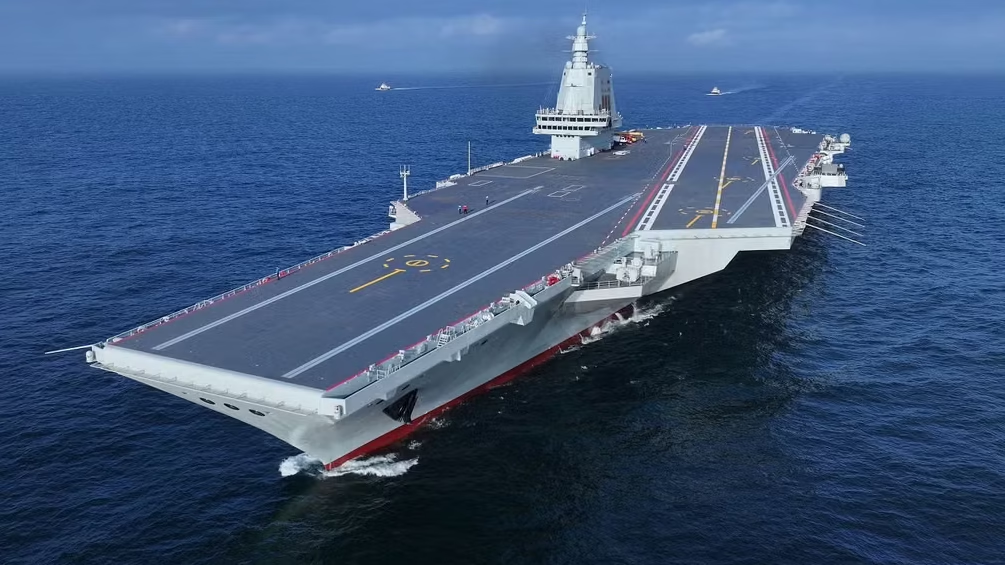
China now operates the world’s largest navy by hull count, and the Pentagon projects its battle force will reach 435 ships by 2030. Beijing has paired that mass with a missile-centered anti-access strategy and a shipbuilding base that U.S. intelligence assesses can outproduce American yards many times over, forming a coherent wager against Western qualitative superiority that a constrained United States is straining to answer.
The assessment matters now because two trend lines are converging. The Pentagon’s 2025 China Military Power Report, released in December, documents a People’s Liberation Army Navy expanding across every combatant category just as U.S. hull numbers are set to bottom out. China commissioned its first catapult-equipped carrier, the Fujian, on November 5, 2025, and floated the world’s first purpose-built drone carrier a year earlier.
Chinese Navy Buildup: Force Structure and the 2027 Gap
The Pentagon’s 2025 report and supporting Office of Naval Intelligence and Congressional Research Service assessments place the PLAN battle force at more than 370 ships and submarines, excluding roughly 60 HOUBEI-class missile patrol craft. That force is projected to reach 395 ships in 2025 and 435 by 2030. The U.S. Navy counted 296 battle force ships as of September 30, 2024, and projects 294 by the end of fiscal 2030, with a near-term trough around 287. The potential gap approaches 140 hulls by the end of the decade.
Hull count is not combat power. The United States retains 11 nuclear-powered carriers against China’s three, the ski-jump Liaoning and Shandong and the new Fujian, and its submarine fleet is entirely nuclear. The Fujian, displacing more than 80,000 tons, is the first Chinese carrier with an electromagnetic catapult and arrested-recovery system, working up an air wing of J-15T, stealthy J-35, and KJ-600 early-warning aircraft. The Pentagon assesses that Beijing aims to field nine carriers by 2035.
China also operates six Type 094 ballistic missile submarines, six Type 093 attack boats, and 48 diesel-electric submarines, a force projected to grow toward 65 hulls in 2025 and 80 by 2035, with new Type 093B cruise-missile and Type 096 ballistic-missile classes entering service. The numbers weigh most around 2027, an analyst scenario rather than a forecast, when U.S. strength bottoms out as China’s peaks.
How Missiles and Drones Anchor China’s A2/AD Bet
China’s naval strategy is not built to refight Midway. It is designed to deter or delay U.S. intervention in the Western Pacific through precision fire at range, layered around the first and second island chains. At its center is the PLA Rocket Force and a family of anti-ship ballistic missiles: the DF-21D, with an estimated range of 1,500 to 1,700 kilometers and a maneuvering reentry vehicle built to defeat Aegis; the DF-26, reaching roughly 4,000 kilometers and Guam; the hypersonic DF-27, which the 2025 report identifies as China’s longest-range anti-ship weapon; and the DF-17 glide vehicle.
Naval hypersonics are now spreading across the surface fleet. The YJ-20 anti-ship ballistic missile, first shown at the September 2025 military parade, was demonstrated in a finalization test from a Type 055 cruiser in December 2025, then from the more numerous Type 052D destroyer in July 2026. Open-source estimates place its speed at Mach 6 to Mach 10 and its range between roughly 1,000 and 2,000 kilometers, extending hypersonic strike from a handful of flagships to some 45 destroyers.
Beijing complements the missiles with a projected drone wall of motherships and loitering munitions meant to attrit carrier groups before the first island chain. The Type 076 Sichuan, a 40,000-ton drone carrier fitted with an electromagnetic catapult, has been in sea trials since November 2025, with delivery expected by late 2026 and an air wing centered on the GJ-11 stealth combat drone. The logic is economic: missiles generate mass cheaply where carriers are costly and slow. Yet neither the DF-21D nor the DF-26 has struck a moving target in combat, and the kill chain needed to cue them against a maneuvering carrier is untested.
Why Shipyard Capacity Is the Decisive Variable
The variable that may matter most is not the number of hulls today but the capacity to build and replace them under attrition, and here China holds a structural advantage. The Pentagon judges Beijing nearly self-sufficient, able to produce submarines, surface combatants, amphibious ships, and auxiliaries in any required quantity. Civil-military fusion lets Chinese yards build commercial and military tonnage on the same lines, generating economies of scale U.S. shipbuilders cannot match. One widely cited Office of Naval Intelligence estimate places Chinese shipbuilding capacity at roughly 230 times that of the United States.
The American picture is the inverse. Workforce shortages, aging infrastructure, and limited throughput have left the Virginia and Columbia submarine programs behind schedule, and the U.S. attack submarine force, projected at around 57 boats by 2030, has at times seen close to 40 percent of its hulls in maintenance. Washington’s Golden Fleet initiative aims to reverse the trend, but shipyard capacity cannot be rebuilt on crisis timelines.
The West is not standing still. The DDG(X) surface combatant is being designed with margins for directed-energy weapons and greater power generation, alongside investment in distributed maritime operations and unmanned systems. But a protracted conflict rewards the side that regenerates losses fastest, and there China leads.
Analysis: Two easy narratives should be resisted: that China has already won on numbers, and that Western quality will automatically suffice. Beijing has assembled a coherent theory of victory, mass plus missiles plus industrial depth, that shifts risk onto the U.S. carrier just as American industry is most constrained. But it rests on a kill chain never tested against a moving target in combat, an anti-submarine capability the Pentagon still rates as a weakness, and a fleet with modest blue-water experience. The United States retains nuclear carriers and submarines, eight decades of carrier operations, and a coalition, spanning AUKUS, the Japan Maritime Self-Defense Force, and the Royal Navy, that China cannot field. The balance will turn less on today’s hull count than on which side can regenerate under fire.
The near-term milestones are concrete. The Fujian will spend the coming year integrating its air wing and validating catapult operations while the Type 076 Sichuan moves toward delivery. Beijing’s nine-carrier target for 2035 and the spread of the YJ-20 across the destroyer force will test how far mass extends. On the U.S. side, the AUKUS submarine timeline and Golden Fleet’s effect on shipyard output will shape the response. The central unknown is whether Chinese mass and untested carrier killers convert into combat power against a qualitatively superior but shrinking coalition. The 2027 window remains a scenario to plan against, not a date to expect.