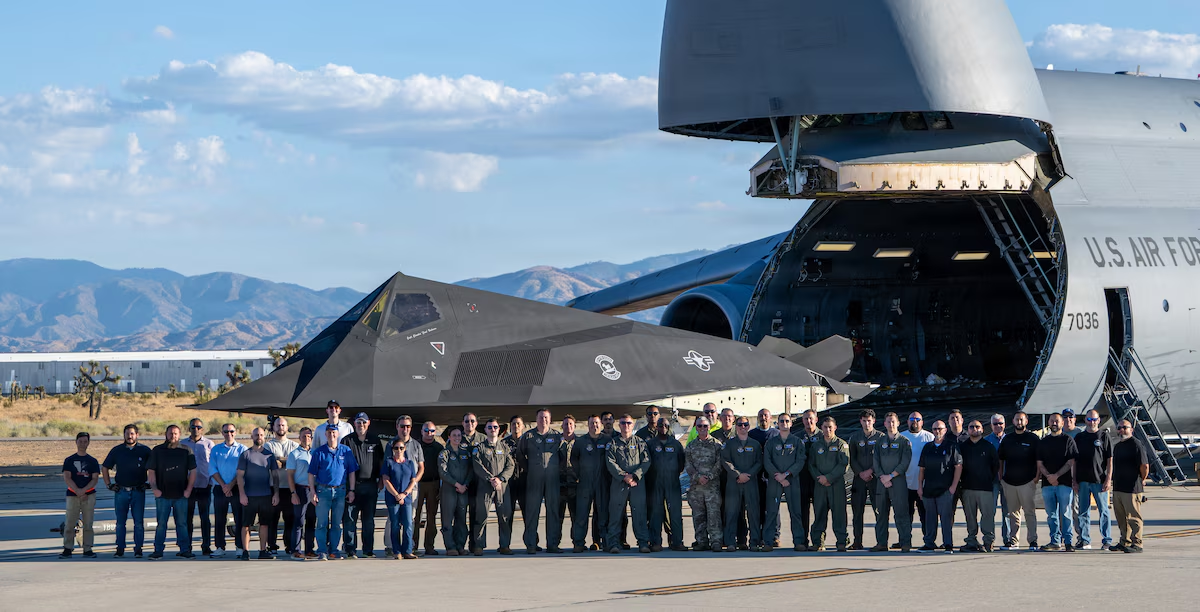
A U.S. Air Force Reserve C-5M Super Galaxy has delivered F-117A Nighthawk serial 85-0818, nicknamed \”The Overachiever,\” to the Smithsonian Institution’s National Air and Space Museum. Reservists of the 512th Airlift Wing completed the two-day, cross-country mission, loading the demilitarized stealth jet at Palmdale, California, and handing it to the museum team on October 6, 2026.
The aircraft is the only Nighthawk to fly combat in all four campaigns in which the type saw action: Just Cause, Desert Storm, Allied Force, and Iraqi Freedom. The museum announced the acquisition on September 14, 2026, and plans to display the jet at its Steven F. Udvar-Hazy Center in Chantilly, Virginia, from late October. It is the Smithsonian’s first F-117 and, by open-source counts, the 16th of 64 built to be released for public display.
Inside the C-5M Airlift That Moved the F-117A Nighthawk
The mission fell to the 709th Airlift Squadron, a C-5M unit of the 512th Airlift Wing at Dover Air Force Base, Delaware. After landing at Palmdale, home of Lockheed Martin’s Skunk Works, loadmasters secured the jet’s detached wings in the cargo compartment within two hours while leaving room for the fuselage. The 29,500-pound load demanded precise weight distribution and millimeter-level clearances, according to the Air Force.
The fuselage upload then slipped overnight after a coordination breakdown over the number of tie-down points the airframe required. With both aircraft held on the ramp, a Skunk Works mechanical team fabricated and installed the points before morning. Maj. Billy Hafker, the 709th Airlift Squadron instructor pilot who commanded the mission, said the crew saw the move as a chance to preserve the jet for future generations.
Before any of that, the airframe had to clear demilitarization, which strips sensitive low-observable components before an F-117 can go on public display. Jeff Corbets, the Skunk Works program manager who led the restoration, called it \”the most difficult piece\” of the project. The Air Force said it retained roughly 48 F-117As as of January 2021. The fiscal 2017 National Defense Authorization Act cleared the service to dispose of up to four per year, while the Air Force plans to keep some flying for test and training through at least 2034.
Faceted Stealth Design: F-117A Specifications, Sensors, and Weapons
The Nighthawk descends from the Have Blue demonstrators Skunk Works flew in 1977. Engineers applied radar cross-section prediction methods derived from Soviet physicist Pyotr Ufimtsev’s diffraction research, and the computers of the day could only calculate returns from flat panels. The result was a faceted airframe that deflects radar energy away from the emitter. The first F-117A flew on June 18, 1981, just 31 months after full-scale development began, and the 4450th Tactical Group reached initial operating capability at the Tonopah Test Range, Nevada, in October 1983. The Pentagon did not acknowledge the aircraft until November 1988.
Publicly available specifications describe a single-seat jet about the size of an F-15 Eagle, with a 43-foot, 4-inch wingspan and a 52,500-pound maximum takeoff weight. Two non-afterburning General Electric F404-GE-F1D2 engines produce between 9,040 and 10,600 pounds of thrust each, depending on the source. Top speed is roughly Mach 0.9, and unrefueled mission radius reaches 656 miles with a 5,000-pound weapons load. Omitting afterburners cut the infrared signature; omitting radar removed an emitter adversaries could track.
Instead, the Infrared Acquisition and Designation System paired forward- and downward-looking infrared sensors with a laser designator. Two internal bays each held one 2,000-pound-class weapon, initially GBU-10 and GBU-27 Paveway laser-guided bombs and later GPS-aided munitions. Quadruple-redundant fly-by-wire controls kept the aerodynamically compromised shape flyable. Lockheed built five full-scale development aircraft and 59 production F-117As.
From Panama to Baghdad: The Overachiever’s Four-Campaign Combat Record
The F-117A’s combat debut came in Operation Just Cause in December 1989, when two jets from the 37th Tactical Fighter Wing struck targets near Rio Hato, Panama. In 1991, the wing’s 415th and 416th squadrons deployed to Saudi Arabia and opened Desert Storm over Baghdad on January 17. F-117As were the only manned coalition aircraft sent against downtown Baghdad. The Air Force credits the fleet with 1,271 sorties, an 80% mission success rate, and no losses or battle damage. A 1997 General Accounting Office review put the probability that a planned F-117 strike hit its target between 41% and 60%, which it still judged highly effective.
Operation Allied Force produced the type’s only combat loss. On March 27, 1999, a Yugoslav S-125 Neva battery, NATO designation SA-3 Goa, commanded by Zoltán Dani shot down F-117A 82-0806, callsign Vega 31, near Buđanovci, west of Belgrade. Combat search-and-rescue forces recovered the pilot, Lt. Col. Dale Zelko, hours later. It remains the only stealth aircraft confirmed lost to hostile fire.
On March 20, 2003, two F-117As opened Operation Iraqi Freedom by striking the Dora Farms compound near Baghdad. Aircraft 85-0818 flew in all four campaigns and retired in 2007. The Air Force formally retired the fleet on April 22, 2008.
Analysis: The Overachiever’s record carries both halves of the lesson behind every U.S. low-observable program since. In 1991, a small stealth force held a disproportionate share of Iraq’s strategic targets at risk without a loss, the operational case that underwrote the B-2, F-22, F-35, B-21, and F-47. In 1999, a crew operating a 1950s-era missile system exploited repetitive routing to defeat a first-generation design. The later emphasis on broadband, all-aspect signature reduction, less predictable mission planning, and integrated electronic attack reflects the second lesson as much as the first.
The museum expects 85-0818 to go on public display at the Udvar-Hazy Center in late October 2026. The Air Force has not disclosed how many F-117As still fly or which airframes will go to museums next. With flight operations planned through at least 2034, the type’s flying career will outlast The Overachiever’s museum debut by at least eight years.