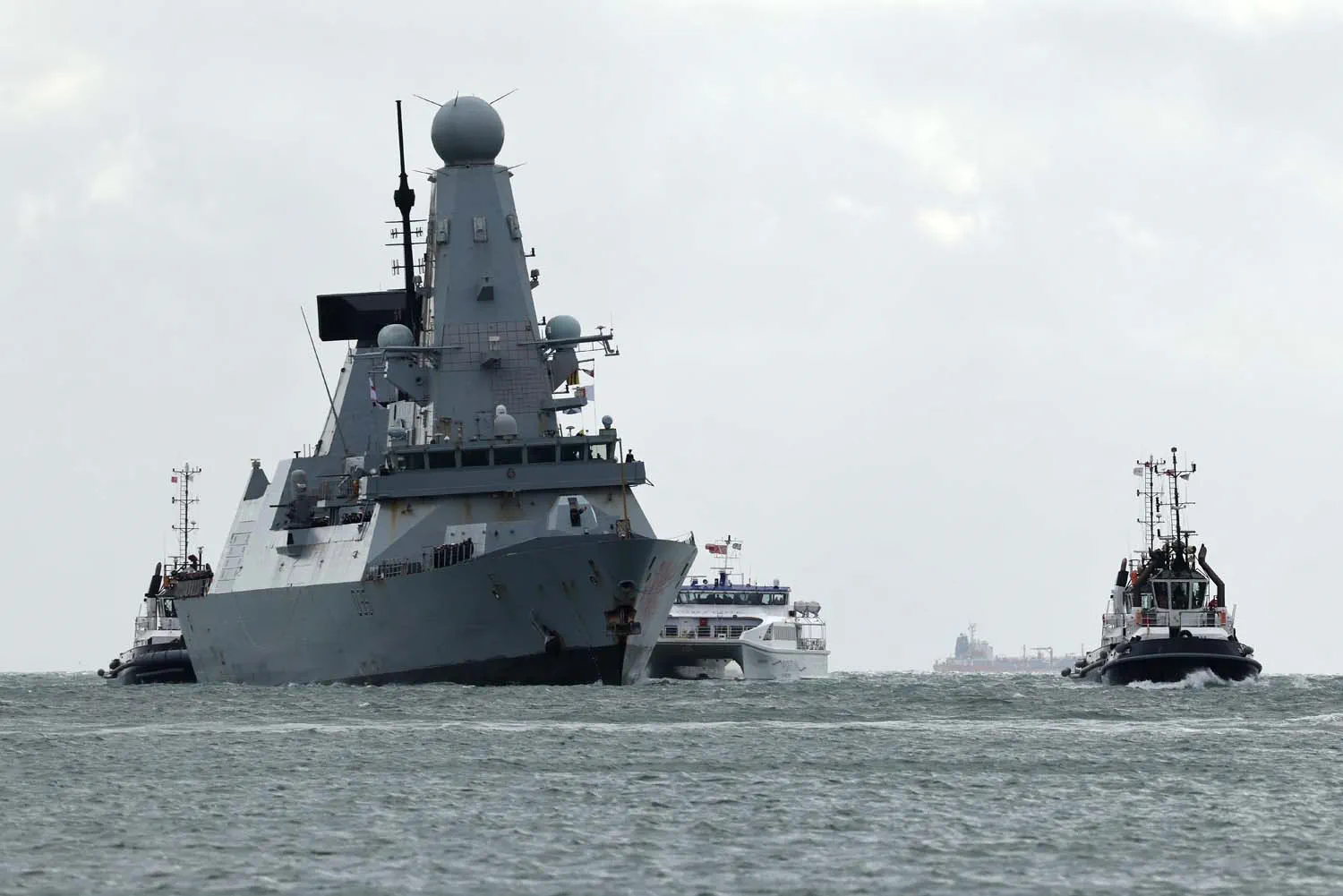
The Royal Navy Type 45 destroyer HMS Dragon returned to Portsmouth on October 9, 2026, ending a 214-day deployment that began with the air defense of British bases in Cyprus and closed with escort duty alongside France’s carrier strike group east of Suez. Around 950 family members and friends greeted the crew, according to the Royal Navy.
The deployment traces to the war that opened with US and Israeli strikes on Iran on February 28, 2026. Shortly after midnight on March 2, a Shahed-type one-way attack drone hit RAF Akrotiri, the first attack on the base since a rocket strike by Libyan militants in 1986. With no British warship in the region, opposition lawmakers and the Cypriot government criticized the pace of the UK response. Prime Minister Keir Starmer announced Dragon’s deployment on March 3, the day Defence Secretary John Healey approved it.
HMS Dragon Deployment: From Dry Dock to Cyprus Air Defense
Dragon was in dry dock for planned maintenance when she was activated and, according to the Royal Navy, went from dock to deployment in seven days. Officials judged her the readiest hull available; publicly available information indicates she had already received the Power Improvement Project generator upgrade, which targets the class’s chronic propulsion failures. She sailed on March 10 after loading Aster missiles at Portsmouth’s Upper Harbour Ammunitioning Facility and reached the eastern Mediterranean on March 24, integrating with the force defending the island alongside RAF Typhoon and F-35B fighters, ground-based counter-drone teams and radar systems.
Her value in that role rests on Sea Viper, the British designation for the Principal Anti-Air Missile System. Publicly available specifications indicate a 48-cell Sylver A50 vertical launcher loaded with MBDA Aster 15 and Aster 30 interceptors, cued by the SAMPSON active electronically scanned multifunction radar and the S1850M long-range volume search radar. The Ministry of Defence states the system can launch eight missiles in under ten seconds and guide up to 16 at once. Dragon’s embarked Wildcat HMA2 from 815 Naval Air Squadron carried Thales Martlet lightweight missiles, a cheaper layer against one-way attack drones that preserves Aster rounds for cruise and ballistic missile threats.
The Royal Navy has not disclosed whether Dragon fired Sea Viper in combat. Minor technical issues with her water systems forced the ship to dock in April; the Ministry of Defence said the defects were rectified after testing off Crete.
Sea Viper East of Suez: Hormuz Standby and French Carrier Escort
On May 9, the Ministry of Defence confirmed Dragon would pre-position in the Middle East ahead of a multinational mission, jointly led by the UK and France, to protect shipping through the Strait of Hormuz when conditions allow. Iran had largely closed the strait after the war began, and the US Navy later imposed its own blockade of Iranian ports. On May 12, London and Paris convened 38 nations to back an independent, strictly defensive mission including mine clearance, with RFA Lyme Bay converted into a mothership for uncrewed mine-hunting systems.
Dragon transited the Suez Canal in May and passed through the Bab el-Mandeb Strait, where Houthi forces in Yemen have fired missiles and drones at shipping since 2023. She integrated with the French Navy carrier strike group built around FS Charles de Gaulle in the Gulf of Aden and operated with the group in the Arabian Sea before conducting maritime security patrols in the Indian Ocean. The pairing was technically natural: France’s Horizon-class destroyers field the same Aster interceptor family, and the Type 45 was designed to screen a carrier. Commander Iain Giffin was in command when Dragon joined the French group; Commander Graeme Hazelwood brought her home.
Analysis: Dragon’s 214 days show both the reach and the thinness of British naval air defense. She is one of six Type 45s, she had to be generated from dry dock, and her departure removed her from a planned role as flagship of Standing NATO Maritime Group 1, which passed to the German Navy frigate FGS Sachsen. East of Suez, the UK contribution took the form of a single escort inside a French carrier group rather than a British-led task group. Fleet Commander Vice Admiral Steve Moorhouse set the benchmark: “In an increasingly uncertain world, we need a warfighting ready Navy that can respond at pace wherever the nation requires.” Dragon met it; the fleet’s depth to repeat that on short notice remains the open question.
The Hormuz mission remains proposed rather than active, and no successor air defense ship for the region has been publicly announced. The next markers are whether a durable cessation of hostilities allows the UK-French coalition to deploy, which Type 45 the Royal Navy can generate next, and how quickly the Aster 30 Block 1NT interceptor under the Sea Viper Evolution program reaches the fleet.