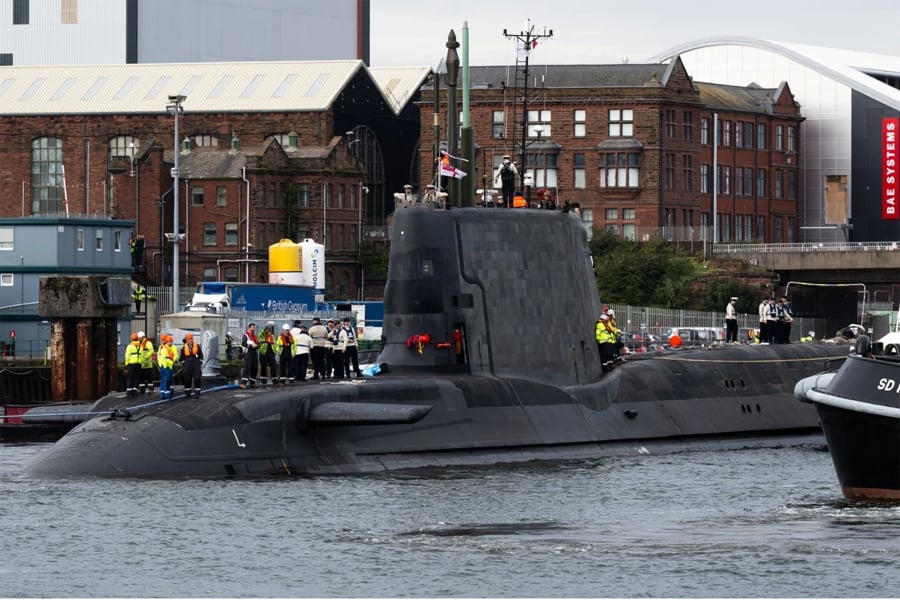
HMS Agamemnon, the Royal Navy’s sixth Astute-class nuclear-powered attack submarine, departed BAE Systems’ shipyard in Barrow-in-Furness on September 25, 2026, and put to sea for the first time under her own power. The 7,400-tonne hunter-killer took a planned two-day transit through Barrow’s dock system and the narrow Walney Channel before reaching the open waters of the Irish Sea, where she now begins sea trials ahead of joining the fleet at HM Naval Base Clyde.
The departure caps nearly 13 years of construction and testing at the only shipyard in the UK that builds nuclear submarines. BAE Systems named Agamemnon in April 2024, floated her out at Barrow’s Devonshire Dock Hall that October, and King Charles III formally commissioned her into the Royal Navy in September 2025; she completed a three-day trim dive to verify her pressure hull the following month. Her first voyage lands three months into the government’s Defence Investment Plan, the funding settlement Defence Secretary Wes Streeting inherited in July 2026 that converts the 2025 Strategic Defence Review into committed spending for the submarine enterprise at Barrow and at Rolls-Royce’s reactor plant in Derby.
HMS Agamemnon Sea Trials Cap a 13-Year Build Program
BAE Systems cut first steel for Agamemnon at Barrow around 2013, and the boat spent nearly 11 years in build before her naming ceremony in April 2024, when sponsor Lady SJ Sedwill christened her. She rolled out of the Devonshire Dock Hall into the adjoining basin that October. Commissioning followed on September 22, 2025, with King Charles III reading the commissioning warrant, after which her 100-strong crew and BAE Systems engineers spent roughly a year testing systems alongside. An October 2025 trim dive, a three-day evaluation in a specially deepened section of the basin, confirmed the pressure hull’s integrity and the boat’s underwater stability ahead of this week’s transit. The near-13-year span from first steel to open water reflects the length of the Astute program’s build and commissioning cycle, even with five sister boats’ worth of institutional experience behind it, and comes as HMS Achilles, the seventh and final Astute-class boat, remains under construction in the same dock hall.
Spearfish Torpedoes, Tomahawk Missiles, and the Sonar 2076 Suite
A Rolls-Royce PWR2 pressurized water reactor powers Agamemnon, driving a pump-jet propulsor in a configuration that avoids the cavitation noise of a conventional propeller and supports a design reactor life of 25 to 30 years without refueling. Publicly available specifications indicate a submerged speed in excess of 29 knots and a test depth beyond 300 meters, with endurance limited only by food stores and crew fatigue rather than fuel or air, allowing the class to circumnavigate the globe submerged. Her sensor suite centers on the Thales Sonar 2076 integrated array, combining bow, intercept, flank, and towed sonar arrays, alongside two non-hull-penetrating CM010 optronic masts that replace a conventional periscope with thermal, low-light, and color imaging feeds into the Astute Combat Management System. For weapons, Agamemnon carries six 21-inch torpedo tubes with stowage for up to 38 weapons, typically a mix of Spearfish heavyweight torpedoes for anti-submarine and anti-surface engagements and Tomahawk Block IV land-attack cruise missiles, which publicly available specifications put at a range of roughly 1,600 kilometers. That pairing gives Agamemnon both an underwater hunter-killer role and a standoff land-attack capability her five sisters already exercise in Royal Navy service. Against the Trafalgar-class boats the Astute design replaces, the last of which retired in 2025, Agamemnon displaces roughly 40 percent more submerged tonnage while trading Trafalgar’s first-generation PWR1 reactor for the newer PWR2 core, the same reactor family developed for the Vanguard-class deterrent boats.
What Agamemnon Means for Barrow’s Submarine Enterprise
Agamemnon’s transit adds urgency to a Barrow production line now running three submarine programs at once. Alongside Achilles, the yard is building the first of four Dreadnought-class ballistic missile submarines that will replace the Vanguard-class boats carrying the UK’s continuous-at-sea deterrent, and is conducting early design work on SSN-AUKUS, the attack submarine meant to eventually replace the Astute class under the trilateral partnership with the United States and Australia. The Defence Investment Plan commits roughly £47 billion to submarines, maintenance, and infrastructure, plus a further £6 billion to expand manufacturing capacity, with a stated goal of sustaining Dreadnought and up to 12 SSN-AUKUS boats at a production drumbeat of one submarine every 18 months. Prime Minister Andy Burnham used a July 2026 visit to Barrow to unveil an £8.4 billion tranche specifically for Dreadnought’s fourth delivery phase, of which £5.9 billion goes directly to BAE Systems, a sign of how much of the government’s industrial strategy now runs through this single Cumbrian shipyard and the roughly 47,000 jobs tied to its supply chain.
Analysis: The gap between Agamemnon’s nearly 13-year build cycle and the Defence Investment Plan’s stated ambition of a submarine every 18 months is the more consequential story here. That drumbeat figure assumes a steady-state production line, not the sequential handover Barrow now faces: finishing Achilles, ramping four Dreadnought hulls toward an early-2030s in-service date, and eventually cutting first steel on SSN-AUKUS, all without workforce and infrastructure expansion falling behind the funding announcements. The £47 billion submarine settlement and the £8.4 billion Dreadnought tranche solve for money, but money alone does not compress a build-and-commission cycle that, for Agamemnon, ran past a decade even with five sister boats’ worth of institutional knowledge already banked. First Sea Lord General Sir Gwyn Jenkins said the boat will play a central role in “keeping the United Kingdom safe, contributing to NATO’s collective defence.” For NATO planners, and for the AUKUS partners counting on SSN-AUKUS arriving on schedule, Agamemnon’s long final stretch from commissioning to open water is a useful data point on how much slack actually exists in Britain’s only nuclear submarine yard.
Agamemnon will now conduct contractor and Royal Navy sea trials of unspecified duration before sailing north to HMNB Clyde to join Astute, Ambush, Artful, Audacious, and Anson in front-line service; the Ministry of Defence has not published a target in-service date. HMS Achilles remains under construction at the Devonshire Dock Hall with no announced launch date. The nearer-term markers to watch are delivery progress on Dreadnought’s lead boat under the newly funded fourth phase, due to reach sea trials in the early 2030s, and any confirmation of when SSN-AUKUS moves from concept work to cut steel, a milestone that will show whether Barrow’s promised 18-month drumbeat is achievable or aspirational.