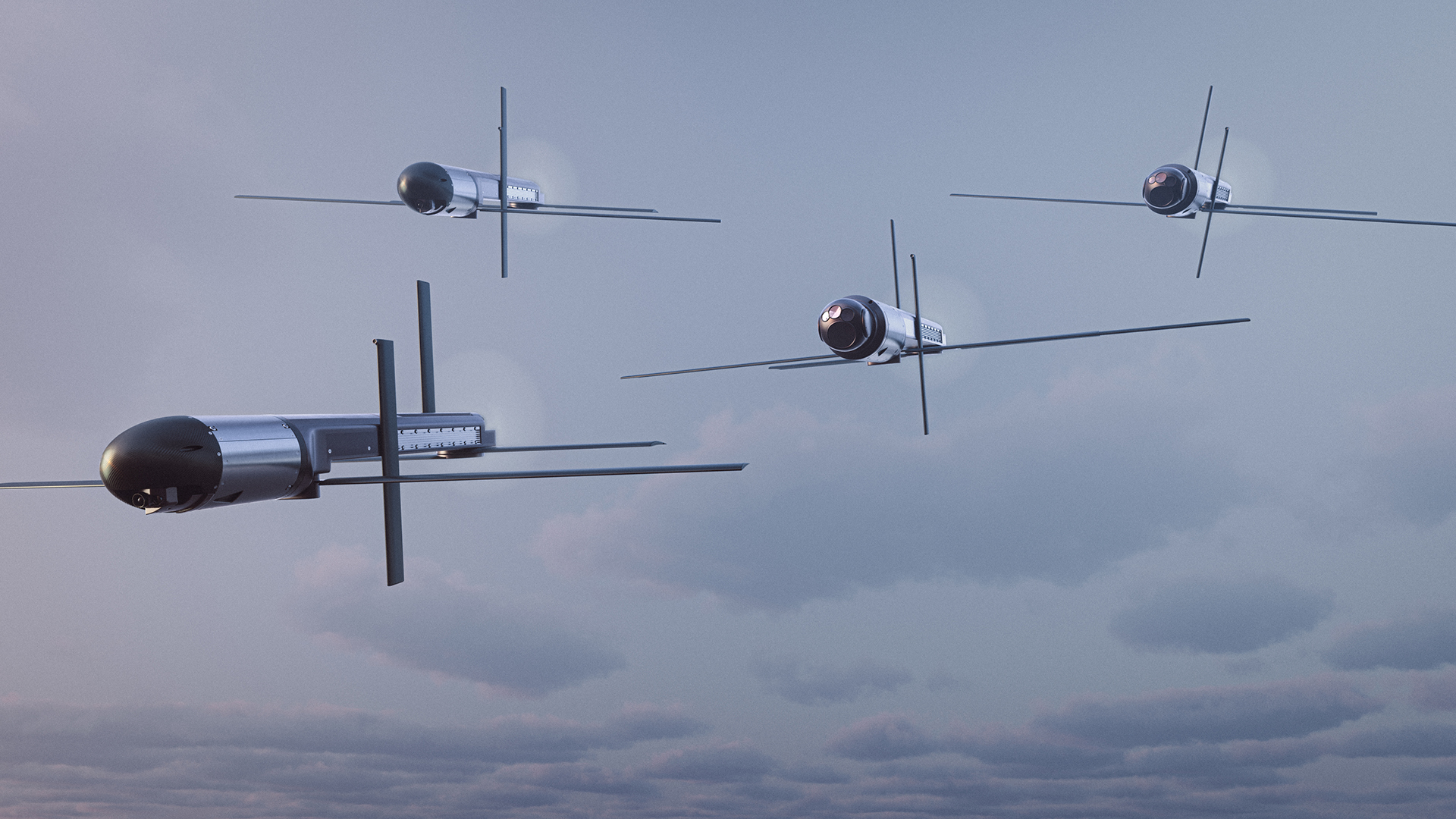
AeroVironment (AV) and Israel-based, ASX-listed connectivity firm Elsight announced on October 14, 2026, a partnership to integrate Elsight’s Halo multi-link communications module into AV’s Mayhem 10 launched effect. The integration gives the Group 2 air vehicle a single connectivity layer that bonds satellite, private and public cellular, and point-to-point radio links. Work is already underway, according to both companies, which disclosed no contract value, test schedule, or target date for a production configuration.
The announcement comes as the US Army pushes to field Launched Effects-Short Range (LE-SR) capability to all active-duty divisions by the end of 2026, an effort that has already produced initial fielding selections for the AEVEX Aerospace Atlas and the Anduril Altius 600. AV unveiled Mayhem 10 at the Army Aviation Association of America (AAAA) forum in Nashville on April 15, 2026, positioning it against the LE-SR tier, and on July 29 signed a teaming agreement with Applied Intuition to integrate collaborative autonomy software. The Elsight deal adds a resilient communications layer to that partner-built architecture.
How Elsight Halo Hardens the Mayhem 10 Launched Effect Data Link
Halo aggregates every available communications bearer into one bonded, encrypted connection, carrying command and control, telemetry, and sensor video across whichever links remain healthy and rerouting traffic automatically as conditions degrade. On Mayhem 10, the companies said, the module will manage satellite, cellular, and radio paths through one layer and adapt to changing network conditions without operator intervention. The stated goals are eliminating single points of failure and cutting operator workload, the variable that determines how many launched effects a single soldier can supervise at once.
“Reliable connectivity is critical to mission success, particularly in contested environments,” said Austin Miller, vice president and general manager of AV’s loitering munition systems business unit. Elsight CEO Yoav Amitai said the integration is meant to keep operators in control as conditions shift, without forcing them to juggle multiple links manually.
Publicly available specifications indicate the Halo module weighs less than 100 grams and draws 6.5 watts on average, with Ethernet, USB, and serial interfaces, native MAVLink support, and encryption up to AES-256. That mass equals roughly 2 percent of Mayhem 10’s 10-pound (4.5-kilogram) payload allowance, although neither company has said whether Halo will be built into the core avionics or occupy space in the removable payload section.
Halo also brings procurement credentials. It was added to the Defense Contract Management Agency (DCMA) Blue UAS Cleared List in the second quarter of 2026, carries a non-ITAR export classification, and advanced in November 2025 to the fielding phase of the Defense Innovation Unit’s Project G.I. Elsight’s $21.2 million Halo contract with a European defense OEM, announced in December 2025, was scheduled for delivery between January and April 2026.
Speed, Payload, and Range: How Mayhem 10 Stacks Up in LE-SR
AV lists Mayhem 10 at a 42-pound (19-kilogram) all-up round, with an 80 mph (128 km/h) cruise speed, a 120 mph (193 km/h) dash, more than 50 minutes of endurance, and over 100 kilometers (62 miles) of range. The design draws on the Switchblade 400, which AV describes as its sister system. The removable forward payload section accepts up to 10 pounds of interchangeable effects: intelligence, surveillance, and reconnaissance (ISR) sensors, electronic warfare (EW) packages, decoys, communications relay, and precision strike. AV has said the airframe can accommodate the Javelin Multi-Purpose Warhead used on the Switchblade 600. The system assembles and launches in under five minutes and is flown through AV’s Tomahawk Grip controller and AV_Halo COMMAND software, an AV product line unrelated to Elsight’s Halo despite the shared name.
Those figures leave Mayhem 10 short of the AEVEX Atlas on reach and persistence; publicly available specifications credit Atlas, a roughly 34-pound Group 2 system, with about 130 kilometers of range and over 70 minutes of loiter. AV is competing instead on modularity and software. Under the July agreement, Applied Intuition’s Acuity ISR/Strike software lets teams of Mayhem 10s find, fix, track, target, and engage under one operator’s supervision, and AV says the system is designed to operate in GPS-denied conditions while resisting jamming and spoofing. Teaming depends on real-time data exchange, which is where Halo plugs in.
Analysis: The partnership targets the weakest element of any launched effect architecture: the network. Autonomy reduces how often a vehicle needs to hear from its operator, but collaborative hunter-killer behavior, retasking, and battle damage assessment still require data to move. Bonding several bearers does not make a link jam-proof; an adversary able to suppress satellite, cellular, and radio frequencies across a sector still wins the spectrum fight. What multi-link bonding does is force that adversary to attack several bands at once, raising the cost of denial. The deal also reflects a broader trend in which commercially derived, Blue UAS-cleared components migrate into munition-class systems, compressing integration timelines but introducing cellular pathways whose availability in a high-intensity theater cannot be assumed.
Neither company has published an integration timeline or flight-test date for the Halo-equipped configuration. AV said in April that Mayhem 10 would enter low-rate initial production in calendar 2026 at about 10 units per month, with a full-rate goal of 100 per month, and reported no firm orders at launch; whether that schedule has held has not been publicly confirmed. The next markers to watch are a Halo-equipped flight demonstration, further Army LE-SR awards, and a first production contract for the system.