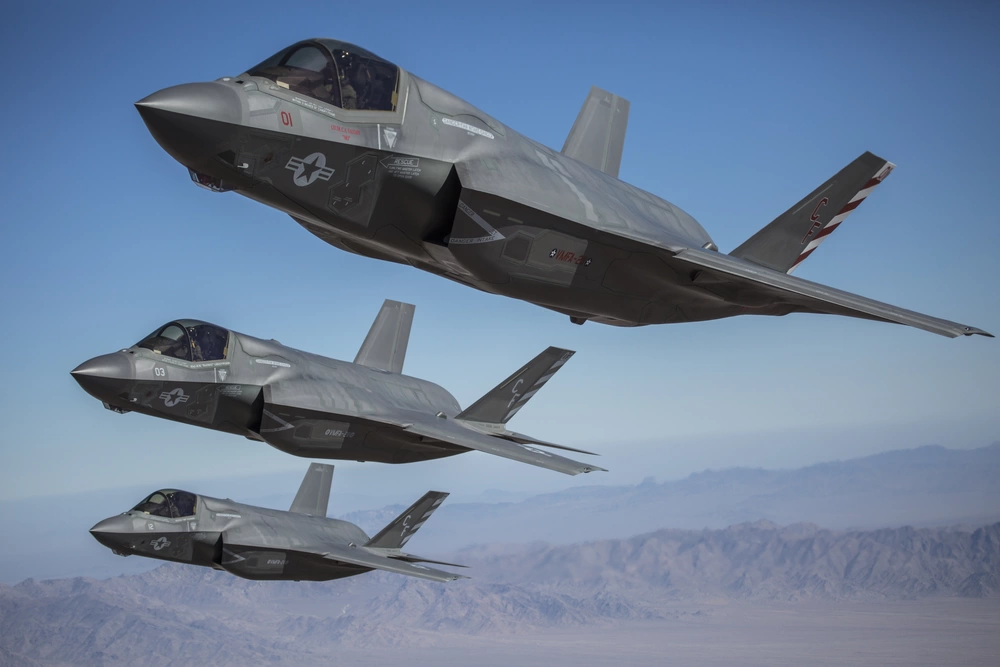
The Department of War announced on September 24, 2026, that Naval Air Systems Command (NAVAIR) awarded Northrop Grumman a not-to-exceed $123,781,000 contract for long-lead materials, parts and components supporting 67 production AN/APG-85 radars for Air Force, Marine Corps and Navy F-35 fighters. The award funds components, not finished radar sets, and work runs through February 2031.
The award arrives while the radar it supports is late. Jets built with the redesigned nose bulkhead sized for the APG-85 cannot take the older AN/APG-81, and Lt. Gen. Gregory Masiello, the F-35 program executive officer, told the Senate Armed Services Committee on June 23, 2026, that the Marine Corps had accepted six F-35B jets without radars. The Government Accountability Office (GAO) reported in September 2025 that Block 4 modernization costs exceed original estimates by more than $6 billion and completion is at least five years late.
APG-85 Radar Lot 7 Long-Lead Contract: Structure and Funding
The fixed-price incentive contract, with a firm target, was not competed, and NAVAIR at Patuxent River, Maryland, manages it. The announcement lists $66,527,000 in fiscal 2026 Air Force aircraft procurement funds and $57,254,000 in Navy funds, all obligated at award, which together equal the ceiling. Northrop Grumman will perform the work at Linthicum Heights, Maryland.
The award follows a $97.5 million long-lead contract for APG-85 Lot 6 announced in September 2025. Averaged across 67 radars, the Lot 7 ceiling comes to about $1.85 million per set, roughly one-fifth of the $8.8 million production-line unit cost, including two years of advance procurement, in the Air Force’s fiscal 2027 budget request. That request seeks nearly $335 million for 38 radars, which the government furnishes to Lockheed Martin for installation rather than buying through the aircraft contract.
Publicly available information indicates the APG-85 is an active electronically scanned array (AESA) radar, reportedly built on gallium nitride transmit/receive modules, that Northrop Grumman describes as compatible with all three F-35 variants. Program descriptions indicate it is meant to extend detection range and add electronic attack against adversary radars beyond what the APG-81 offers. The F-35 Joint Program Office keeps performance figures classified.
Certification, not only fabrication, has paced the radar. Rep. Rob Wittman, who chairs the House Armed Services tactical air and land forces subcommittee, has said the APG-81 could be certified in three days while the APG-85 takes far longer. Long-lead orders narrow fabrication risk but do not shorten that test cycle.
Ballast Jets and Retrofit Costs Before 2028 Radar Deliveries
Program sources indicate the Marine Corps ordered its Lot 17 jets with the new bulkhead, while the Air Force and Navy switch in Lot 18, which begins production this fall. Air Force Lot 17 F-35As still deliver with the APG-81. A common bulkhead that accepts either radar is not expected before Lot 20, whose deliveries begin in 2028.
Jets without radars are expected to remain flyable but limited to training. They retain the F-35’s other sensors and can take off-board data over datalinks, yet they lack the primary sensor for long-range air-to-air tracking and synthetic aperture radar ground mapping. Masiello acknowledged that F-35s without radars are not fully mission capable and said the six Marine Corps F-35Bs were the only such aircraft delivered as of June 23. The Air Force and Navy were expected to accept similar jets later this year.
Retrofits carry a cost. The Air Force plans to spend more than $1.7 billion to install APG-85s on 181 F-35As from Lot 17 and earlier, including $133 million in fiscal 2031 for 14 jets, about $9.5 million each, and roughly $1.6 billion beyond the five-year plan for another 167. It expects its first production APG-85 in April 2028, nine months earlier than previously scheduled.
Export customers are unaffected. The APG-85 has not been cleared for foreign sale, so allied F-35s continue to leave the line with the APG-81.
Analysis: The Lot 7 award addresses parts supply, but the binding constraints on APG-85 fielding sit elsewhere. Certification pace and bulkhead compatibility determine when jets receive radars, and thermal margin may limit how much of the radar the aircraft can use. Masiello said the current cooling system tops out near 32 kilowatts while future Block 4 systems need 62 to 80 kilowatts, and GAO reported in 2025 that Engine Core Upgrade production, which supports that growth, is expected to start in 2031. Masiello declined to discuss APG-85 capabilities in open session, so the modes affected by that limit remain unknown. Long-lead funding protects the schedule only if those upstream gates clear.
Three milestones will test the schedule. An APG-85 production contract could follow as early as November. Air Force and Navy acceptance of their first radar-less jets, expected later this year, will show how many aircraft the gap ultimately touches. Lockheed Martin’s common bulkhead is not expected before Lot 20. The radar’s performance figures remain classified, and the retrofit timeline for ballast-configured jets remains unclear.