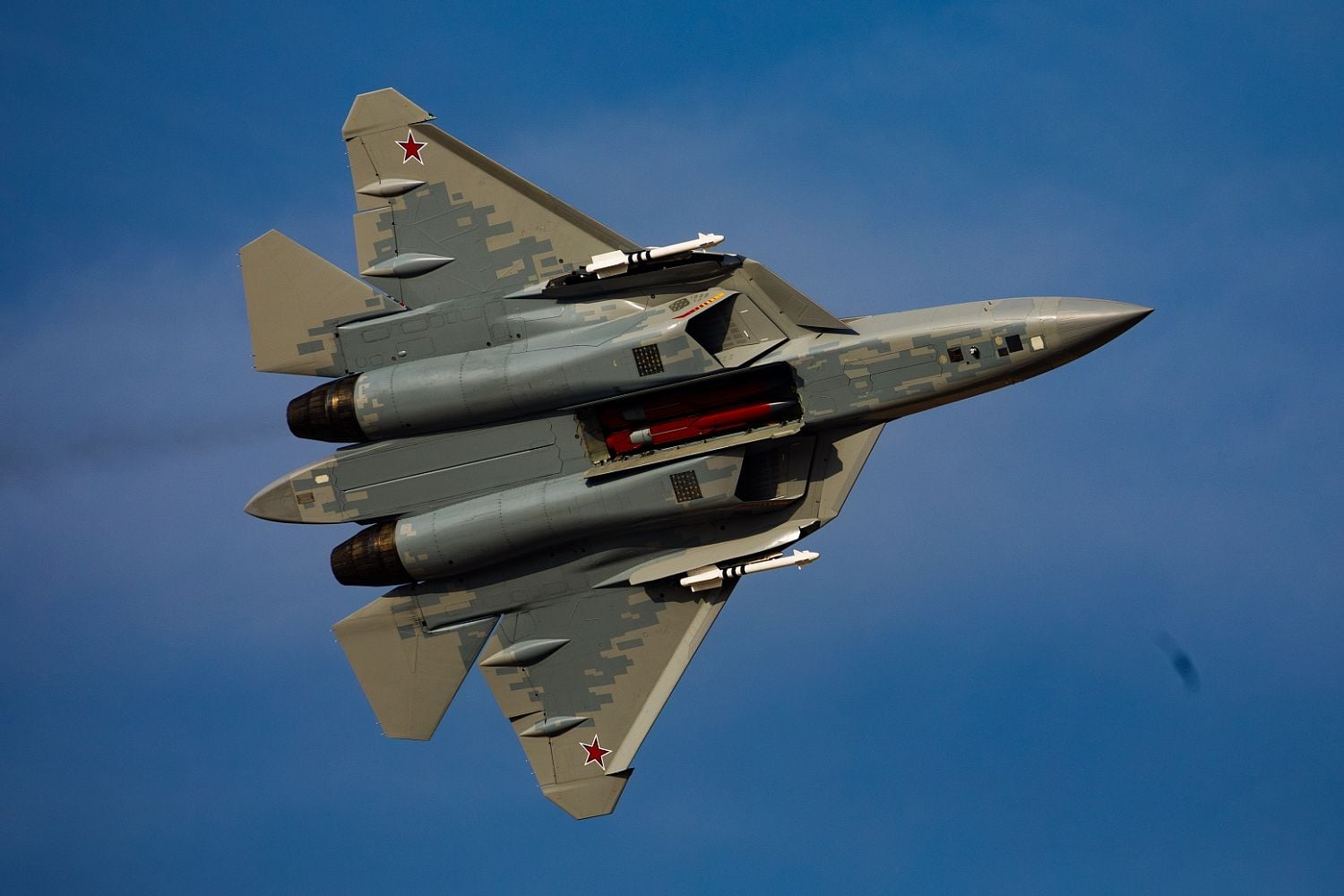
Russia’s United Aircraft Corporation (UAC) has delivered another batch of Su-57 fifth-generation multirole fighters to the Russian Aerospace Forces (VKS), announcing on September 24, 2026, that the jets were built to a new technical configuration shaped by combat use over Ukraine. UAC, part of the state conglomerate Rostec, did not disclose how many aircraft were handed over, which base received them, or what equipment changed.
The handover is the second publicly announced Su-57 batch of 2026, after a February delivery that UAC also described as a new technical configuration with upgraded onboard systems and weapons. Both sit against a contract signed at the Army-2019 forum in June 2019 for 76 production aircraft by 2028, enough to re-equip three regiments. Since February 2022, UAC has not published batch sizes and retouches tail numbers in released imagery, leaving the program’s pace to be reconstructed from photographs.
September Su-57 Delivery Follows February Batch and April Plant Fire
According to Rostec, the aircraft completed a full cycle of factory tests, were flown in various operating modes by Russian Ministry of Defense pilots, and then ferried to their home airfield. Company imagery shows at least two jets. The handover took place at the Komsomolsk-on-Amur Aircraft Plant named after Yuri Gagarin (KnAAZ), a Sukhoi branch and the only serial production site for the type.
That plant caught fire on the night of April 11, 2026, in Shop No. 46, which fabricates polymer composite components for the Su-57. Open-source assessments credit the shop with roughly 300 part designations, about 100 of them large structural elements such as flaperon panels, air intake sections, and wingtip fairings. The Su-57 uses far more composite parts than the Su-35S built alongside it. Satellite imagery published on April 14 showed multiple collapsed roof spans. KnAAZ, Sukhoi, UAC, and Rostec have not publicly addressed the damage.
The September batch shows that final assembly continued after the fire. It does not establish the workshop’s current output, and whether these airframes used composite sets produced before April is unknown.
Fleet size remains opaque. Open-source estimates run from fewer than 20 aircraft identifiable in service to Russian specialist estimates of up to 50 delivered, a spread wide enough to separate a program on schedule from one running years late. UAC chief executive Vadim Badekha said fulfilling the state defense order for the Su-57 and other tactical aircraft remains the corporation’s top priority, and that specialists are refining production processes to sustain required build rates.
Sensors, Weapons, and Propulsion: Where the Su-57 Configuration Is Evolving
Publicly available specifications indicate the baseline Su-57 pairs the N036 Byelka radar complex, built around an X-band active electronically scanned array (AESA) nose antenna, side-looking cheek arrays, and L-band arrays in the wing leading edges, with the 101KS Atoll electro-optical suite, which combines infrared search and track, ultraviolet missile approach warning, and laser directional infrared countermeasures. Weapons ride in two tandem main bays and two side bays for short-range air-to-air missiles, preserving the low-observable profile.
UAC has not itemized the 2026 changes. Open-source analysts examining company imagery point to modified defensive sensor apertures, additional electro-optical windows, and a newer head-up display, features that appear common to the February and September aircraft. A VKS Su-57 pilot quoted by Rostec said the new configuration widens the missions assigned to the type and that growth built into the weapons control system permits new types of aircraft weapons. The statement did not specify air-to-air or air-to-surface munitions.
The export catalogue offers a guide. Rosoboronexport markets the Su-57E with RVV-MD2 and RVV-BD air-to-air missiles and Kh-38MLE, Kh-69, and Kh-58UShKE air-to-surface weapons, and unveiled two new weapons, the S-71M and S-71K, at the El Alamein International Airshow in Egypt on September 8 to 10, 2026. Stand-off munitions matter most: the Su-57 has largely been reported launching missiles from Russian airspace, a mission that rewards sensor fusion and weapons integration over close-in maneuvering.
Propulsion is the unresolved variable. Production jets fly on the interim AL-41F1, or izdeliye 117, rated at about 15,000 kgf in afterburner per publicly available figures. The Product 177 engine began flight testing on a Su-57 on December 22, 2025, with manufacturer claims of 16,000 kgf in afterburner and 11,000 kgf dry. Nothing in the September announcement indicates the new batch carries it, and the definitive izdeliye 30 remains in trials.
Analysis: The Su-57 program has shifted from a volume story to a configuration story. Moscow is iterating sensors and weapons in small wartime batches, which sharpens the aircraft Russia already fields but does little to close the gap to 76 airframes by 2028. Exports add pressure: Rosoboronexport says new Su-57E contracts have been signed with unnamed buyers and that deliveries begin in 2026, and every export jet competes for the same KnAAZ line whose composite workshop burned in April. For NATO air planners, the metric to track is weapons integration on a small stand-off strike fleet, not the fleet count.
The next markers are concrete. Russian state defense order deliveries typically cluster in December, and a third 2026 batch would indicate whether KnAAZ has restored composite output. Other milestones include any official statement on Shop No. 46, the transition of Product 177 from flight test to production standard, and verifiable Su-57E deliveries beyond Algeria, widely reported but not formally confirmed as the launch customer. Until UAC publishes quantities, progress toward the 2028 target remains an estimate.