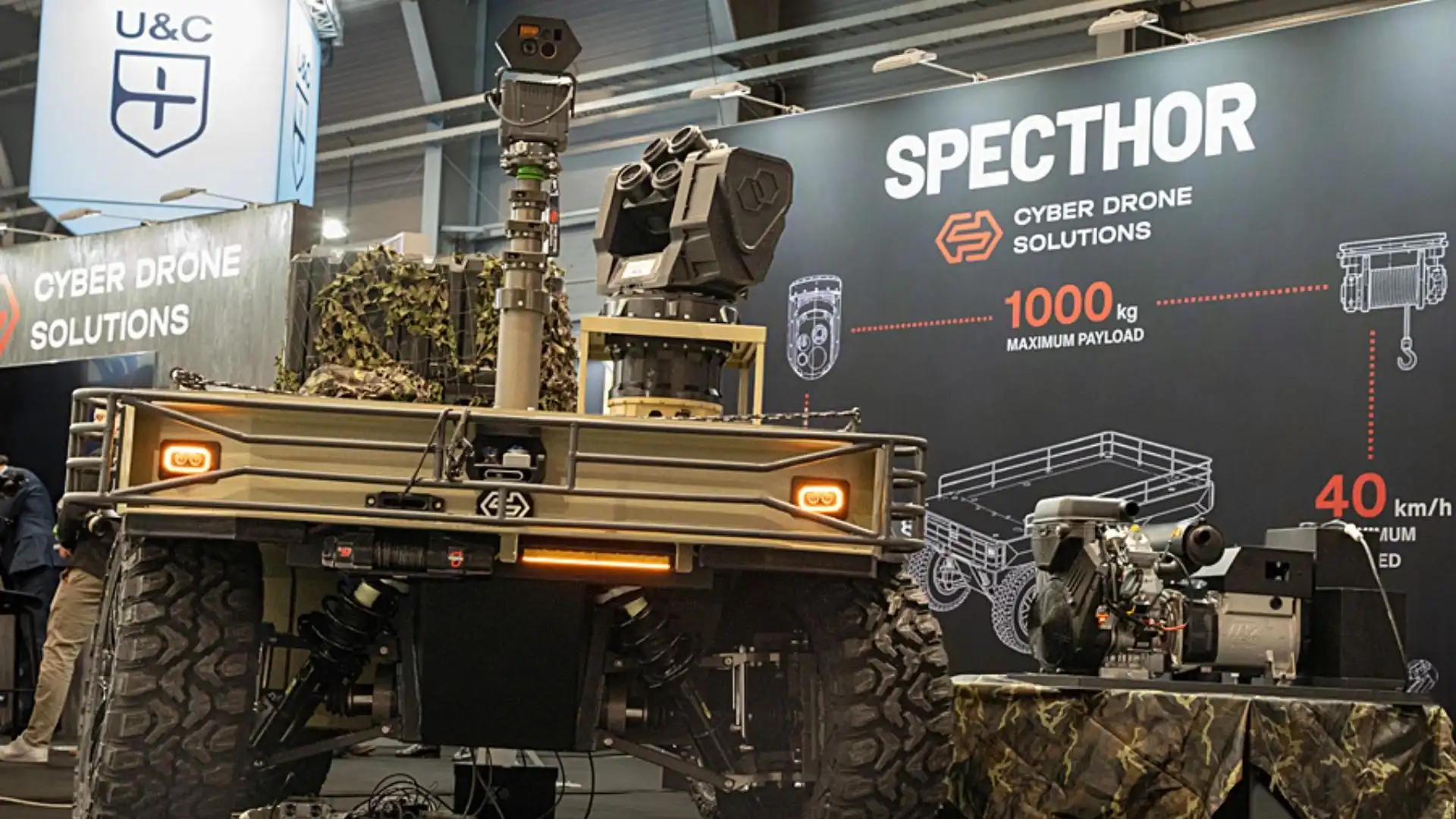
Czech defense integrator Cyber Drone Solutions unveiled the Specthor heavy unmanned ground vehicle (UGV) at the Future Forces 2026 exhibition in Prague, the company announced on October 22, 2026, pitching the 3,000 kg wheeled, all-electric platform for border and perimeter protection. The company says it is already testing the vehicle in India and adapting it to the requirements of an unnamed Indian partner for operations in the Himalayas at altitudes of around 5,000 meters.
The debut comes as armies move UGVs from experimentation toward routine logistics and security roles, a shift most visible in Ukraine, where the Ministry of Defense says units carried out more than 100,000 UGV logistics and evacuation missions between January and August 20, 2026. Cyber Drone Solutions, a subsidiary of Czech defense technology group S-Tech Group, positions itself as an integrator of UAV, UGV and counter-UAS (C-UAS) systems. Specthor debuted at the show, held at PVA Expo Prague from October 21 to 23.
Specthor Heavy UGV Specifications: One Chassis, Modular Mission Bay
Specthor measures 3.5 m long, 2 m wide and 1.5 m high and carries up to 1,000 kg of payload, a third of its own mass. Its electric drive delivers eight hours of endurance and a top speed of 40 km/h, and the vehicle climbs gradients of up to 20 degrees. Hydraulic steering on both the front and rear axles lets the vehicle maneuver in confined spaces and difficult terrain. The manufacturer has not disclosed battery capacity, motor output, ground clearance or protection level.
The modular mission bay accepts cargo, observation sensors, firefighting equipment or a remote weapon station (RWS); no specific weapon or RWS model has been named. Operators can drive the vehicle remotely at ranges of up to 15 km, with assisted and autonomous functions layered on top. Sensor inputs are fused into a single operational picture, and the decision stays with the operator, keeping a human in the loop for any armed configuration. “We built one chassis for different missions, not four variants of one vehicle,” said Jan Macák, Chief Technology Officer of Cyber Drone Solutions, adding that the electric drive was chosen for quiet running and simple maintenance.
Specthor sits above Estonia’s Milrem THeMIS, which Milrem says has been acquired by 21 nations, including eight NATO members. Milrem lists the tracked, hybrid diesel-electric THeMIS at 1,815 kg, with a top speed of 20 km/h and line-of-sight control up to 1.5 km, extendable beyond line of sight via LTE or SATCOM. Specthor doubles the speed and claims 15 km of remote control, but its 20-degree gradient limit falls short of the 60 percent (about 31 degrees) quoted for THeMIS.
Himalayan Adaptation and a European Supply Chain for Specthor
Working to the Indian partner’s requirements, Cyber Drone Solutions is modifying Specthor’s structure, propulsion and control systems for steep terrain, thin air, sudden weather shifts and absent infrastructure. The company handles research and development, manufacturing and integration for the partner, with Himalayan test results feeding directly back into the design. Sales Director David Kubiš said India offers conditions the firm cannot find in Europe. The Embassy of the Czech Republic in India helped put the cooperation in place. Neither the partner, the end user, nor any contract value or schedule has been disclosed.
Most components come from Componentas, a sister company within S-Tech Group that brings together European manufacturers of unmanned-systems components, and the manufacturer describes the entire supply chain as European. Macák framed this as a customer requirement: certainty that the platform contains no components of unknown origin.
Analysis: The Himalayan brief exposes the central trade-off of an all-electric heavy UGV. Electric drive avoids the power loss combustion engines suffer in thin air at 5,000 meters, which suits high-altitude operations, but battery capacity typically degrades in extreme cold, and a 20-degree gradient limit is modest for mountain terrain. The published eight-hour endurance figure is unlikely to hold at altitude without changes, and propulsion is one of the three areas being reworked alongside structure and controls. The European supply chain claim is the stronger commercial lever, because it speaks directly to buyers’ concern over components of unknown origin.
The next markers are a named Indian partner and end user, published results from high-altitude trials, and revised specifications for a Himalayan variant. Production capacity, unit cost and any European military evaluation also remain undisclosed.