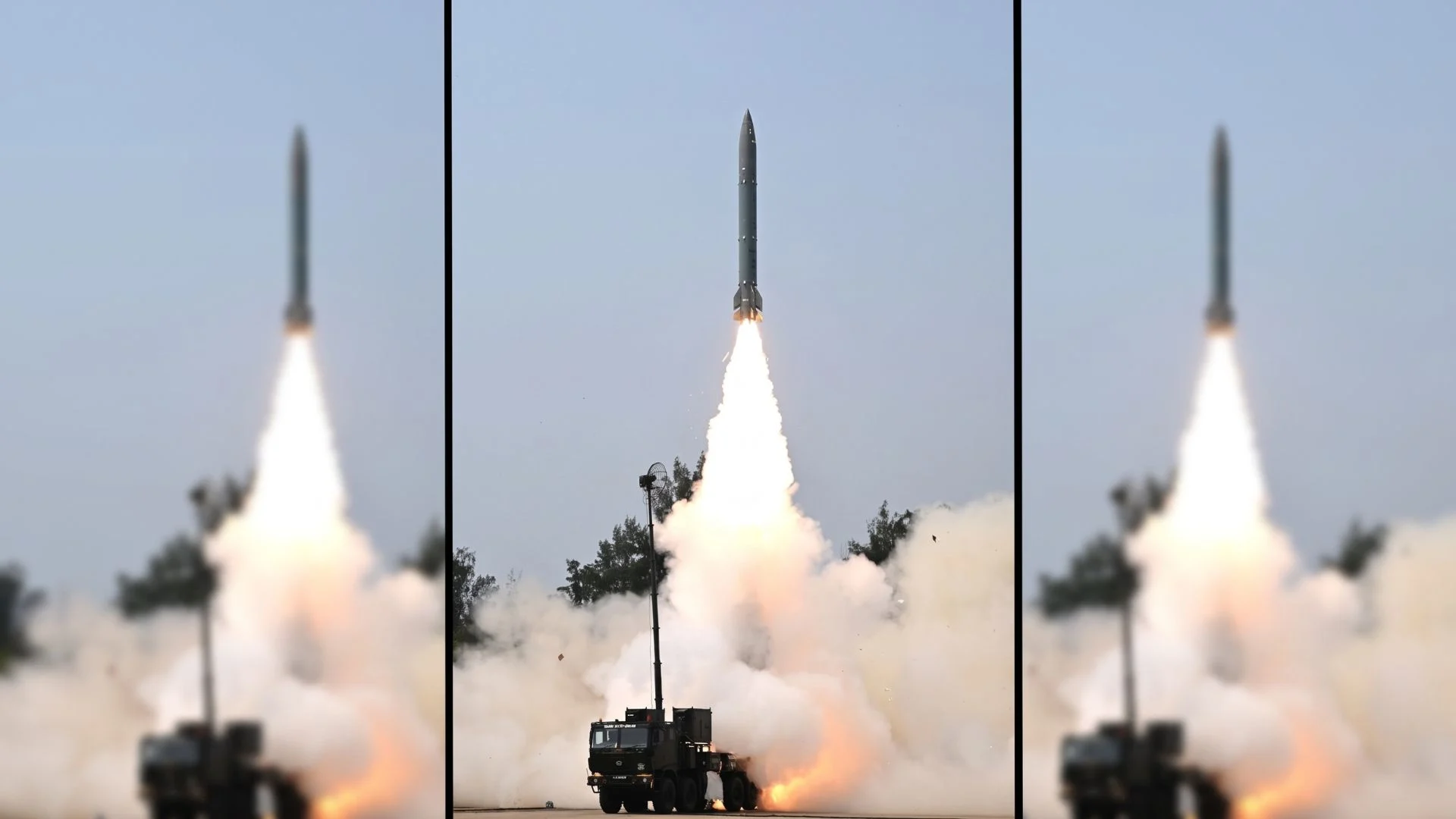
India’s Defence Research and Development Organisation (DRDO) flight-tested the Pralay missile, a quasi-ballistic weapon, from Dr APJ Abdul Kalam Island, off the coast of Odisha, at about 11:10 local time on November 5, 2026. According to the Ministry of Defence, all test objectives were met, as confirmed by data from range instruments of the Integrated Test Range (ITR), Chandipur.
The launch was part of user evaluation trials, witnessed by senior DRDO officials, industry representatives and the Defence Forces, and the ministry stated that induction of the system has now become imminent. It caps a test sequence that opened with back-to-back developmental launches on December 22 and 23, 2021, continued with a further flight test on November 7, 2023, and moved into user evaluation with two launches validating maximum and minimum range on July 28 and 29, 2025, followed by a two-round salvo from a single launcher on December 31, 2025. DRDO has not disclosed the range flown or the warhead configuration used on November 5.
Pralay Missile Design: Propulsion, Payload, and Guidance Architecture
Pralay was designed by Research Centre Imarat (RCI), Hyderabad, with other DRDO laboratories, and is produced by Bharat Dynamics Limited (BDL), a Development-cum-Production Partner alongside Bharat Electronics Limited (BEL). Development began in 2015 to meet an Indian Army requirement for a conventional tactical strike weapon sitting between long-range rocket artillery and nuclear-capable strategic missiles.
The missile is canisterised, road-mobile and powered by a solid-propellant motor. That removes the fuelling cycle of the liquid-fuelled Prithvi-II and shortens the interval between arrival at a firing position and launch. Publicly available specifications indicate a launch mass of about 5 tonnes and a strike envelope of 150 to 500 km. Payload figures vary across open sources, from 350 kg to 1,000 kg, with maximum range achieved at the lighter end of that bracket. Three warhead types have been reported: pre-fragmented (PF), penetration-cum-blast (PCB) for hardened targets, and runway denial penetration submunition (RDPS) for airbase attack.
The defining feature is the quasi-ballistic profile. Rather than following a predictable parabolic arc, Pralay flies a depressed trajectory and manoeuvres in flight, a combination intended to compress warning time for adversary radars and complicate fire-control solutions for ballistic missile defence interceptors. Official releases describe state-of-the-art guidance and navigation for high precision. Open-source assessments point to inertial navigation updated by satellite navigation, including India’s NavIC constellation, but DRDO has not published an accuracy figure.
Pralay Orders, Salvo Capability, and How It Compares to Regional Peers
The December 31, 2025 salvo, in which two missiles left the same launcher in quick succession, matters operationally more than any single range figure. A launcher that fires twice before relocating raises the volume of fire a battery can place on time-sensitive targets such as command posts, air defence radars and logistics nodes, while limiting its exposure to counter-battery fire and air attack.
Procurement approvals preceded the end of trials. India’s Ministry of Defence reportedly cleared about 120 missiles for the armed forces in December 2022, with the Indian Air Force expected to be the first operator, and approval to raise a Pralay regiment for the Indian Army was reported in September 2023. Neither contract value nor delivery schedule has been officially released. A reduced-performance export version, limited to 300 km and 500 kg to stay within Missile Technology Control Regime (MTCR) thresholds, has also been reported.
The closest functional analogue is Russia’s 9K720 Iskander-M, which pairs a solid-fuelled, manoeuvring quasi-ballistic missile with a range of about 500 km. Open-source accounts describe Pralay as a response to China’s DF-12 tactical missile and, at the shorter end of the spectrum, Pakistan’s Nasr. Facing the People’s Liberation Army Rocket Force, which fields far larger tactical missile inventories, Pralay narrows a qualitative gap rather than a quantitative one.
Analysis: Pralay’s core value is doctrinal. India’s existing ballistic inventory, from Prithvi-II to the Agni series, carries nuclear-capable associations that make any conventional launch hard for an adversary to read. A dedicated, conventionally armed quasi-ballistic missile gives commanders a deep-strike option below the nuclear threshold and reduces the risk of a conventional strike being misread as a nuclear one. Paired with BrahMos cruise missiles, it forms the ballistic half of the conventional theatre strike force that Indian commanders have discussed under the label of an integrated rocket force.
The next markers are a formal induction announcement, first production deliveries from BDL, and clarity on which service fields the first operational unit. DRDO has not disclosed the range flown on November 5, the planned production rate, or whether an extended-range variant is in development. A Notice to Airmen issued ahead of the test window covered a corridor of about 595 km, according to Indian defence outlet IDRW, which suggests a long-range profile but does not confirm it.