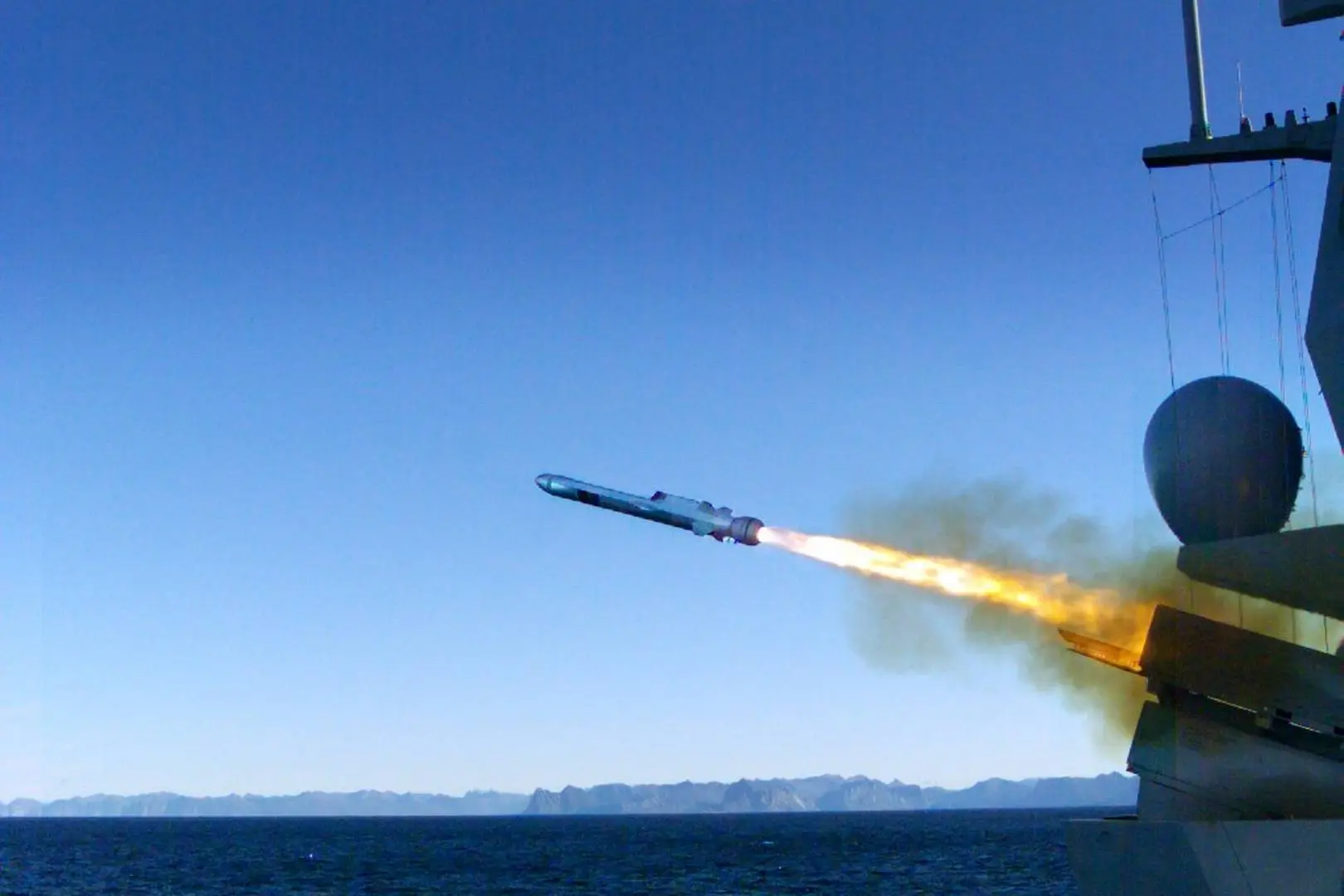
The U.S. Marine Corps has awarded Kongsberg Defence & Aerospace a sole-source contract worth up to $404,354,590 for full-rate production and sustainment support of the Naval Strike Missile (NSM) Launcher Unit, Weapon Control System, and ancillary support equipment, the Department of War announced September 25, 2026. The firm-fixed-price, indefinite-delivery/indefinite-quantity (IDIQ) contract runs through September 24, 2034, and obligates no funds at award; funds will be obligated order by order.
The hardware forms the firing end of the Navy-Marine Expeditionary Ship Interdiction System (NMESIS), the ground-based anti-ship system central to the Corps’ Force Design concept. Kongsberg Gruppen confirmed the frame agreement in a regulatory filing on September 28, adding that notable orders will be announced as call-offs are made. The award lands three months after NMESIS reached the Okinawa-based 12th Marine Littoral Regiment (MLR) and five months after the Department of the Navy requested 32 NMESIS launchers and 103 NSMs in its fiscal 2027 budget.
Naval Strike Missile Launcher, Fire Control, and the NMESIS Kill Chain
The contract covers the launcher and its fire control, not the missiles or the vehicle. Each NMESIS carries two NSMs on a Remotely Operated Ground Unit for Expeditionary Fires (ROGUE-Fires) carrier built by Oshkosh Defense on a Joint Light Tactical Vehicle (JLTV) chassis, with no crew cab. Missiles are procured separately under the NSM multiyear procurement contract the Navy awarded Kongsberg in 2024, which covers both its shipboard Over-the-Horizon Weapon System and NMESIS.
Publicly available specifications indicate the NSM measures 3.96 m (13 ft) and weighs about 407 kg (897 lb) with its solid rocket booster; a Microturbo TRI 40 turbojet then sustains high subsonic cruise. The missile carries a 125 kg (276 lb) titanium-cased blast-fragmentation warhead with a programmable fuze and navigates by inertial, GPS, and terrain-reference inputs. Terminal homing relies on a passive imaging infrared seeker matched against an onboard target library, allowing the missile to discriminate a designated ship class without emitting radar energy. It flies a sea-skimming profile and performs randomized terminal maneuvers.
Those traits shape how NMESIS fights. A passive seeker denies an adversary’s electronic support measures an early cue, and autonomous target recognition reduces the risk of engaging a fishing vessel or decoy in crowded littoral traffic. Kongsberg now lists NSM range at more than 300 km, well beyond the 185 km (100 nautical miles) long cited for the baseline missile; which configuration NMESIS batteries will field under current buys has not been disclosed. At those distances the launcher cannot see its target, making the Weapon Control System, which handles mission planning and launch control, the link between off-board targeting data and the missile.
NMESIS Fielding Goals and the 85/15 Norway-Pennsylvania Workshare
The 3d MLR in Hawaii formally received NMESIS on November 26, 2024, and the 12th MLR on Okinawa followed in June 2026, placing the first forward-based U.S. anti-ship missiles along the first island chain. The system has also deployed for Balikatan 2025 and 2026 in the Philippines and Resolute Dragon 2025 in Japan. The Corps’ October 2025 Force Design update sets a goal of 18 launchers per medium-range missile battery, with full realization in fiscal 2033. The fiscal 2027 request places the 32 launchers and 103 missiles inside a $6.3 billion Marine Corps ground procurement line.
NMESIS also carries more weight after the fiscal 2026 budget terminated the Long Range Fires program, which had planned to field 56 Tomahawk launchers on the same ROGUE-Fires carrier by fiscal 2028. The Corps concluded that system could not be employed in austere, expeditionary, littoral environments. That leaves NMESIS as the service’s only dedicated ground-launched anti-ship missile system in production.
Under the award, 85% of the work will be performed in Kongsberg, Norway, and 15% in Johnstown, Pennsylvania, the company’s largest production site outside Norway and its U.S. remote weapon station plant since 2008. A separate NSM and Joint Strike Missile assembly, upgrade, and repair facility in James City County, Virginia, broke ground on January 16, 2026. The Pentagon justified sole-source procurement under 10 U.S.C. 3204(a)(1), the only-one-responsible-source exception, with the Portfolio Acquisition Executive Marine Corps at Quantico, Virginia, as contracting activity. Neither the Pentagon nor Kongsberg disclosed unit quantities, unit prices, or the timing of the first order.
Analysis: The zero-obligation IDIQ is the substance of this award. It locks in pricing and production capacity for launchers and fire control through 2034 while letting annual appropriations, starting with the fiscal 2027 request, set quantities, which aligns industrial commitment with the Force Design goal of full batteries by fiscal 2033. The trade-off is concentration. With Long Range Fires gone, the Corps’ ground-based sea denial now rests on one missile, one launcher family, and one sole-source prime performing 85% of this launcher work in Norway. For a force meant to operate inside an adversary’s weapons engagement zone, wartime replacement of lost launchers and expended missiles depends on transatlantic supply lines, which makes the Johnstown and Virginia ramp-up central to NMESIS sustainability.
The next markers are the first delivery order under the IDIQ, which Kongsberg has said it will disclose if notable, and final fiscal 2027 appropriations, which will settle the 32-launcher request. Neither the Corps nor Kongsberg has said which NSM range configuration the batteries will field, or when the Virginia plant begins deliveries. Those answers will determine how quickly NMESIS moves from two regiments to battery-scale mass across the Pacific.