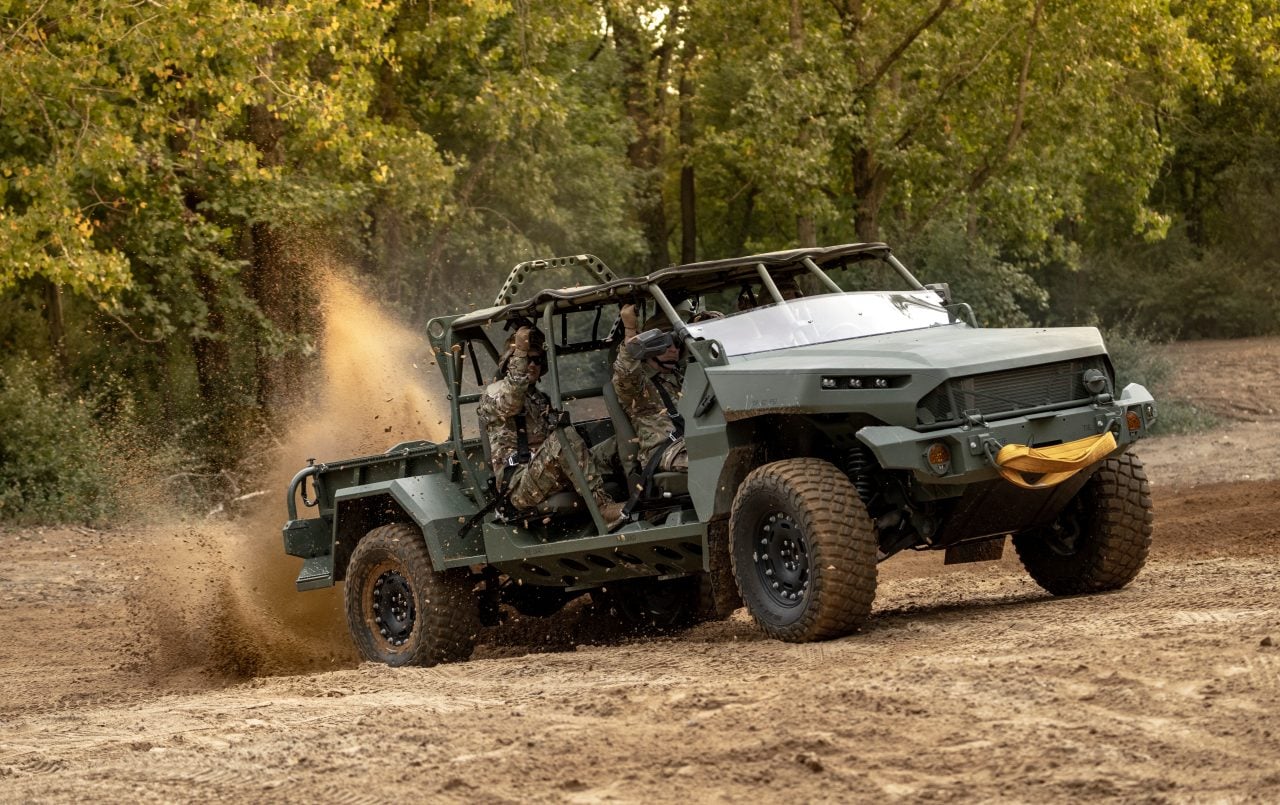
The U.S. Army has awarded GM Defense LLC a $697,686,693 contract modification to fund engineering change proposals for the Infantry Squad Vehicle Utility (ISV-U) and its winch kit, according to the Department of War’s contract announcements for September 21, 2026. Modification P00053 to contract W56HZV-20-D-0066 raises the contract’s cumulative face value to $915,597,166. Army Contracting Command-Detroit Arsenal, Michigan, is the contracting activity.
The award arrives as the Army rebuilds its light tactical fleet around the Infantry Squad Vehicle (ISV). The 2025 Army Transformation Initiative ended Army procurement of the High Mobility Multipurpose Wheeled Vehicle (HMMWV) and the Joint Light Tactical Vehicle (JLTV), and is converting Infantry Brigade Combat Teams into Mobile Brigade Combat Teams equipped with the ISV. The June 2020 production award, worth $214.3 million, covered 649 vehicles against an objective of 2,065. That objective rose to 2,593 at the March 30, 2023, full-rate production decision and to 9,282 in fiscal 2026 budget documentation, which requested $308.62 million for 1,275 ISVs.
Inside the $697.7 Million Infantry Squad Vehicle Utility Modification
The announcement frames the work narrowly. GM Defense, which holds the prime contract for both the ISV-U and its winch solution, has said the engineering changes add a windshield and a heater and defrost system, along with options for a full crew enclosure kit. The winch kit gives crews an organic self-recovery capability on a vehicle expected to operate off-road without heavier recovery assets nearby.
The contract structure matters more than the headline figure. The D designator in W56HZV-20-D-0066 identifies an indefinite-delivery vehicle, and the announcement states that work locations and funding will be determined with each order, with an estimated completion date of June 25, 2028. No obligation at award was disclosed. The $697.7 million therefore represents ordering capacity rather than money spent. It is also roughly 3.2 times the contract’s prior cumulative value of about $217.9 million. The Army solicited one bid and received one, so the price of the changes has no competitive benchmark, a point appropriators may press as orders are placed.
What the announcement does not show is how that ceiling divides between non-recurring engineering, production of vehicles built to the revised configuration, retrofit kits for ISV-Us already delivered, and winch kits. A windshield, a heater and an enclosure option do not by themselves explain a figure of this size. The more plausible reading is that the ceiling is sized to carry follow-on ISV-U orders incorporating the changes, but the Army has not published a breakdown, and unit pricing will surface only as individual orders are announced.
ISV-U Payload, Powertrain, and Modular Mission Architecture
The ISV-U is GM Defense’s multi-mission and logistics derivative of the nine-passenger M1301 ISV. It replaces the rear troop seats with a medium-sized cargo bed and seats five in a 2/3 layout or four in a 2/2 layout. Publicly available specifications indicate a 2.8-liter Duramax turbodiesel rated at 275 hp and 420 lb-ft of torque, a six-speed automatic transmission, a payload of 3,200 lb (1,452 kg) and a curb weight of about 4,900 lb, light enough for helicopter transport. The platform draws on the Chevrolet Colorado ZR2 architecture and roughly 90% commercial off-the-shelf components, including Chevrolet Performance suspension parts.
GM Defense says the Utility variant supports logistics requirements and can integrate command and control, fire support, electronic warfare and counter-drone mission packages. The company cites uniformly drilled bolt-on mounting points tied into the structure to speed integration. A company executive has said the Army intends eventually to field more ISV-Us than nine-seat troop carriers, a shift GM Defense attributes to feedback from the Army’s Transforming in Contact units.
That mission set explains the modification. The baseline ISV is a doorless, open vehicle built for rapid infantry movement. Crews running logistics circuits, command posts or electronic warfare systems spend far longer in the vehicle, often in cold, wet or high-latitude conditions where an open cab erodes endurance. The enclosure addresses weather, not threats. The announcement makes no reference to ballistic protection, and the Director, Operational Test and Evaluation left its initial survivability assessment of the ISV unchanged in a 2023 follow-up, according to the Congressional Research Service.
Analysis: The modification marks the ISV’s transition from a light infantry mobility tool into the Army’s general-purpose light tactical platform, filling the gap left by the HMMWV and JLTV halt. Enclosed cabs, heaters and winches are the predictable cost of that transition, because a vehicle selected for air-assault speed must now sustain logistics and electronic warfare crews in every climate. The risk is requirement creep: each kit adds weight and cost to a design whose value rests on commercial pricing and helicopter transportability. Congressional committees are already probing the line: House appropriators recommended $274.172 million less than requested for fiscal 2026, and Senate authorizers proposed a $62.458 million cut, citing funding ahead of need.
Individual delivery orders under the expanded ceiling will reveal quantities, unit pricing and whether the changes apply to new builds, retrofits or both. GM Chief Executive Mary Barra told investors on July 21, 2026, that GM plans to supply 10,000 ISVs, an order expected to exceed $1 billion, if federal funding is approved. GM Defense targeted more than 1,200 ISV-U deliveries in 2026; the Army has not confirmed whether it met that schedule. Fiscal 2027 appropriations will decide how much of the ceiling becomes vehicles before work concludes on June 25, 2028.