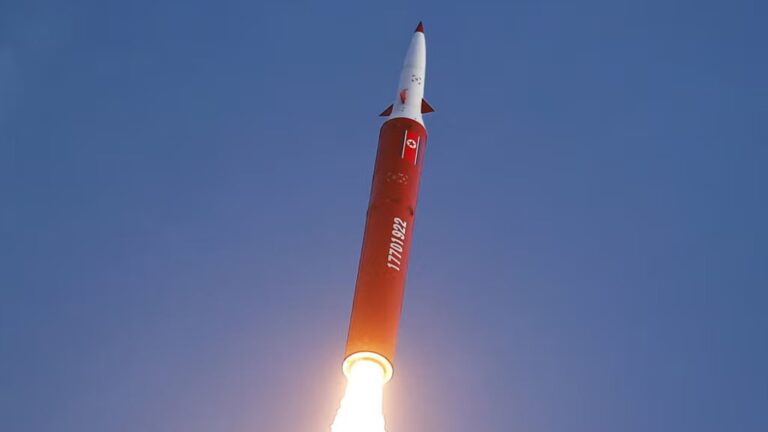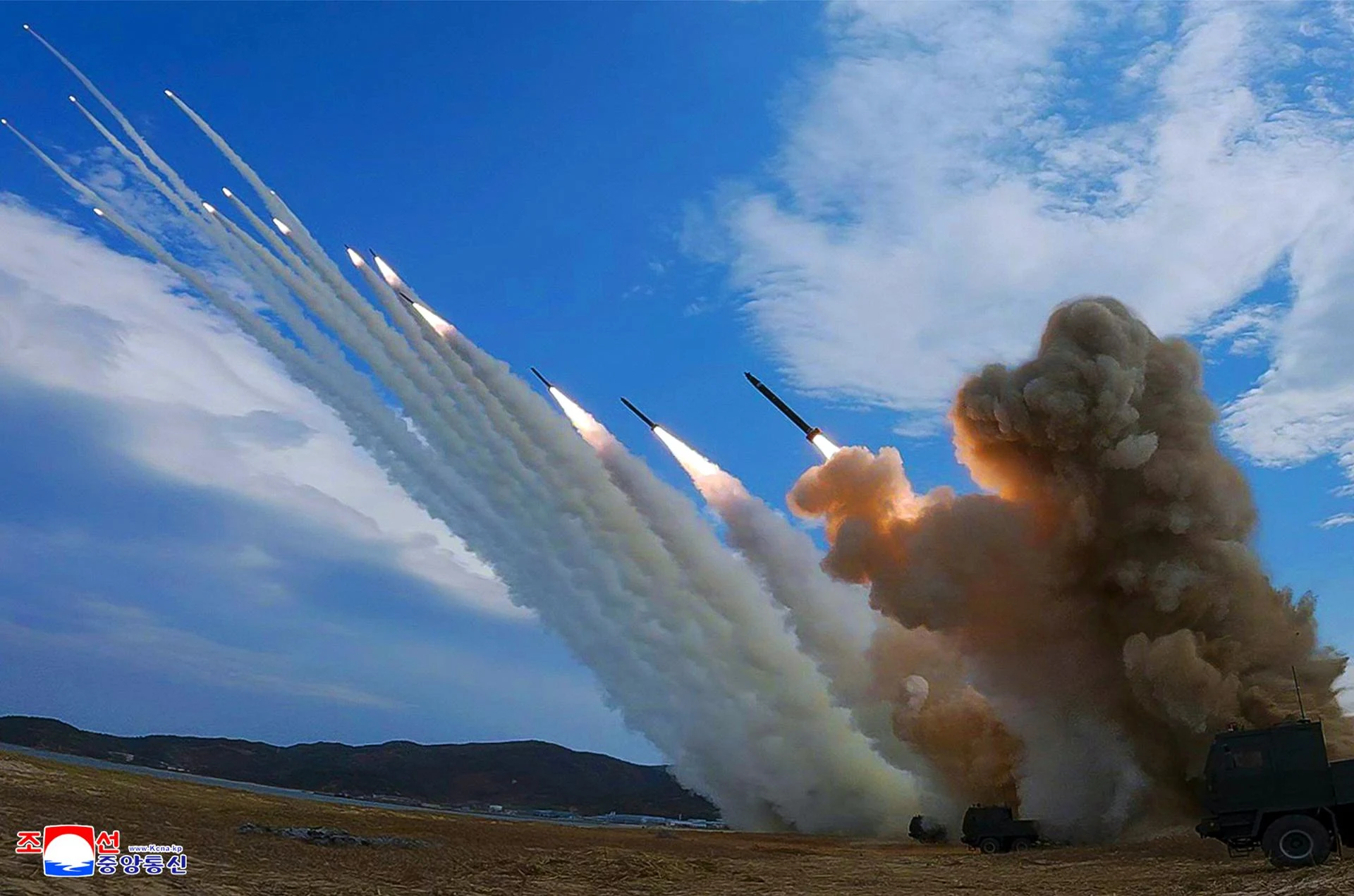
North Korea fired its upgraded 600mm “Sniper” multiple rocket launcher (MRL) before an audience for the first time on October 29, 2026, in a live-fire demonstration that also involved one-way attack drones, drone-launched air-to-surface missiles, and tactical cruise missiles, the state-run Korean Central News Agency (KCNA) reported on October 30. Leader Kim Jong Un attended the event, which was staged alongside the Unmanned Aeronautical Technology Development-2026 exhibition.
The same day, South Korea’s Joint Chiefs of Staff (JCS) detected around 10 short-range ballistic missiles (SRBMs) launched from the Wonsan area toward the East Sea, flying about 250 km. A South Korean military official said the launches likely involved the 600mm system the U.S. and South Korea designate KN-25. Seoul counts the event as North Korea’s 17th ballistic missile launch of 2026, coming 17 days after an October 12 test. An upgraded variant was test-fired on January 27, and 50 new launchers were unveiled at a February 18 ceremony in Pyongyang ahead of the Ninth Congress of the Workers’ Party of Korea.
Sniper Rocket Launcher: Inside the Upgraded KN-25 Strike System
KCNA said a 600mm MRL battalion took part and claimed the combat reliability and effectiveness of all major weapon systems were “successfully verified.” State media imagery shows more than 10 launchers firing simultaneously. KCNA did not disclose the number of rounds fired, their range, or the distance to the target, a small island off the east coast. Structures in the released photos place the event at the Wonsan-Kalma area, site of the air force’s 80th anniversary event in 2025.
Publicly available estimates put the KN-25 rocket at roughly 8.2 m in length and about 3,000 kg. First tested in July 2019, the system has a demonstrated range of about 380 km and has appeared on at least three launcher types: a four-tube 8×8 wheeled vehicle, a six-tube tracked chassis, and a five-tube four-axle wheeled launcher. Pyongyang calls it a “super-large” MRL; Washington and Seoul classify the round as an SRBM.
The upgrade centers on guidance. During the January 27 test, KCNA said four rockets struck a sea target 358.5 km from the launch point, and Kim described a “self-steered” precision-guided flight system immune to outside interference. That language is consistent with autonomous inertial navigation with in-flight correction, designed to deny adversaries a jamming target. In February, Kim said the launchers incorporate AI technology and a compound guidance system, combining the accuracy and destructive power of tactical ballistic missiles with the firing rate of a rocket launcher. The “Sniper” label fits that narrative: Pyongyang is recasting a saturation weapon as a point-target system.
In caliber and reach, each round sits alongside the U.S. Army Tactical Missile System (ATACMS) at 610mm and roughly 300 km, and the CTM-290 tactical missile fired by South Korea’s K239 Chunmoo at about 290 km. The difference lies in employment: North Korea fires the KN-25 in battalion-sized volleys. Pyongyang also claims the system can carry the Hwasan-31 tactical nuclear warhead unveiled in March 2023, a claim that remains unverified.
Drones, Cruise Missiles, and Conflicting Allied Launch Counts
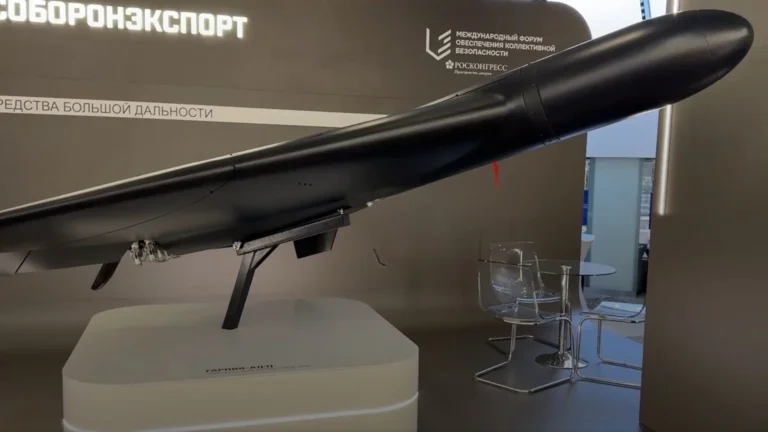
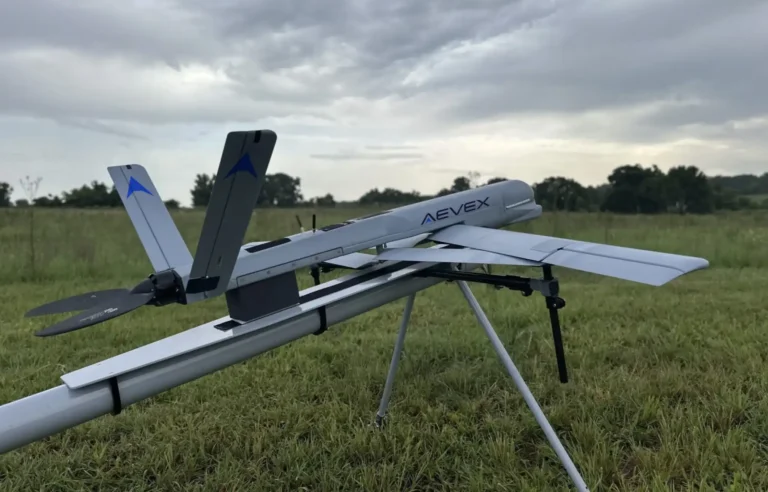
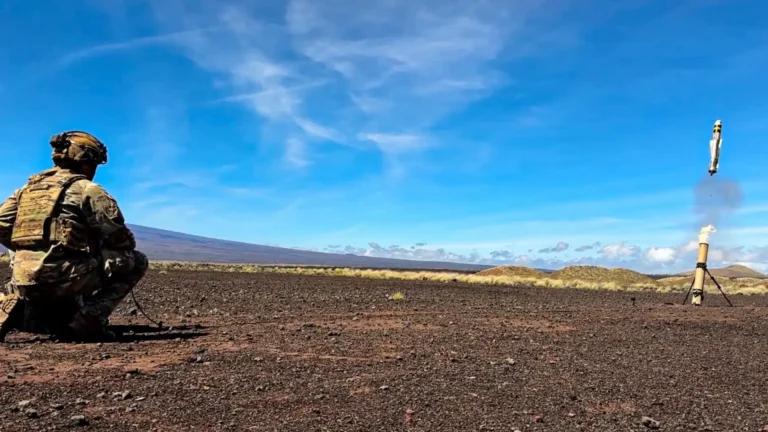
The unmanned component carried equal weight. KCNA said tactical suicide attack drones, air-to-surface missiles fired from multipurpose drones, and cruise missiles hit the islet target “with 100 percent accuracy.” Janes identified the armed Saetbyol-9 multirole UAV launching an unidentified weapon and the Saetbyol-4 strategic reconnaissance UAV in the released imagery. Both types, first shown in July 2023, closely resemble the U.S. MQ-9 Reaper and RQ-4 Global Hawk externally. Loitering munitions fired from launchers along Kalma Beach, which NK News identified as Kumsong-series suicide drones, struck mock targets resembling South Korean front-line guard posts, U.S. M1 Abrams tanks, and radars. Kim used the exhibition to call for “absolute superiority” in unmanned technology and faster work on drones and AI for national defense.
Allied tracking diverged. The JCS initially reported an “unidentified projectile” before settling on around 10 SRBMs. Japan reported a single ballistic missile, and its final notice omitted the range and apogee data it usually publishes. U.S. Indo-Pacific Command reported two. Shin Seung-ki, a research fellow at the Korea Institute for Defense Analyses (KIDA), told NK News that a gap in the trilateral data-sharing in place since 2023 was an unlikely cause, pointing instead to South Korea’s closer position for detecting and tracking launches from the North. The near-simultaneous mix of rockets, drone-launched missiles, and suicide drones also made the event harder to track than most North Korean launches.
Analysis: The October 29 event presents the KN-25 as the fires backbone of an integrated strike package: guided heavy rockets in battalion volleys, armed UAVs releasing standoff munitions, and loitering munitions hunting forward posts, armor, and radars. KCNA’s precision claims cannot be independently verified, and Shin argued that matching the accuracy of comparable U.S. or South Korean systems would require costlier, more sophisticated components than North Korea can currently produce. Accuracy, however, is not the decisive metric. A volley that three allied sensor networks counted as one, two, or ten rounds illustrates the warning and cueing problem massed quasi-ballistic fires create for South Korea’s layered missile defense, where Patriot PAC-3 and Cheongung-II (KM-SAM) interceptor inventories, not detection alone, set the ceiling on defensive capacity.
Key unknowns include the number of rounds fired, the launcher variant used, and actual impact accuracy. The next indicators to watch are whether allied militaries reconcile their counts and publish range and apogee data, further “Sniper” deliveries to front-line Korean People’s Army units, and follow-on drone tests driven by Kim’s call for rapid expansion of unmanned forces. Any drill pairing the system with the Hwasan-31 warhead would sharpen its role as a dual-capable battlefield weapon.