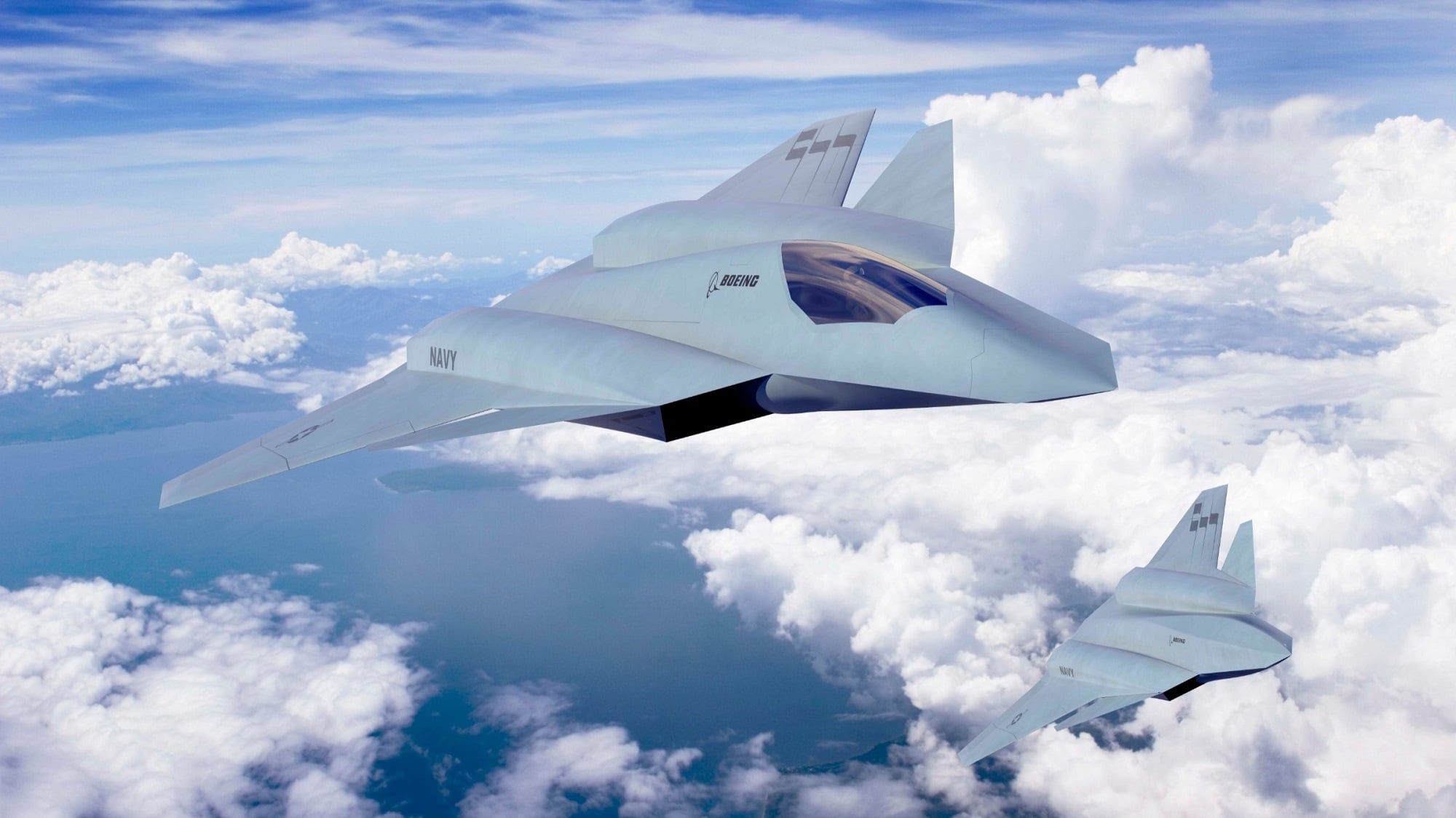
The U.S. Navy has awarded Boeing a contract valued at more than $20 billion for the full-scale development of the F/A-XX sixth-generation carrier-based strike fighter, the Department of War announced on September 29, 2026. The contract procures multiple test aircraft for ground, airworthiness, systems and weapons integration testing. The aircraft will augment and eventually replace the F/A-18E/F Super Hornet and EA-18G Growler beginning in the 2030s, operating alongside the F-35C Lightning II.
The award closes 18 months of uncertainty. Boeing and Northrop Grumman were the final bidders after Lockheed Martin was reportedly eliminated in March 2025, the same month Boeing won the Air Force’s F-47 Next Generation Air Dominance (NGAD) fighter. In June 2025, the Pentagon’s fiscal 2026 budget request cut F/A-XX to $74 million to complete design work, citing limited industrial capacity to run two sixth-generation fighters at once. Congress intervened; Sen. Eric Schmitt (R-Mo.) says lawmakers provided $972 million for F/A-XX development in fiscal 2026 appropriations. Chief of Naval Operations (CNO) Adm. Daryl Caudle had promised a selection by August 2026, a deadline the service missed by a month.
What the $20 Billion Navy Sixth-Generation Fighter Contract Buys
The F/A-XX is the crewed strike fighter at the center of the Navy’s own NGAD family of systems, an effort separate from the Air Force program despite the shared name. Navy officials have repeatedly said the aircraft will use a different airframe from the F-47, avoiding the single-design joint approach of the F-35 program.
The full-scale development phase corresponds to engineering and manufacturing development (EMD), the stage that turns a mature design into flight-test hardware. The Department of War did not disclose the contract type, the number of test aircraft, a first-flight target or an eventual procurement quantity. Boeing said technical and programmatic details remain classified.
Under Secretary of War for Acquisition and Sustainment Michael Duffey said the F/A-XX “will dominate contested airspace, extend operational reach, and deliver a decisive combat advantage for the warfighter.” Acting Secretary of the Navy Hung Cao described the fighter as “a generational leap in air superiority.”
The future air wing will pair the fifth-generation F-35C with a sixth-generation fighter that Navy officials describe as the stealthy leading edge of carrier aviation. Controlling carrier-based Collaborative Combat Aircraft (CCA), still being defined by the Navy, is expected to be a core F/A-XX mission.
Range, Propulsion and Growler Replacement: What F/A-XX Must Deliver
Range is the program’s defining requirement. In April 2025, Rear Adm. Michael Donnelly, director of air warfare on the CNO’s staff, said the F/A-XX would offer roughly 25 percent more operational range before refueling than current carrier-based fighters. Publicly available figures put the Super Hornet’s combat radius at roughly 390 to 500 nautical miles depending on profile, a reach that pushes carriers inside China’s anti-ship missile envelope in a Western Pacific fight.
Navy officials have also indicated that F/A-XX will rely on existing propulsion technology rather than the adaptive-cycle engines the Air Force has funded through its Next Generation Adaptive Propulsion effort. The choice trades range growth for lower technical risk. The specific powerplant has not been disclosed.
Organic tanking is meant to close the gap. On September 14, 2026, the Navy awarded Boeing a $562 million contract for three MQ-25A Stingray uncrewed tankers in low-rate initial production, with deliveries expected from 2029. The Stingray is designed to deliver at least 14,000 pounds of fuel at 500 nautical miles, according to a Government Accountability Office report.
The Growler reference is the least explained element of the award. The EA-18G carries the air wing’s airborne electronic attack mission, including the AN/ALQ-249 Next Generation Jammer Mid-Band. Whether F/A-XX absorbs that role through an integrated electronic warfare suite, a dedicated variant or offboard uncrewed jammers has not been stated.
How Boeing Plans to Build F-47 and F/A-XX in Parallel
Industrial capacity drove the program’s pause and likely shaped its outcome. On September 16, 2026, Air Force Gen. Dale White, the Pentagon’s Direct Reporting Portfolio Manager for Critical Major Weapon Systems, again flagged concerns about building F/A-XX alongside the F-47, which he said will fly by 2028.
Boeing’s answer is concentration in St. Louis. The company says construction continues there on a secure manufacturing facility, which it describes as the largest in the United States. The same Boeing Defense, Space & Security enterprise builds the F-15EX Eagle II, the T-7A Red Hawk and the MQ-25A, while Super Hornet production winds down.
“Delivering two advanced fighters in parallel was always our plan, and we invested accordingly,” said Steve Parker, president and chief executive officer of Boeing Defense, Space & Security.
The Pentagon’s April 2026 Selected Acquisition Report attributed MQ-25 delays to technical risk and the 2025 labor strike at Boeing’s St. Louis-area plants, pushing Stingray initial operational capability to 2029, four years later than planned.
Analysis: The award makes Boeing the sole prime contractor for both U.S. sixth-generation crewed fighter programs and shuts Northrop Grumman out of crewed fighter prime work, while Lockheed Martin remains anchored to the F-35. For the Navy, the selection turns the industrial-base argument once used to freeze F/A-XX into a case for the bidder able to share engineering talent, suppliers and digital tooling with the F-47. The trade-off is concentration: the Navy’s next fighter, its first operational carrier-based drone and the Air Force’s top tactical aviation priority now depend on one enterprise and one regional workforce, where a single labor dispute or supplier failure can ripple across all three.
Contract type, test fleet size, engine and first-flight date remain undisclosed. Northrop Grumman has not said whether it will contest the decision, and a protest could pause work. Fiscal 2027 appropriations will show whether Congress funds EMD at a pace consistent with a contract above $20 billion, after a Navy fiscal 2027 request of only $140 million for F/A-XX research and development. The first test of Boeing’s parallel-production claim will be the F-47’s first flight, expected by 2028.