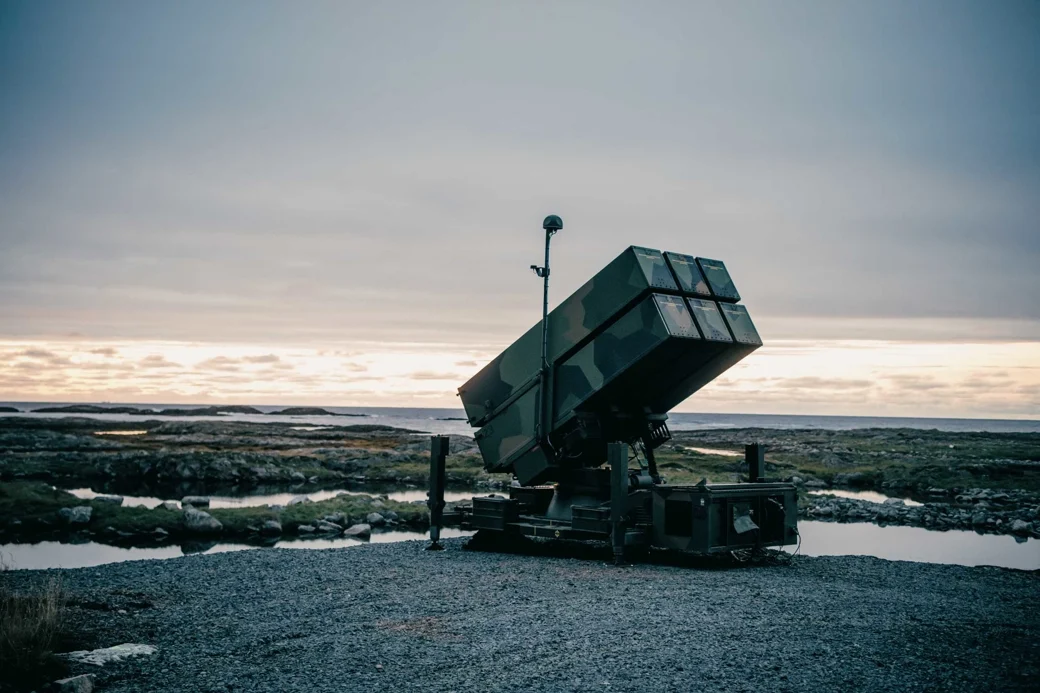
Kongsberg Gruppen signed a NOK 10 billion (roughly $1 billion) contract on September 29, 2026, to deliver the National Advanced Surface-to-Air Missile System (NASAMS) to Belgium, restoring a medium-range ground-based air defense (GBAD) capability the country has not fielded in roughly two decades. The Netherlands’ armed forces procurement authority, already a NASAMS operator, signed on Belgium’s behalf, with the Belgian Air Force as end user.
The award formalizes a decision announced at the NATO summit in Ankara, Türkiye, in July, when Belgium signed a cooperation agreement with the Netherlands covering 10 NASAMS fire units: nine for Belgium and one for Luxembourg. “After twenty years without one, Belgium will rebuild its own powerful air defense capability with this joint purchase,” Defense Minister Theo Francken said. Kongsberg President and CEO Eirik Lie welcomed Belgium “to the family of NASAMS nations.” The contract lands as European governments accelerate air defense spending after repeated drone incursions along NATO’s eastern flank.
Inside the NASAMS Air Defense Architecture Belgium Is Buying
NASAMS is a networked short- to medium-range system built around three elements: sensors, the Fire Distribution Center (FDC) command-and-control node, and canister launchers. Publicly available specifications indicate the Raytheon AN/MPQ-64F1 Sentinel X-band radar provides 360-degree coverage with an instrumented range of up to 120 km and can track more than 60 targets, while passive electro-optical/infrared sensors allow engagements without radar emission. Each launcher carries up to six missiles, and the FDC can control launchers dispersed well away from the radar, complicating enemy targeting and suppression.
The system’s defining feature is effector flexibility. NASAMS fires the AIM-120 AMRAAM, the active radar-guided missile carried by NATO fighters, from the ground. Open-source figures place the baseline ground-launched AMRAAM’s reach at roughly 25 km. The AMRAAM-Extended Range (AMRAAM-ER) mates the AMRAAM guidance section with the rocket motor of the RIM-162 Evolved Sea Sparrow Missile, delivering a 50 percent increase in maximum range and a 70 percent increase in maximum altitude, according to its manufacturers, or about 40 km of reach per publicly quoted figures. The infrared-guided AIM-9X Sidewinder Block II adds a short-range passive option against low, maneuvering targets such as drones and helicopters.
For Belgium, that mix matters more than raw range. The government has framed the requirement around missile, helicopter, and drone threats to fixed sites, including nuclear facilities and the Port of Antwerp-Bruges. Prime Minister Bart De Wever said in March that at least one battery would protect Antwerp, with entry into service expected in 2027. NASAMS has defended the US National Capital Region since 2005 and has been in operational use in Ukraine since late 2022.
Kongsberg did not disclose the number of fire units, radar configuration, or interceptor mix covered by the contract. European operators have typically ordered AMRAAM-family interceptors through separate US government sales, and Belgium has not yet detailed its missile buy.
How the Dutch Framework Accelerates Belgium’s Air Defense Rebuild
Routing the purchase through The Hague is the central programmatic choice. Belgium is buying on the back of CITADEL, the Dutch air defense program under which Kongsberg signed a contract in 2024. On the same day as the Belgian award, Kongsberg announced a separate Dutch order worth about NOK 1.5 billion that adds NOMADS mobile short-range air defense systems and expands Dutch NASAMS capacity. A shared contracting vehicle lets Brussels skip a standalone tender and aligns both countries on software, training, and maintenance, the stated rationale for the framework.
NASAMS is one layer of a package worth more than €3 billion that Francken announced in Ankara. It also includes 20 Rheinmetall Skyranger 30 gun systems, 14 Thales Ground Master 200 (GM200) radars, and Iveco trucks. Concepts presented in March envisage static Skyranger 30s protecting NASAMS sites, cued by GM200 radars. Belgium is separately studying a long-range layer such as Patriot.
Belgian press reporting had estimated the NASAMS share at about €1.2 billion ($1.37 billion), above the roughly $1 billion now contracted with Kongsberg. Interceptors, infrastructure, and support outside Kongsberg’s scope may explain the gap, but neither government has published a breakdown. To bridge the period before deliveries, Belgium plans to lease a minimum NASAMS capacity from Kongsberg starting in 2027, according to Belgian reporting.
Industrial return is also in motion: at the Brussels European Defense Exhibition and Conference (BEDEX) on March 12, 2026, Kongsberg signed letters of intent with three Belgian firms, including Sioen Industries and Feronyl, for camouflage, electronics, and components.
Analysis: Belgium’s order creates a Benelux NASAMS bloc sharing a contracting vehicle, a logistics chain, and a common air picture, strengthening NATO integrated air and missile defense in a rear area that hosts the Alliance’s headquarters and one of its main reinforcement ports. The binding constraint is no longer hardware selection but force generation. A country without GBAD units for two decades must now recruit and train radar operators, fire control crews, and maintainers, while competing with fighter fleets and Ukraine for AMRAAM production slots. Missile supply, not launcher delivery, will determine how quickly the Belgian Air Force fields credible magazine depth.
The next milestones are the interim lease and the first Antwerp battery, both targeted for 2027. Still undisclosed are the full delivery schedule, interceptor quantities and procurement route, arrangements for Luxembourg’s fire unit, and the outcome of Belgium’s long-range air defense study. Those answers will decide how fast Belgium’s rebuilt air defense arm reaches operational depth.