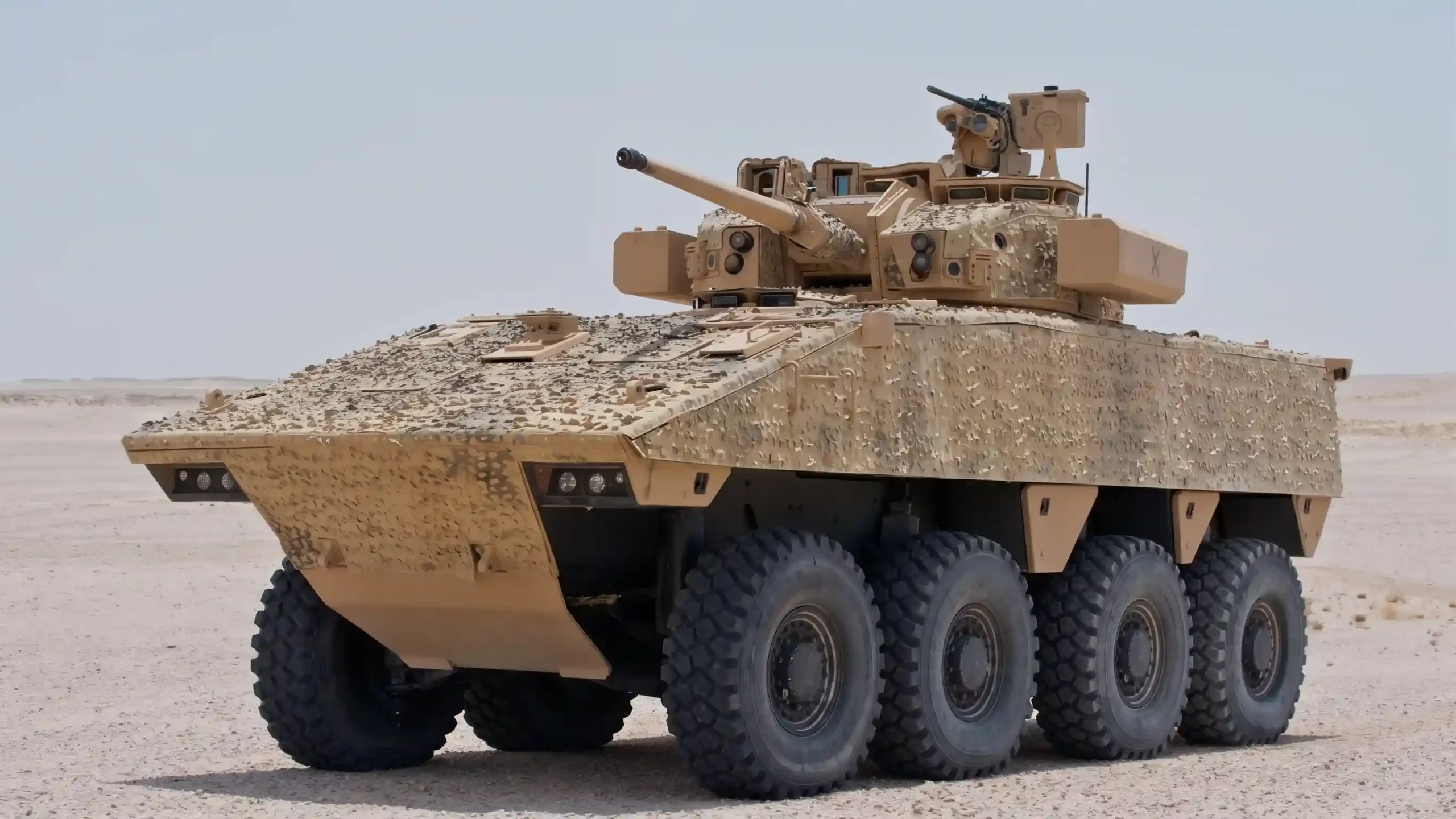
The VBCI (Véhicule Blindé de Combat d’Infanterie, or armored infantry combat vehicle) is the French Army’s 8×8 wheeled infantry fighting vehicle. Developed by GIAT Industries, now KNDS France, with Renault Trucks Defense, now Arquus, it entered service in 2008 to replace the tracked AMX-10P. The Army took delivery of 630 vehicles, 520 infantry fighting vehicles and 110 command posts, with final deliveries in 2015.
The platform is back on the agenda. France’s draft 2027 finance bill envisages €260 million to launch the first increment of a VBCI mid-life renovation, now a standalone major program. On October 21, 2026, during President Emmanuel Macron’s visit to Doha, Qatar signed a letter of intent selecting KNDS France and Belgium’s John Cockerill Defense, according to the joint French-Qatari statement, with French reporting citing several hundred VBCI Mk2 vehicles.
VBCI Infantry Fighting Vehicle Design, Protection and Mobility
The VBCI uses a conventional layout: driver and powerpack at the front, a one-man turret in the center and a troop compartment with a rear ramp. It carries a driver and a gunner plus a nine-soldier combat group whose leader also commands the vehicle, 11 personnel in all.
The welded aluminum hull carries modular THD steel and titanium armor that crews can replace in the field. Publicly available specifications indicate all-round protection against 14.5 mm armor-piercing rounds and 155 mm shell fragments. The original vehicle was rated at 29 tonnes gross weight. After Afghanistan, the Directorate General for Armament (DGA) funded mine, IED and rocket protection for 95 vehicles, lifting the ceiling to 32 tonnes with reworked transmission and running gear. The DGA qualified this version on September 24, 2014, after 18 months of trials covering 25,000 km; empty weight rose by only 200 kg.
A Renault six-cylinder in-line diesel rated at 550 hp (410 kW) drives an automatic gearbox. Published figures give a road speed of 100 km/h, an unrefueled range of 750 km and an unprepared fording depth of 1.2 m. The vehicle fits in the Airbus A400M Atlas.
Those numbers define its niche. The VBCI can road-march hundreds of kilometers with a full squad aboard and arrive ready to fight, which is what France’s expeditionary model demanded. Heavier tracked infantry fighting vehicles accept lower strategic mobility in exchange for greater armor mass.
Dragar Turret, 25mm M811 Cannon and VBCI Variants in French Service
The infantry fighting variant, the VCI, mounts the one-man Dragar turret. Its stabilized, dual-feed 25 mm M811 cannon fires NATO-standard ammunition at about 400 rounds per minute, with 150 ready rounds, alongside a coaxial 7.62 mm machine gun. The turret carries no anti-tank guided missile, so anti-armor fires rest with dismounted teams armed with the MBDA Akeron MP medium-range missile. The command post variant, the VPC, replaces the turret with a remotely operated 12.7 mm machine gun and carries command workstations and radios.
The fleet has worked hard. VBCIs deployed to Afghanistan, Lebanon, Mali and the Central African Republic, and they have rotated through NATO forward presence missions in Estonia and Romania. In 2020, 22 vehicles were held out of the inventory awaiting regeneration after operational wear far exceeded forecasts, according to French parliamentary reporting. On October 14, 2025, the Army’s land equipment support agency, SIMMT, notified the first hybrid support contract, awarded to KNDS France and Arquus and covering 627 of the 630 VBCIs delivered.
The weak point is firepower. The 25 mm caliber was chosen when the program was specified in the 1990s, before drones and heavier infantry fighting vehicles reshaped the close fight. Greater lethality is the first requirement units raise for the renovation, according to Forces Operations Blog, which notes that the budget documents do not yet detail its target fleet or scope.
VBCI Mk2 and Philoctetes: Export Variants for Qatar and Greece
The VBCI Mk2, first marketed as the VBCI 2, is the export evolution. According to KNDS, it is designed for a combat weight of up to 32 tonnes, with an empty weight of 19 tonnes, a payload of up to 13 tonnes and a 600 hp diesel driving a 7+2 automatic gearbox. Its modular armor is rated against up to 30 mm APFSDS rounds. KNDS offers an open weapons fit, from 12.7 mm, 20 mm and 25 mm remote weapon stations and the one-man 25 mm turret to 30 mm, 40 mm CTA and 105 mm turrets, with mortar and anti-tank missile options. Variants include an armored personnel carrier, a 105 mm armored fighting vehicle, a 120 mm self-propelled mortar, a command post, an ambulance and a recovery vehicle.
The VBCI has yet to win an export order. The British Army trialed it before selecting the Boxer for its Mechanised Infantry Vehicle program in 2019. Qatar signed a letter of intent for 490 vehicles on December 7, 2017, then valued at about €1.5 billion, which never became a contract. Qatar’s new letter of intent pairs the KNDS hull with a John Cockerill Defense turret whose model has not been disclosed; the same week, Cockerill displayed a VBCI fitted with its 30 mm 1030 turret at Milipol Qatar in Doha. La Tribune reported a three-month exclusive negotiation window and a program of 489 vehicles in batches of 389 and 100, figures the joint statement does not confirm. Doha is already receiving Boxer RCT30 vehicles.
In Greece, KNDS offers the Philoctetes, a VBCI Mk2 fitted with a remotely operated 40 mm turret and an Akeron MP anti-tank missile pod. The proposal covers 200 new infantry fighting vehicles, 50 specialized variants and 120 vehicles from French Army stocks. On April 7, 2025, KNDS France and Greek group METLEN announced an exclusive partnership for hull production in Volos. No Greek order has been announced.
Analysis: The renovation and the export campaign are linked. France needs more lethality from hulls with years of service left, while KNDS needs a production customer to turn Mk2 improvements into an active line rather than a catalogue. A firm Qatari or Greek order would put Mk2 subsystems back into series production and lower the risk of the French upgrade. Without one, a €260 million first increment, if applied across the fleet, points to a targeted firepower fix rather than a rebuild to Mk2 standard.
Parliament must first adopt the 2027 finance bill. The renovation’s target fleet and scope must then be defined before the first increment is launched, with the Army’s roadmap expecting effects beyond 2035. In Doha, the reported exclusivity window would close around January 2027, and La Tribune’s sources consider a contract unlikely. Athens has yet to order the Philoctetes.