Lithuania and Denmark have signed agreements to acquire the BLOCKER influence sea mine from Finnish manufacturer FORCIT, adding two more navies to a Finland-led joint procurement aimed at rebuilding allied Baltic Sea minelaying capacity. Lithuania’s Defence Resources Agency under the Ministry of National Defence announced its contract on November 4, 2026, and the Danish Ministry of Defence’s Materiel and Procurement Agency (FMI) announced its own agreement on November 5, 2026. Neither government disclosed quantities, contract values, or delivery schedules.
Both purchases run through the Naval Mines Cooperation (NMC), launched in July 2024 with a letter of intent signed by nine Baltic Sea region defense ministers. A ten-nation framework arrangement, adding Belgium, followed in October 2025. On June 25, 2026, the Finnish Defence Forces Logistics Command signed the NMC Fast Track Main Contract with FORCIT for an initial five buyers: Finland, Germany, Denmark, Lithuania, and Norway. Finnish authorities valued that agreement at hundreds of millions of euros. The new signatures are national agreements concluded within that framework.
Inside the BLOCKER Naval Mine: Warhead, Sensors, and Laying Options
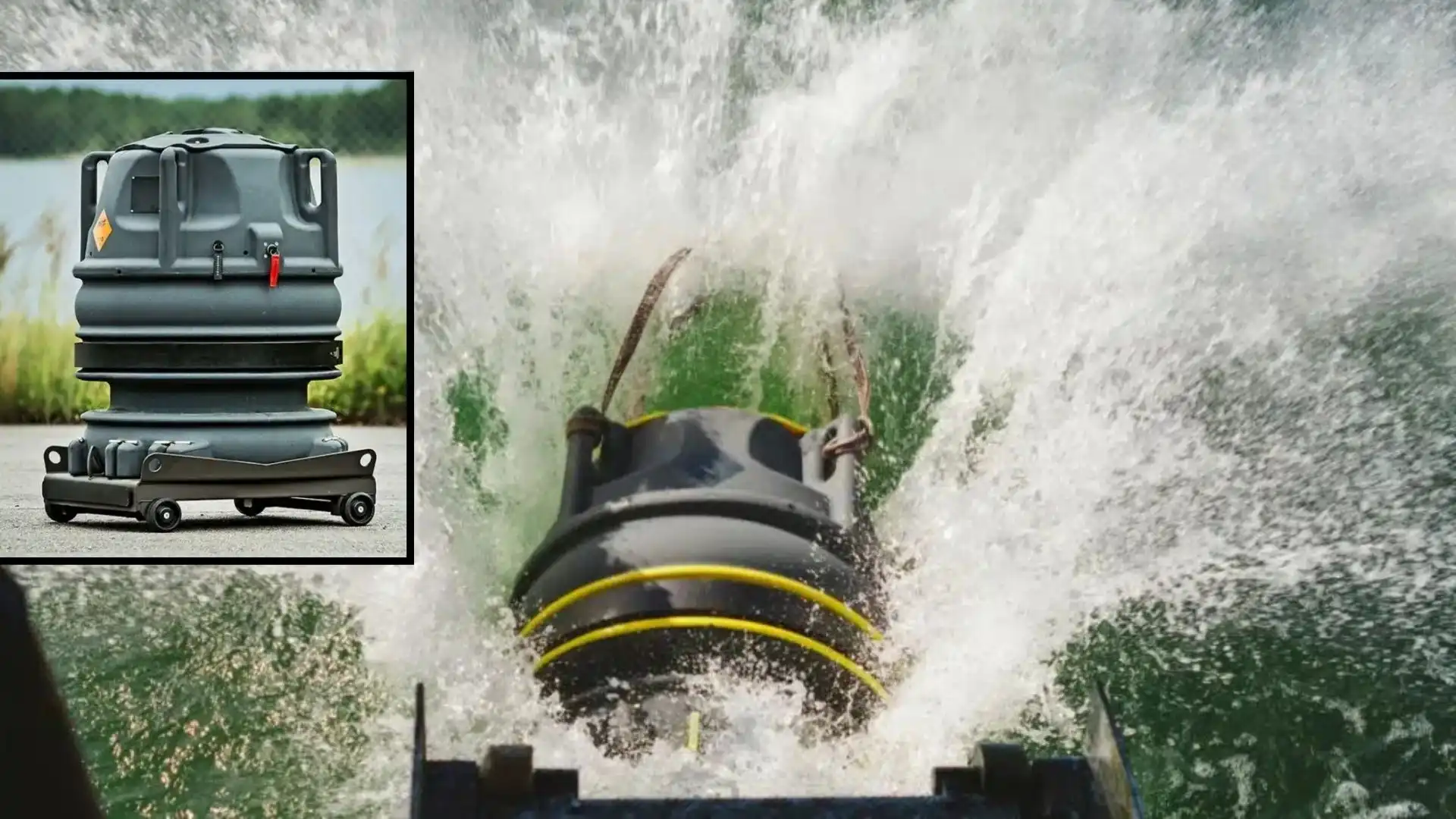
BLOCKER, designated PM16 in Finnish Navy service, is a seabed-deployed influence mine suited to the shallow, cluttered waters of the Baltic littoral. Publicly available specifications indicate a main charge of 560 kg of FORCIT’s Foxit plastic-bonded explosive, initiated by an FPX R1 booster. FORCIT rates the warhead at more than 1,000 kg of TNT equivalent, and open-source references cite up to 1,260 kg once the bubble effect is factored in. Foxit is certified as extremely insensitive under NATO STANAG 4439, which eases peacetime storage and handling aboard non-specialist vessels. FORCIT data give a gross weight of about 750 kg, of which roughly 600 kg is net explosive quantity.
The mine’s effectiveness rests on its target detection system as much as on its warhead. The sensor suite combines acoustic, magnetic, pressure, and inertial channels, with underwater electric potential (UEP) and photonic sensors offered as options. Detection and firing logic runs on freely programmable algorithms, which the manufacturer says allows navies to discriminate between target types and build in resistance to sweeping and other countermeasures. According to open-source reporting, the sensors also give exercise rounds a secondary role: Finland uses them to record the signatures of passing vessels, turning a training mine into a seabed intelligence collector.
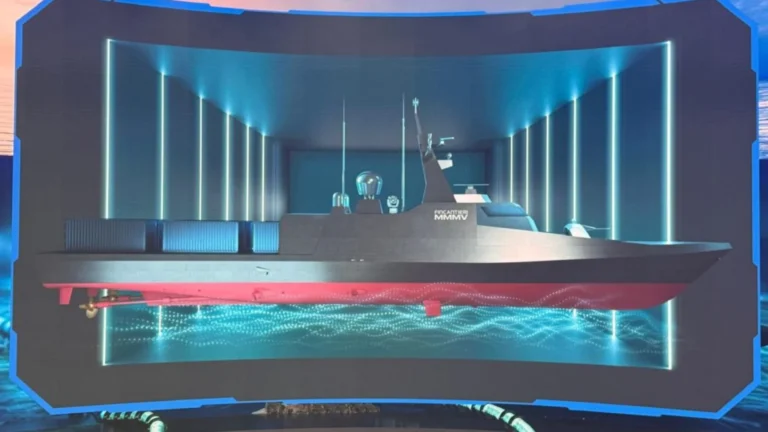
Deployment does not depend on a dedicated minelayer. FORCIT and partner DA-Group offer the SUMICO containerized system, whose standard 20-foot module holds 12 BLOCKER-sized mines, while Danish firm SH Defence markets its Cube laying system, built around a 20-foot launcher module. Any ship able to embark a standard container can therefore lay a minefield. Neither Vilnius nor Copenhagen has identified which platforms will lay their mines.
Common Configuration, National Algorithms: How the NMC Joint Buy Works
The NMC model replaces bespoke national requirements with a single baseline. According to FORCIT, the framework agreement rests on a common BLOCKER configuration across all participating navies to ensure interoperability and interchangeability, with each country then defining its own detection algorithms against its operational needs. In practice, a German, Danish, or Lithuanian mine should be logistically interchangeable while remaining tactically distinct. The cooperation also covers logistics, training, exercises, and lifecycle support, which Vilnius identified as core objectives across the systems’ service life.
Lithuanian Minister of National Defence Robertas Kaunas framed the purchase in coalition terms. “Naval mines are an important part of Lithuania’s defense, helping to ensure security in the Baltic Sea,” he said, noting that because Lithuania is not the only buyer, it will coordinate with allies and ensure interoperability. In Copenhagen, Captain Steen Balslev, head of FMI’s maritime division, said BLOCKER strengthens “Denmark’s maritime defense and our ability to solve tasks together with our allies.”
For Denmark, the agreement follows a March 2025 government decision to acquire several hundred sea mines, with deliveries then projected for 2027 to 2029. FMI did not say whether the new agreement covers that full quantity. A Danish Navy mine warfare specialist said in 2024 that the country’s remaining Cold War-era mine stocks needed updating, making BLOCKER a recapitalization rather than a new mission.
FORCIT says it already holds significant production capacity and that an investment program to expand it is progressing on schedule. Estonia, which bought BLOCKER under a separate national contract in 2021, is not part of the initial five-nation joint procurement.
Analysis: With quantities undisclosed, the structure of the buy is the real signal. By standardizing on one mine, one sensor architecture, and shared support arrangements, NMC members are assembling a pooled sea-denial inventory that can be laid from containerized modules rather than scarce dedicated minelayers. For Lithuania, the purchase extends seaward the counter-mobility logic it already applies on land, where Vilnius committed around €1.1 billion over 10 years in May 2025, mostly for antitank mines. For Denmark, the capability bears directly on the straits connecting the Baltic to the North Sea. With five navies on a common baseline, allied planners gain interchangeable stocks from the Gulf of Finland to the Danish straits, complicating the operational calculus for Russia’s Baltic Fleet in any crisis.
Key unknowns remain the size, value, and delivery timelines of both orders, and the platforms each navy will assign to lay them. Next indicators include first deliveries, Denmark’s 2027 to 2029 delivery window, and whether the five remaining framework signatories (Belgium, Estonia, Latvia, Poland, and Sweden) join a later procurement phase.