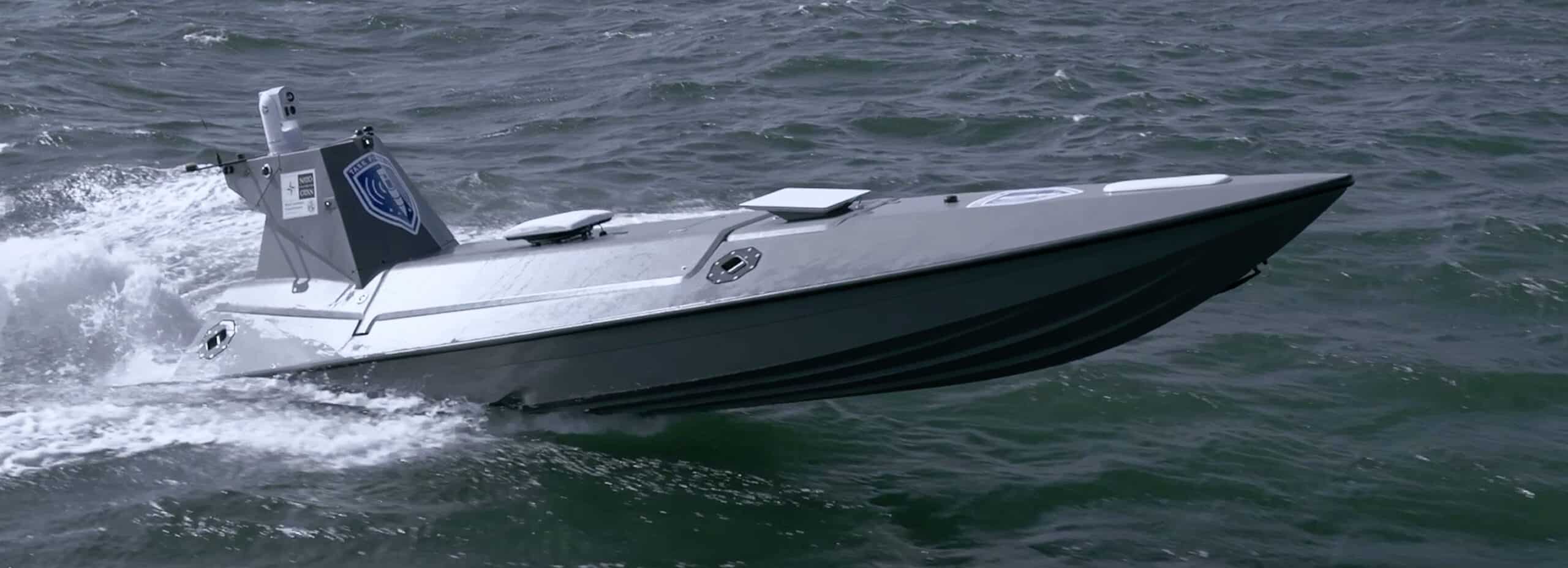
Shield AI and Kraken Technology Group have demonstrated two K3 SCOUT uncrewed surface vessels (USVs) operating as a single autonomous team under Shield AI’s Hivemind AI pilot, completing a coordinated intelligence, surveillance, and reconnaissance (ISR) mission in Portsmouth, U.K. The companies announced the result on September 28, 2026, and described it as Shield AI’s first maritime autonomy demonstration in the United Kingdom.
The trial follows the Royal Navy’s March 11, 2026, award of a £12.3 million Project BEEHIVE contract for 20 K3 SCOUTs, assigned to the Coastal Forces Squadron and 47 Commando Royal Marines as both operational craft and testbeds for the service’s Hybrid Navy concept. Kraken says all 20 boats have since been delivered. Portsmouth also comes two months after Hivemind’s first multi-asset teaming run on water, completed with Thunder Tiger SeaShark 600 and SeaShark 800 USVs in Pingtung, Taiwan, and announced on July 29, 2026.
How Hivemind Maritime Teaming Ran the Portsmouth ISR Mission
According to Shield AI, Hivemind coordinated the two vessels’ search of a designated area using fused data from onboard radar, cameras, and the Automatic Identification System (AIS). After detecting and classifying a vessel of interest, the software directed both USVs to track and escort the contact out of the operating area, then replanned the mission and returned the pair to search.
The operational argument is about manning. Shield AI says Hivemind removes the need for one operator per vessel plus additional personnel to manage onboard sensors, allowing multiple platforms to share sensor data and adapt the plan together while humans retain decision authority. “Hivemind pushes operator intent directly into an autonomous USV team,” said Christian Gutierrez, senior vice president of Hivemind at Shield AI.
Key parameters remain undisclosed: the trial date, sea state, mission duration, the number of supervising operators, the communications architecture, and whether the boats faced jamming or degraded GPS, or whether the vessel of interest was a cooperative target.
K3 SCOUT Specifications and Its Role in Project BEEHIVE
Kraken, a British firm founded in 2020 with roots in offshore racing, lists the K3 SCOUT at 8.4 m in length, 1.93 m in beam, and 0.8 m in draft, with a maximum displacement of 2,500 kg. A composite hull and an inboard diesel with stern drive deliver a top speed of 55 knots and a published range of 650 nautical miles at 25 knots, and up to 30 days of endurance depending on mission. Modular bays carry a 600 kg payload that Kraken says can be re-roled for ISR, logistics, search and rescue, survey, strike, or electronic warfare.
Those figures describe a fast littoral asset rather than an ocean-going picket: quick enough to close on a contact, small enough to launch from shore in numbers, with sensing reach set by the payload fit. Kraken’s specifications also list the Auterion operating system and open interfaces to third-party autonomy. Neither company has explained how Hivemind integrates with that stack, a key question for navies seeking hull-agnostic autonomy.
“K3 SCOUT was designed to be a fully modular and interoperable capability,” said Mal Crease, Kraken’s chief executive and founder. Portsmouth was a company-led demonstration, however, and no Royal Navy or Ministry of Defence contract for Hivemind on the K3 SCOUT has been announced.
Analysis: The Portsmouth run matters less as a technical milestone than as an industrial signal. Shield AI has now shown the same teaming behavior on Taiwanese and British hulls within two months, reinforcing its case that mission autonomy should be bought as a portable software layer, separate from the boat. For a Royal Navy already operating 20 K3 SCOUTs while managing constrained hull numbers and crewing, that decoupling offers a route to wider sensor coverage without adding watch standers. The unresolved test is whether two-boat demonstrations scale to contested, jammed, multi-vessel operations.
Shield AI and Kraken plan joint trials in contested environments with U.K. and NATO partners over the coming year, without naming dates, exercises, or participating nations. Kraken, which reports a $175 million Series B round at a $1 billion valuation, claims each of its facilities can produce up to 1,000 units a year. The milestone to watch is whether a Hivemind-equipped K3 SCOUT moves from demonstration into a funded requirement.