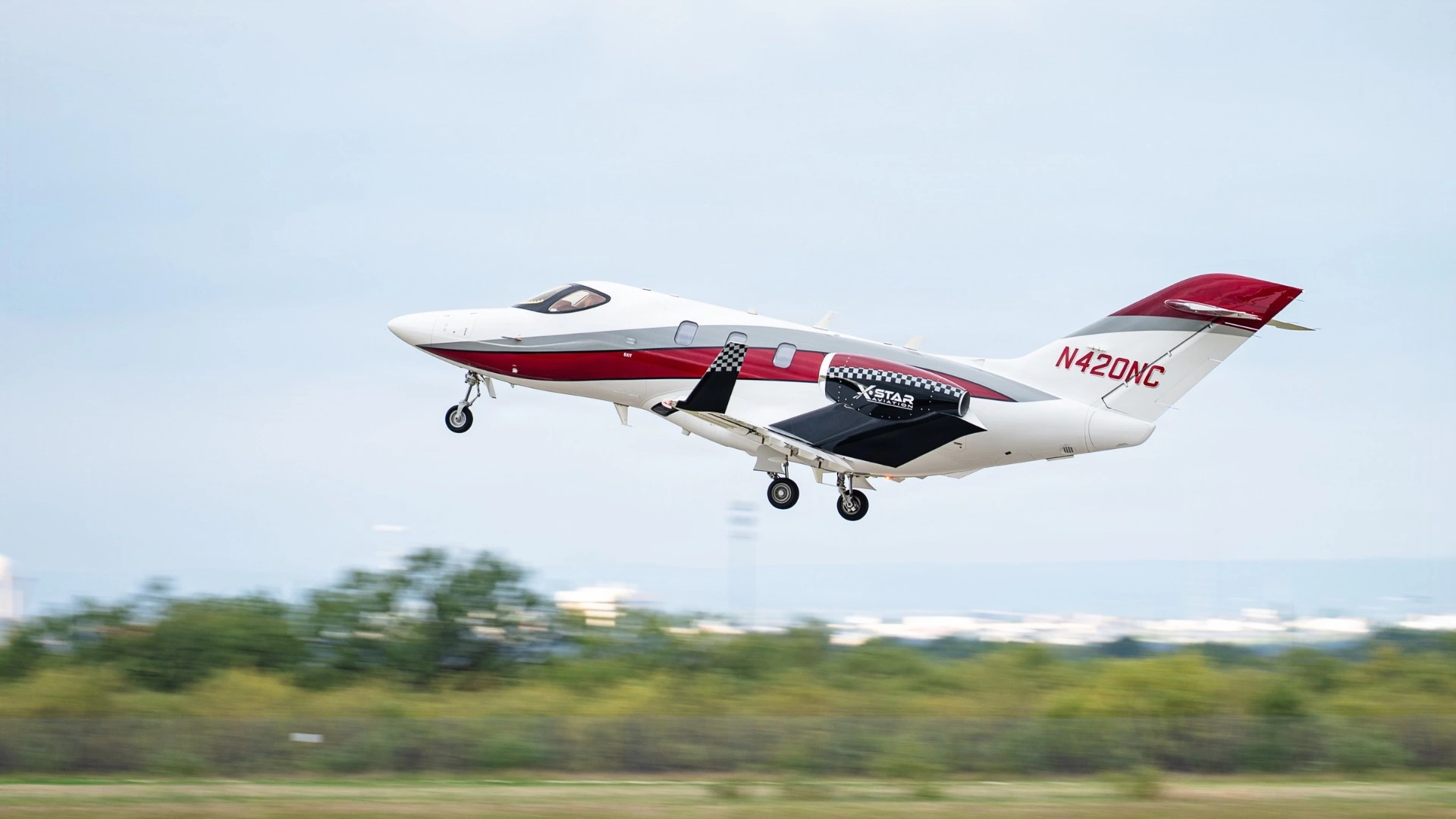
Air Force Global Strike Command (AFGSC) has begun flying B-1B Lancer pilots in contractor-operated HondaJet light business jets from Abilene Regional Airport, Texas, under a new B-1B pilot training effort called the Bomber Supplemental Trainer for Aircrew Readiness (BSTAR). A pilot from nearby Dyess Air Force Base flew the inaugural military training sortie on November 2, 2026, and the command formally launched the initiative two days later, with AFGSC commander Gen. S.L. Davis and Maj. Gen. Ty Neuman, commander of Eighth Air Force and the Joint-Global Strike Operations Center, flying as observers.
BSTAR targets a structural readiness problem. The Air Force now operates 44 B-1Bs, a fleet cut by roughly a third since 2021, while operational demand on the bomber remains high, including heavy employment during Operation Epic Fury. Fiscal Year 2027 budget documents plan $342 million in B-1B upgrades over 2027 to 2031 to keep the aircraft relevant through 2037. Every hour flown on an aging Lancer competes with maintenance capacity, airframe life, and the minimum flying requirements of the Ready Aircrew Program (RAP), which governs combat-ready status.
How BSTAR Reshapes B-1B Pilot Training at Dyess and Ellsworth
The initiative runs on a contractor-owned, contractor-operated (COCO) model. XSTAR Aviation supplies the aircraft, instructor pilots, maintenance, and scheduling, so the Air Force commits no additional B-1s and no military maintenance personnel. The prototype goal is approximately 100 additional flight hours per eligible pilot each year, equivalent to roughly four extra two-hour sorties per month.
The syllabus concentrates on foundational airmanship: instrument procedures, mission planning, aircraft handling, and crew resource management. It explicitly does not replace bomber-specific training. Aerial refueling, tactical employment, and weapons delivery remain tied to the B-1 itself, and the Air Force states that BSTAR flights do not reduce the requirement for bomber aircraft availability.
“Combat-ready aircrews are built on foundational airmanship, sound decision-making and time in the air,” Davis said, adding that the approach provides additional flying opportunities “at a much lower cost.” Neuman framed the payoff in operational terms: “BSTAR increases airmanship, which translates to safer, more effective and lethal B-1 operators, while preserving B-1 flight hours for our specialized, mission-specific training.”
Aircraft and personnel deployed to Abilene earlier this year, with positioning and validation flights in September and contractor instructor-pilot operations beginning in October. XSTAR plans to open a second site at Rapid City, South Dakota, in January 2027 to serve pilots of the 28th Bomb Wing at Ellsworth Air Force Base, giving the program coverage of both B-1 main operating bases. Every sortie is tracked and debriefed, and aircrew feedback will refine flight profiles and measure training effectiveness.
HondaJet HA-420 Specifications Versus the B-1B Lancer
Air Force imagery identifies the trainer as a HondaJet HA-420, a light twinjet powered by two GE Honda HF120 turbofans. Each engine delivers 2,095 pounds of takeoff thrust, mounted on pylons above the wings rather than on the aft fuselage. The current Elite II variant lists a maximum cruise speed of 422 knots, a ceiling of 43,000 feet, and a range of 1,547 nautical miles with four passengers and reserves, behind a Garmin G3000 glass cockpit. The Air Force has not disclosed which variant or how many airframes XSTAR operates.
The B-1B is a variable-sweep, four-seat strike aircraft powered by four afterburning General Electric F101-GE-102 engines, with a maximum takeoff weight of 477,000 pounds, according to the Air Force fact sheet. Nothing in the HondaJet cockpit replicates its flight controls, handling qualities, or offensive and defensive avionics.
That gap defines what BSTAR can and cannot deliver. Live flying in a jet exposes pilots to real weather, air traffic control workloads, and time-critical decisions that simulators reproduce only partially. It does not train mission systems, and, as a former B-1 pilot told The War Zone (TWZ), it offers little direct benefit to the two weapon systems officers in each B-1 crew. The return comes from cost: TWZ estimates HondaJet operating costs at $2,000 to $3,000 per flight hour, against roughly $90,000 for a B-1B hour, a ratio of more than 20 to 1 even at an assumed contracted rate of $4,000 per hour.
The $78 Million XSTAR Award and the Companion Trainer Lineage
The effort rests on a March 23, 2026, award notice listing XStar Inc. as recipient of an agreement worth up to $78 million, including base and option periods, titled Bomber Supplemental Trainer for Aircrew Readiness Production Other Transaction SBIR Phase III. Its scope extends beyond flight hours to curriculum development, performance data collection, training outcome evaluation, and airmanship trend tracking, all intended to inform a possible steady-state BSTAR Companion Trainer Program across AFGSC. XSTAR Aviation describes itself as a veteran-owned small business created as a subsidiary of SBCC following an AFGSC-led BSTAR study.
The concept is not new. B-2 Spirit pilots have long maintained proficiency in T-38 Talons, and T-37 and T-38 trainers previously supported B-52, F-22, KC-135, and U-2 crews. A 1981 Government Accountability Office report examined an Air Force proposal for a business-type Companion Trainer Aircraft for B-52 crews; it never became an operational program. BSTAR revives that logic without buying a fleet, and the contract can be expanded, recompeted, or terminated at the end of its period.
Analysis: BSTAR buys flight hours, not combat capability, and AFGSC appears to understand the distinction. Its value lies in protecting scarce Lancer sorties for the tasks only the bomber can train while keeping pilot fundamentals sharp at a fraction of the cost. The timing also points beyond the B-1, as TWZ has noted. Ellsworth is slated to become the first B-21 Raider main operating base, and a broader mission set for the new bomber will put a premium on airframe availability. A validated COCO trainer model would give the command a ready template for the Raider community.
The next milestone is the Rapid City expansion in January 2027. Key unknowns remain unpublished: the number of aircraft, the size of the eligible pilot pool, the contracted hourly rate, and the metrics AFGSC will use to judge whether BSTAR measurably improves RAP outcomes enough to justify a permanent companion trainer program.