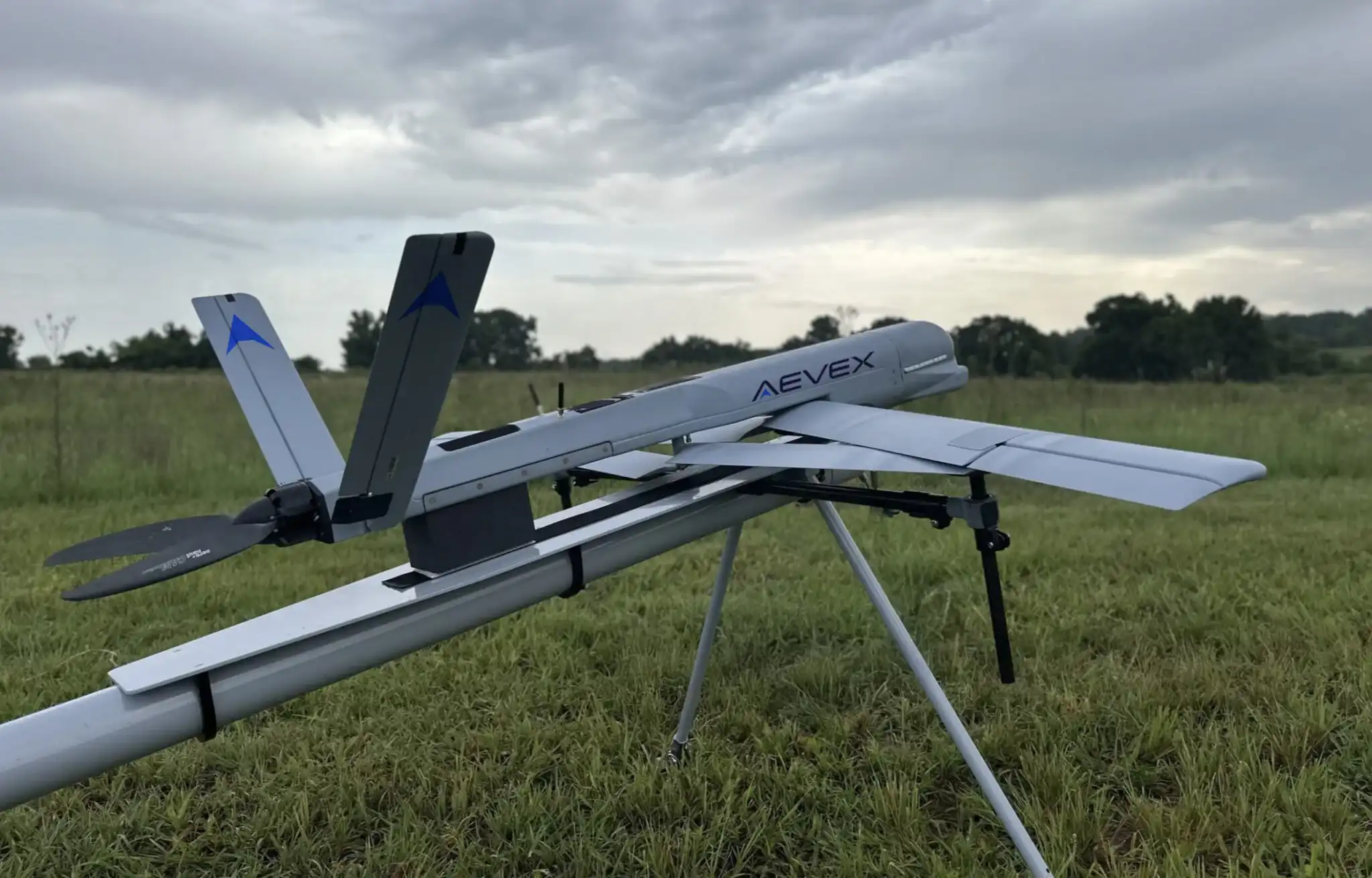
AEVEX Corp. has won an indefinite-delivery/indefinite-quantity (IDIQ) contract with a ceiling of nearly $400 million to supply unmanned aircraft systems (UAS) and associated support services to an unnamed U.S. customer, the Solana Beach, California, company announced on November 10, 2026. AEVEX did not identify the customer, platforms, quantities, period of performance or any initial task order.
The award is the largest AEVEX has announced since its shares began trading on the New York Stock Exchange under the ticker AVEX on April 17, 2026, and it arrives as the Department of War presses the services to buy attritable drones faster and in larger lots. That push is shaped by the war in Ukraine, where both sides launch thousands of one-way attack drones each month. AEVEX holds an unusual position in that market: it built the Phoenix Ghost loitering munitions the U.S. Air Force fast-tracked to Ukraine in April 2022, yet the airframes were not shown publicly until October 2024.
Inside the AEVEX IDIQ Contract: Ceiling, Scope, and Unknowns
An IDIQ ceiling is an upper limit, not obligated funding. The vehicle lets the customer issue task orders for hardware and services as requirements firm up, without running a new competition for each buy. The company’s own disclosure acknowledges the gap between ceiling and revenue: its forward-looking statement lists uncertainty about obtaining task orders under the contract as a specific risk.
According to the company, the framework covers unmanned aircraft systems and support services across a range of mission needs. Chief Executive Officer Roger Wells framed the award around production capacity and adaptability.
“This award deepens our role in helping customers field unmanned aircraft systems that can be manufactured at scale and adapted as mission needs evolve,” Wells said.
The release does not say whether this is a single-award contract or one position on a multiple-award vehicle, nor which contracting activity issued it. The scale is nonetheless material for a company that reported $433 million in revenue for 2025: the ceiling equals roughly nine-tenths of a full year of sales, spread across an unspecified number of years.
The opacity fits AEVEX’s recent record. On July 28, 2026, the company announced $88.1 million in production orders for long-range precision strike systems for unnamed U.S. government customers, and in August it disclosed a $41 million award for one-way attack systems without naming the buyer or the platform. Its U.S. Air Force awards have been more explicit, including $18.5 million in May for additively manufactured Group 3 one-way attack aircraft and $50 million on June 30.
What AEVEX Brings: Phoenix Ghost, Disruptor, and Specter Lines
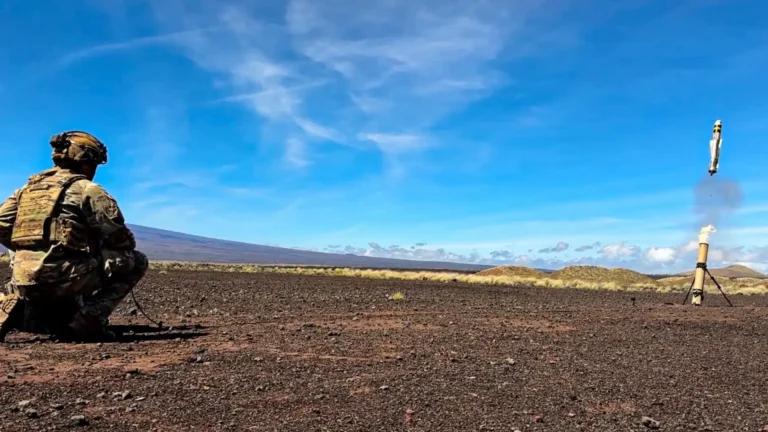
The release names no system, but the company’s portfolio defines what the customer can order. AEVEX markets eight precision strike designs, including Atlas, Disruptor, Dagger, Onyx and Sicario. The core of its strike business remains the Phoenix Ghost lineage, an umbrella effort that produced several airframes of different sizes rather than a single drone.
Disruptor sits at the top of that family. It is a Group 3 aircraft, the Pentagon class covering platforms under 1,320 pounds that operate up to 18,000 feet and below 250 knots. Company figures credit it with a range of up to 1,400 kilometers, more than 14 hours of endurance and a maximum takeoff weight of 83.9 kilograms, with a 22.6-kilogram payload in fragmentation or penetrator configurations. AEVEX has not published the mission profile behind the range figure. The U.S. Army publicly showed the type during Exercise Arcane Thunder 26, which ran April 6 to 29, 2026, with its unmanned systems portion at the National Training Center, Fort Irwin, California.
At the lower end, the Group 2 Atlas loiters for more than 70 minutes and pairs mesh networking with hardened satellite navigation, visual navigation and alternative positioning, navigation and timing (PNT). Resistance to GPS jamming is the common thread: AEVEX says Atlas tracks environmental features onboard to hold its position when GPS is denied, and the company acquired Veth Research Associates in October 2024 to strengthen navigation for contested and GPS-denied environments.
The newest entry is Specter, a turbojet-powered one-way attack aircraft announced on September 23, 2026, and developed with additive manufacturer Divergent Technologies. AEVEX plans ground-launched and air-launched variants with swappable payloads spanning kinetic effects, electronic warfare and intelligence, surveillance and reconnaissance (ISR). Production depth underpins the pitch. At its April 2026 IPO, AEVEX said it had delivered more than 5,000 one-way attack systems to the battlefield over the previous three years, and in September it announced new facilities in Florida and Virginia.
Analysis: The ceiling matters less than the vehicle. A multi-year IDIQ lets an unnamed customer move from evaluation to repeat production orders without a new source selection each time, which is the acquisition behavior the Department of War has demanded for attritable strike and ISR drones. For AEVEX, the award turns episodic order flow into a standing channel, but it guarantees nothing until task orders are issued and funded. The pattern also widens a transparency gap: a growing share of U.S. one-way attack drone spending flows through awards whose customer and platform are withheld, limiting outside scrutiny of unit costs and quantities.
The first indicators will be task-order announcements and AEVEX’s next quarterly results, where management may describe the vehicle’s expected contribution to backlog. A posting in the Department of War’s daily contract announcements could also reveal the awarding activity. Until then, the customer, the platforms in scope and the delivery schedule remain undisclosed.