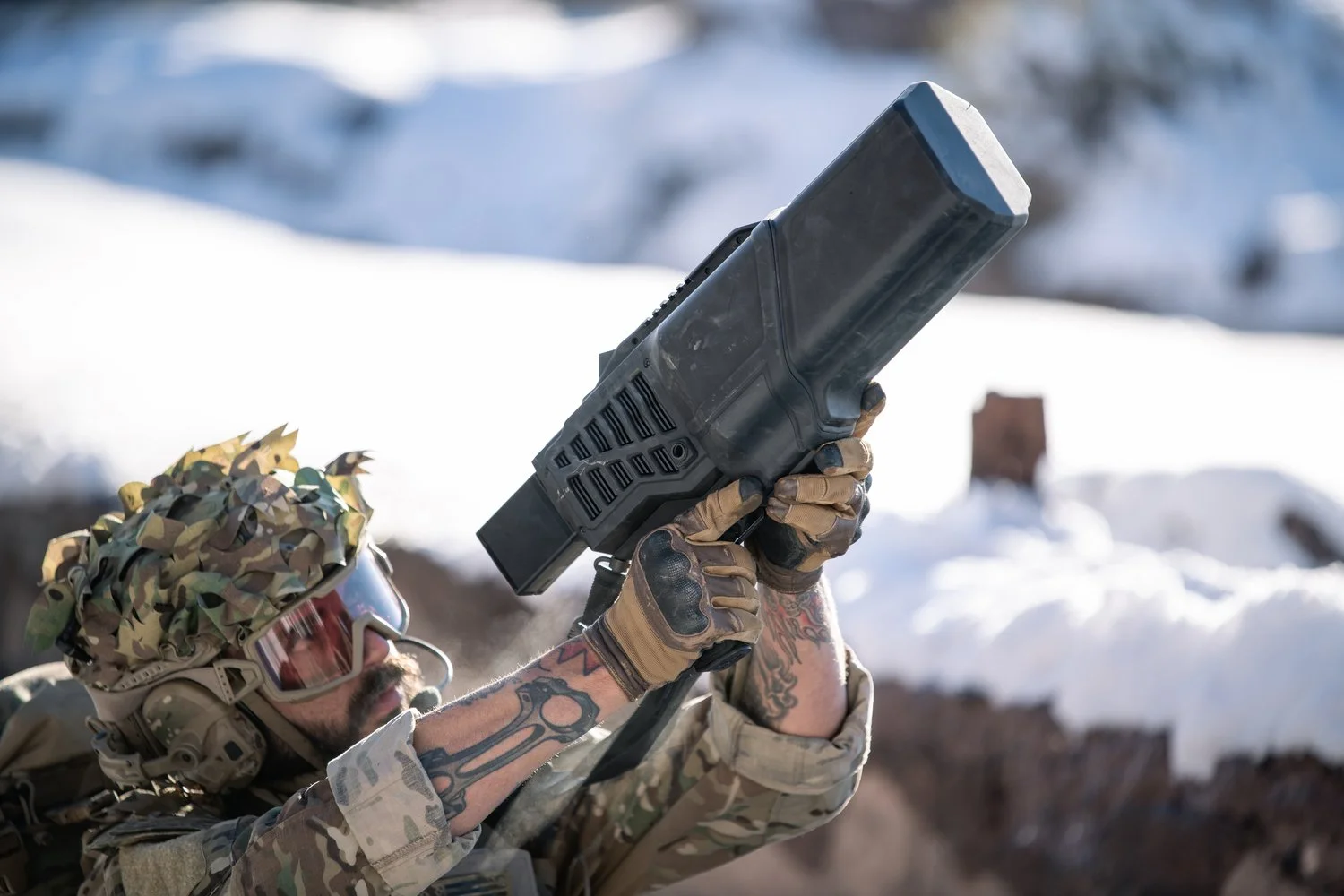
The US Air Force has opened a brand-name-only solicitation for command-and-control tablets, software licenses, batteries and chargers needed to operate DroneShield Immediate Response Kits (IRK) at Joint Base San Antonio (JBSA), Texas, after the 502d Security Forces Group (502 SFG) found that its latest kits lacked key components required to put them into service. The 502d Contracting Squadron published request for quotation FA301627Q0018 on November 10, 2026, with quotes due by 2:00 p.m. Central Time on November 17, 2026.
The order closes a gap in a counter-drone buy that began earlier this year. According to the redacted brand-name justification attached to the notice, the Air Force made two approved purchases in May and July 2026, under orders FA301626P0072 and FA301626P0129, for a total of three IRKs manufactured by DroneShield LLC, the US subsidiary of Australia’s DroneShield. The equipment is intended for all JBSA installations under Department of the Air Force Manual (DAFMAN) 31.102, which makes installation and unit commanders responsible for defending their sites against small unmanned aircraft systems (sUAS). When the final two kits arrived in October, the unit discovered the missing components. The justification does not say why they were missing.
What the DroneShield Immediate Response Kit Order Covers
The schedule lists four line items: six DS-887-932 dual-bay desktop chargers, two DS-121 DroneSentry-C2 Tactical rugged tablets built on Dell hardware, two annual DS-121-1 DroneSentry-C2 Tactical software licenses bundled with DroneShield’s Mission Ready Services support package, and six DS-666-109 batteries (CT-70716BV). Delivery is to JBSA-Randolph within a targeted 60 days of the order.
The IRK pairs two hand-carried systems in a single rugged case. The RfPatrol Mk2 is a wearable, passive detector that uses software-defined radio scanning and a continuously updated AI detection engine to identify drones and their remote controllers without emitting. The DroneGun Mk4 is a compact handheld effector that disrupts command, video and GNSS navigation signals across multiple RF bands. DroneShield’s published specifications list the DroneGun Mk4 at 3.37 kg (7.43 lbs) and the RfPatrol at 1.2 kg (2.6 lbs), both with battery, and the complete kit at 12.17 kg (26.83 lbs) in an IP67 case. The company does not publish detection or disruption ranges.
The DroneSentry-C2 Tactical tablet turns the handhelds into a networked node. Released in December 2023 after trials with the Department of Defense, it is a ruggedized edge version of DroneShield’s command-and-control software that networks DroneShield and third-party sensors on a single map-based display and can activate defeat systems where lawful. Without it, operators hold a detector and a jammer but no shared track picture.
TAK Integration and Legal Review Behind the Brand-Name Justification
The Air Force invoked RFO 11.204(a)(2)(ii), the brand-name provision of the Revolutionary FAR Overhaul. The requirement calls for passive RF detection, integration with the Team Awareness Kit (TAK), ease of use, mobility, and detection coverage across JBSA’s dispersed properties. The justification states that DroneShield is the only IRK source able to integrate with the required TAK because its system uses the Cursor on Target (CoT) message format. According to the justification, the product has been tested and approved for purchase by Air Education and Training Command (AETC) and AF/JAOI, the Air Force’s Air and International Law Division. DroneShield states that its disruption-capable products, including the DroneGun Mk4, are not authorized for sale or use in the United States except by the US government, its agencies and delegated representatives where permitted by law.
The procurement is a total small business set-aside under NAICS code 334511, with a 1,350-employee size standard, so authorized resellers rather than DroneShield will compete. Quoters must prove reseller authorization or be rated technically unacceptable. Award goes to the lowest-priced technically acceptable quote via a single firm-fixed-price purchase order. The notice discloses no estimated value, but the justification is filed under the authority for actions at or below the simplified acquisition threshold.
Analysis: The JBSA case shows that installation-level counter-UAS capability depends as much on command-and-control and sustainment items as on the effector. Three kits bought through two orders still required a third solicitation before security forces could operate them, and the deciding criterion in the justification is data integration, not jamming performance. Since CoT is a common government-developed format, the exclusivity claim rests less on the protocol than on a portable detect-and-defeat kit already wired into TAK. The buy also runs in parallel with a centralization push: on September 30, 2026, Joint Interagency Task Force 401 (JIATF-401) awarded DroneShield a Domestic Shield indefinite-delivery, indefinite-quantity contract with a $500 million ceiling over three years.
Quotes close on November 17, 2026, and the notice goes inactive on December 2, 2026. If the selected reseller meets the 60-day target, the components would reach JBSA-Randolph in early 2027. Open questions remain: how many IRKs JBSA ultimately plans to field across its installations, how the annual software license will be renewed, and whether the base’s handheld kits will feed into the wider domestic counter-drone architecture JIATF-401 is building.