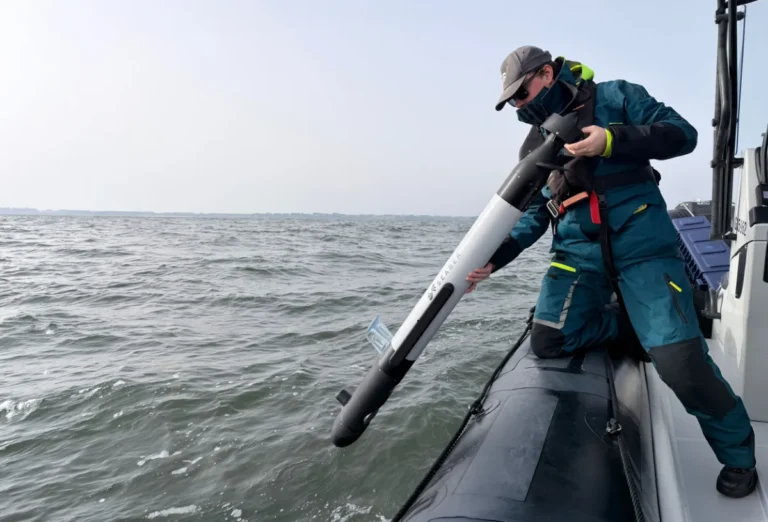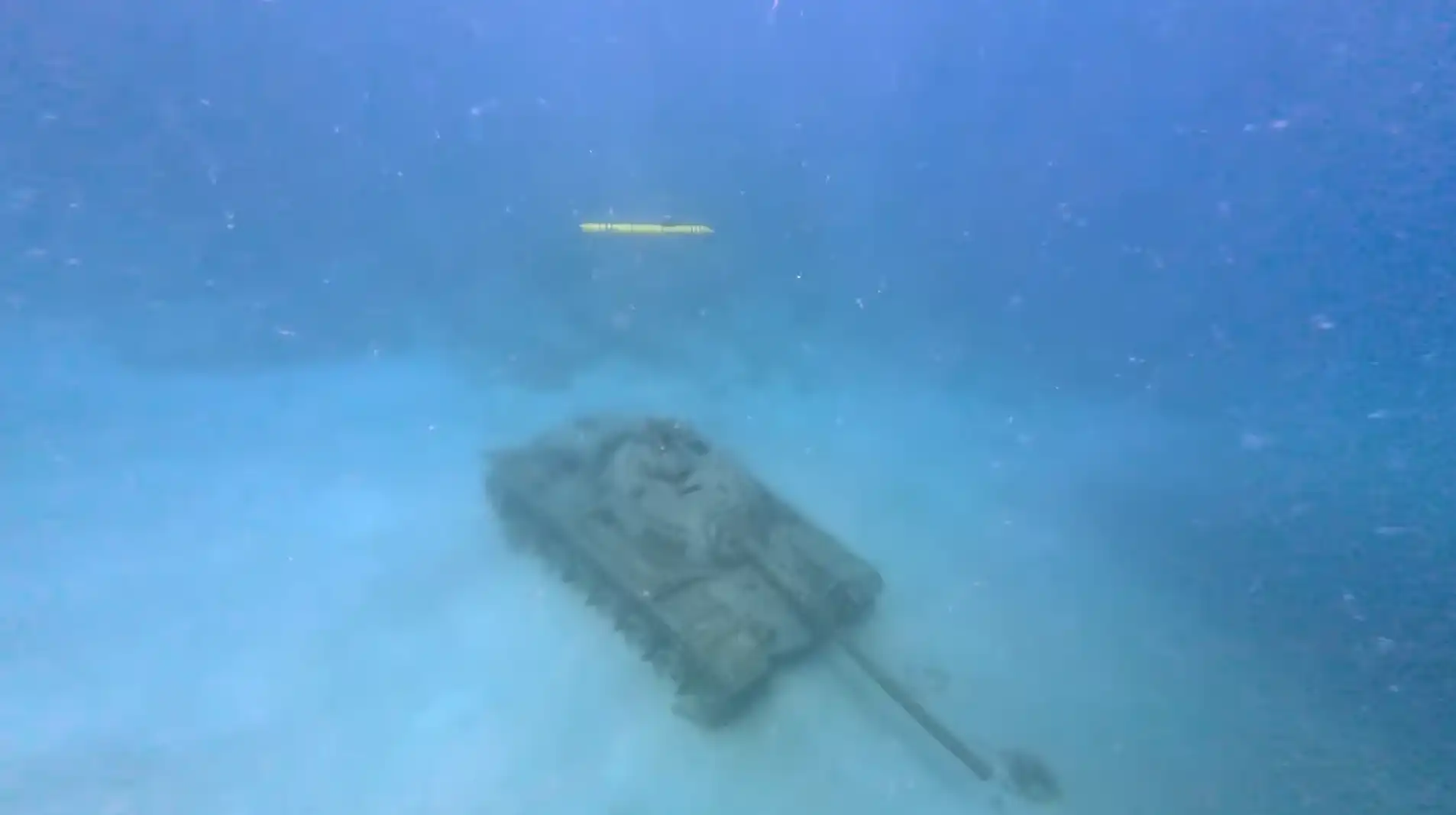
Turkish defense engineering firm STM Savunma Teknolojileri Mühendislik ve Ticaret A.Ş. (STM) announced on November 11, 2026, that its STM NETA 300 Autonomous Unmanned Underwater Vehicle (AUV) located and imaged a sunken tank during an autonomous reconnaissance mission near Güvercin Island, off Kaş in Antalya province, Türkiye. The company has not disclosed the date of the dive.
The tank, a former Turkish Armed Forces vehicle, was scuttled off Güvercin Island in 2017 at the end of its service life to create an artificial reef and support diving tourism. STM has not identified the tank model. The imaging run is a public demonstration, but it follows the vehicle’s participation in the TURNAs-2026 naval exercise in October and comes alongside a first domestic sales contract that will bring the AUV into Turkish Navy service.
STM NETA 300 Specifications: Depth, Endurance, and Sonar Suite
During the Kaş mission, the vehicle performed search and rescue, wreck detection and identification tasks, surveying the seabed with sonar and high-resolution imaging sensors in a Mediterranean area dense with wrecks.
STM NETA 300 is the first member of STM’s AUV family. Its compact, modular design allows two personnel to carry it. According to STM, the vehicle operates at depths of up to 300 meters, reaches a maximum speed of 5 knots and delivers up to 24 hours of mission endurance, depending on battery configuration. STM has not published length, weight, navigation or communications details.
Designed to support mine countermeasures (MCM) operations, the vehicle autonomously surveys suspected minefields with a Side Scan Sonar and a Gap Filler Sonar to detect, classify and identify mines and mine-like objects. Optional Synthetic Aperture Sonar (SAS) integration provides wider area coverage and higher along-track resolution.
TURNAs-2026 Mine Countermeasures Role and First Turkish Navy Contract
During TURNAs-2026 off Antalya, the vehicle supported advance force operations. According to STM, it autonomously detected and identified mines and mine-like objects along a transit route, contributing to the safe passage of main naval units. It also conducted underwater scanning as part of seabed warfare operations, covering critical infrastructure security and pipeline inspection.
Beyond MCM, STM lists Intelligence, Surveillance and Reconnaissance (ISR), Rapid Environmental Assessment (REA), Anti-Submarine Warfare (ASW), Explosive Ordnance Disposal (EOD) and port security among supported missions. Civilian applications include seabed assessments, pipeline and offshore renewable energy inspections, geophysical surveys and marine archaeology.
STM has signed its first domestic sales contract for the vehicle, which is set to enter Turkish Navy service. The company has not disclosed the contract value, the number of units or a delivery schedule.
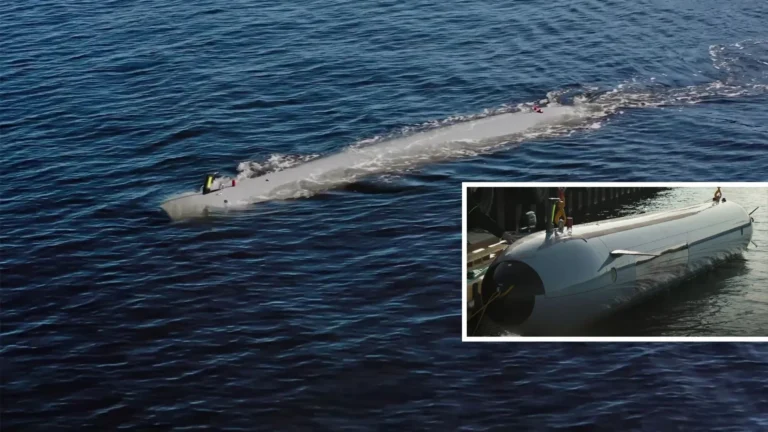
STM General Manager Özgür Güleryüz said the Mediterranean mission “demonstrates the capabilities of our underwater technologies in real-world operating conditions.” He described NETA 300 as the first platform in an expanding unmanned maritime family that now includes TENGİZ, an Extra Large Unmanned Undersea Vehicle (XLUUV), and STM YAKTU, a kamikaze unmanned surface vehicle.
Analysis: The sunken-tank imagery demonstrates sensing in a known wreck field; it is not an operational milestone. The more consequential facts are the TURNAs-2026 mine detection role and the domestic contract, which together show the Turkish Navy moving an indigenous small AUV toward MCM service. Alongside TENGİZ and YAKTU, NETA 300 gives STM a tiered unmanned maritime portfolio. For a NATO navy operating across the Black Sea, Aegean and Eastern Mediterranean, at a time when seabed infrastructure protection has gained priority across the Alliance, a domestically produced MCM and survey AUV reduces reliance on foreign suppliers for a capability in growing demand.
Key unknowns remain: contract value, quantity, delivery timeline and whether the Turkish Navy configuration includes the optional SAS. STM has also not stated when the vehicle will reach initial operational capability, or whether export marketing is underway. Those details will determine how quickly NETA 300 moves from demonstration to routine fleet use.