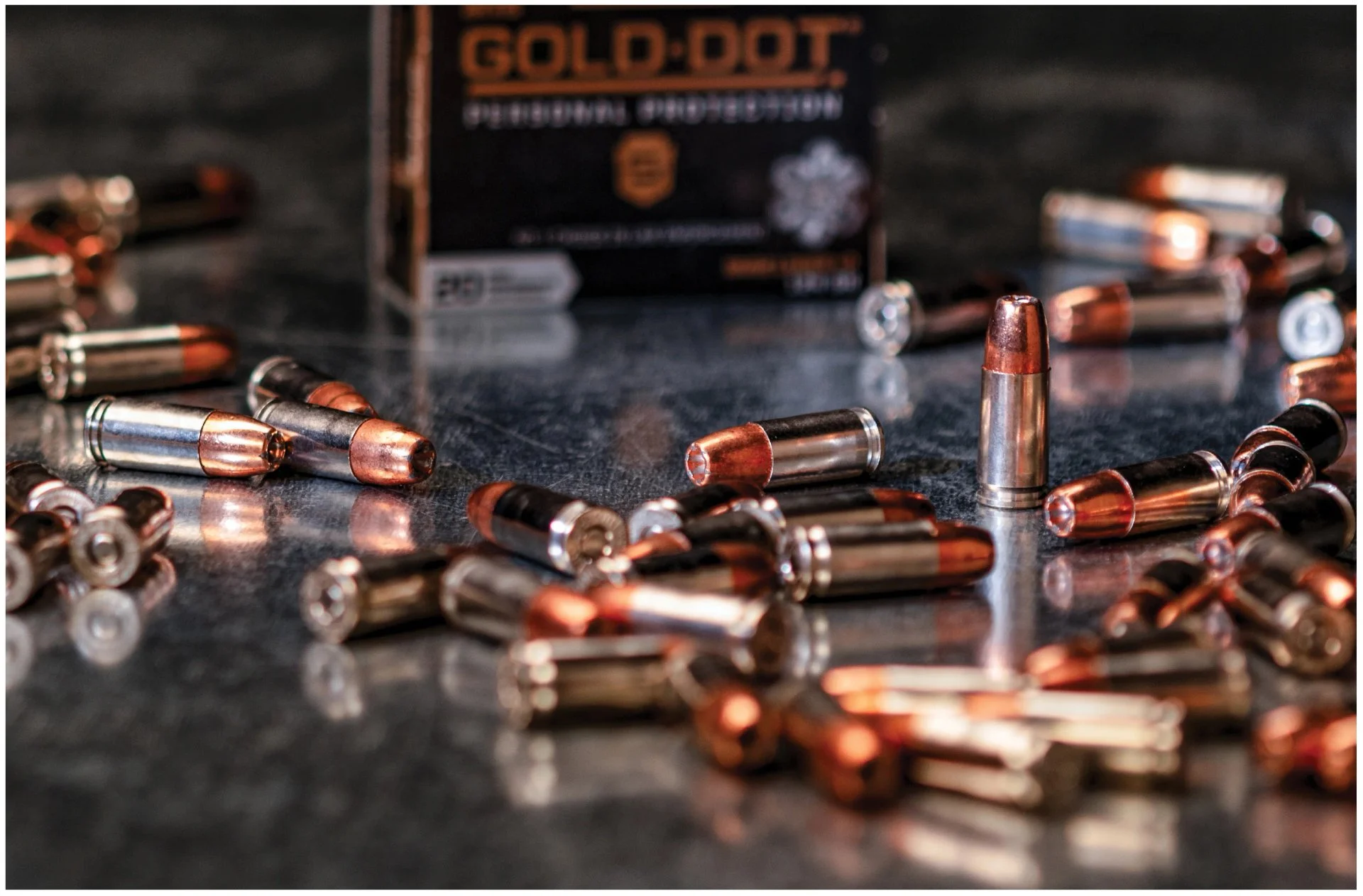
Speer Ammunition, a brand of The Kinetic Group within CSG Group, has won a contract to supply the Canadian Department of National Defence (DND) with up to 4.2 million rounds of 9mm Luger jacketed hollow point (JHP) ammunition over a period of up to three years, the company announced on November 12, 2026. The selected cartridge is the Speer Gold Dot G2 135-grain load, a bonded duty round built around an elastomer-filled nose. CSG did not disclose the contract value or the delivery schedule.
The award lands two weeks after Canada’s Auditor General concluded, in an October 29, 2026 report, that DND did not manage its ammunition inventory to meet its regular-use and strategic stockpile needs. It also extends a run of Canadian federal wins for The Kinetic Group, which CSG acquired from Vista Outdoor in 2024 and which owns Speer alongside the Federal, CCI and Remington ammunition brands. Federal announced a DND contract for 300 AAC Blackout duty and training rounds on August 6, 2026, after 2025 awards covering up to 10 million rounds for four federal agencies, including the Canada Border Services Agency (CBSA) and Correctional Service Canada.
Speer Gold Dot G2 135-Grain Load: Design and Ballistics
The Gold Dot G2 departs from conventional hollow point architecture. Instead of a deep open cavity, the bullet carries a shallow dish in the nose filled with a high-performance elastomer. On impact, the elastomer is driven into engineered internal fissures that start the expansion process, a mechanism Speer says produces uniform expansion, cleaner petal separation and more consistent penetration across barrier types. The design targets a known weakness of open-cavity hollow points: heavy clothing, drywall or sheet metal can plug the cavity, causing the bullet to behave like a full metal jacket round and overpenetrate.
The second element is the Gold Dot bonded construction. Publicly available manufacturer descriptions indicate the jacket is plated onto the lead core rather than formed as a separate cup, which Speer says virtually eliminates core and jacket separation. Retained weight matters for duty use, because a bullet that sheds its core loses mass and penetration depth after passing through intermediate barriers such as vehicle glass.
The 135-grain weight is itself a notable choice. Speer’s standard Gold Dot G2 duty load uses a 147-grain bullet; the 135-grain version was developed for the company’s Gold Dot Carry Gun line and optimized to reach expansion velocity from compact, short-barreled handguns. Publicly available specifications for the commercial 135-grain G2 load list a muzzle velocity of 1,120 feet per second and muzzle energy of 376 foot-pounds from a 4-inch test barrel. CSG described the cartridge as an advanced self-defense and duty load but did not say whether DND’s lot matches the commercial loading or a dedicated government specification.
C22 Pistol Fleet and DND’s Law Enforcement Ammunition Requirement
The Canadian Armed Forces (CAF) completed the initial delivery of 7,000 C22 pistols, the service designation for the SIG Sauer P320 full-frame modular pistol, in June 2023, retiring the Browning Hi-Power adopted in 1944. When DND awarded the pistol contract in October 2022, it specified that the C22 would use existing 9mm ammunition with ballistic performance similar to the Browning. The contract, held by distributor M.D. Charlton Co., carries options for up to 9,500 additional pistols for the Royal Canadian Air Force, Royal Canadian Navy and Military Police.
The announcement does not identify which DND organizations will receive the Gold Dot G2 rounds, but Speer’s own framing points toward a policing user. David Kline, Speer’s Director of Government Contract Engineering, said the award “reinforces the trust international law enforcement agencies place in our reliable, innovative products.” Within DND, the Canadian Forces Military Police, whose members hold peace officer status and police defence establishments, are the most likely recipients. Expanding ammunition carries legal weight in a military context: the Canadian Forces Code of Conduct forbids bullets designed to expand or flatten easily on contact with the human body, a prohibition that originates in the 1899 Hague Declaration and is now recognized as customary international law in armed conflict. Expanding bullets remain lawful in domestic law enforcement, which is why JHP use in Western forces is largely confined to policing and security duties. DND has not said whether the rounds will cover duty issue only or qualification training as well.
Analysis: The contract shows how Canada splits its small-arms ammunition supply. High-volume military calibres flow through the Munitions Supply Program, anchored by General Dynamics Ordnance and Tactical Systems Canada in Quebec, which is set to receive up to roughly C$1.06 billion of the C$1.4 billion Ottawa announced in March 2026 to expand domestic production, chiefly for 155mm projectiles, artillery charges and nitrocellulose propellant. Specialty law enforcement loads such as bonded JHP have recently gone to foreign commercial suppliers, and across 2025 and 2026 The Kinetic Group has won a string of Canadian federal duty contracts through its Speer and Federal brands. Ottawa gains proven off-the-shelf performance, but concentrates its specialty duty ammunition on a single US-based production chain owned by a group listed on Euronext Amsterdam since January 2026.
The next data points will come from Canada’s proactive disclosure of contracts above $10,000, which should eventually show the award value, and from delivery orders drawn against the 4.2 million round ceiling. Two further variables bear watching: how many of the 9,500 optional C22 pistols DND exercises for the Military Police and other services, and whether its response to the Auditor General’s six recommendations changes how the department forecasts regular-use ammunition demand.