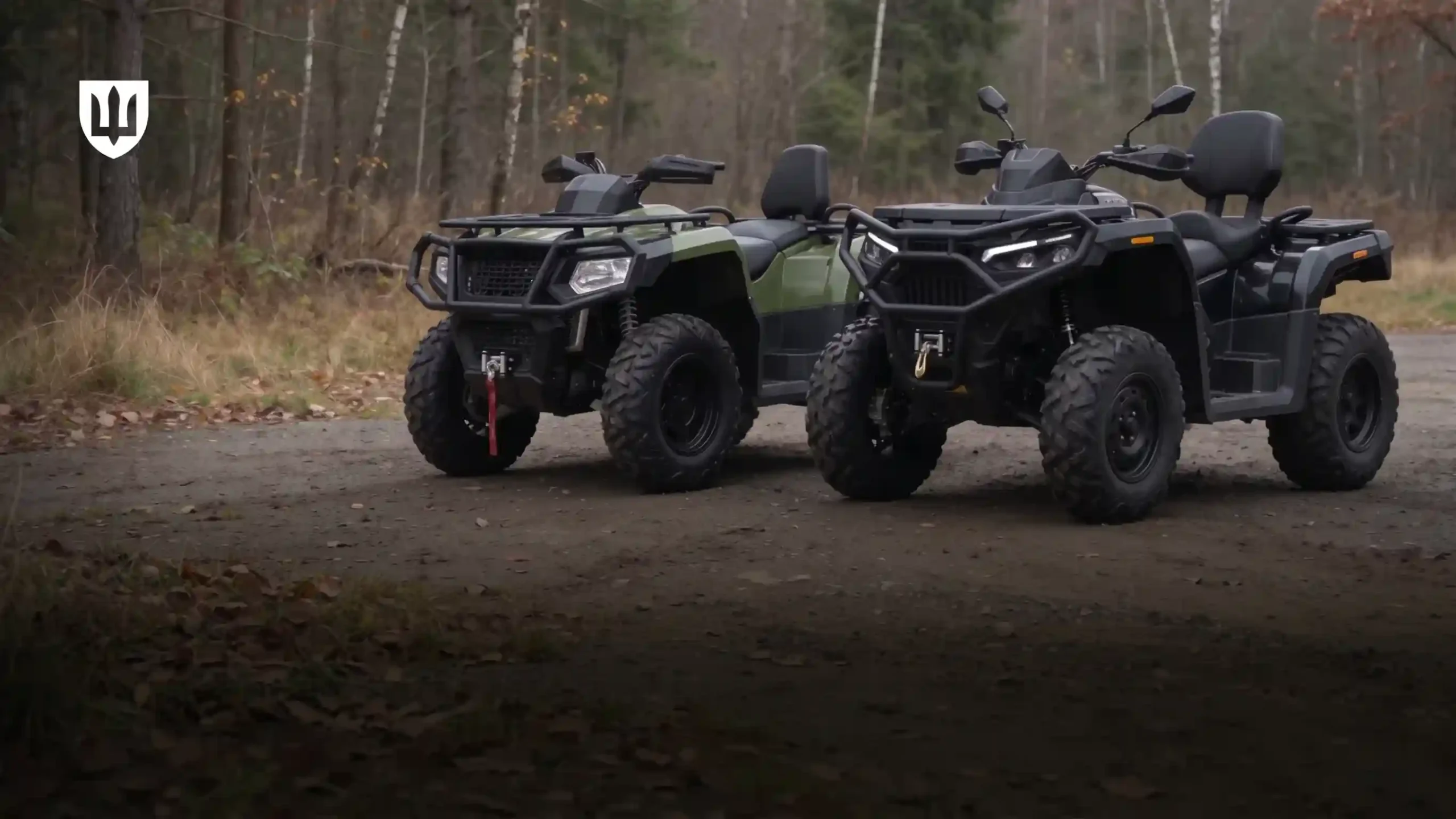
Ukraine’s Ministry of Defense announced on November 13, 2026, that its DOT Defense Procurement Agency has contracted more than 4,000 all-terrain vehicles (ATVs) for the Armed Forces of Ukraine this year, more than eight times the 500 units contracted in 2025. Combined with 1,500 motorcycles and more than 2,000 buggies ordered earlier in the year, the agency has now placed contracts for over 7,500 light vehicles across the three categories in 2026.
The announcement reflects a structural shift in how Kyiv equips units operating near the line of contact. Ukraine consolidated its lethal and non-lethal purchasing bodies into a single Defense Procurement Agency on January 1, 2026, folding the former State Logistics Operator (DOT) into one structure responsible for everything from ammunition to fuel and vehicles. Deputy Defense Minister Mstyslav Banik, appointed on March 25, 2026, to lead procurement reform, framed the light-vehicle surge as a direct response to frontline demand.
Ukraine ATV Procurement: Volumes, Tender Lots, and Delivery Timeline
The motorcycle tranche, signed in early June, tripled the previous year’s volume. The buggy order marked the first time the agency had contracted that vehicle class; the ministry described the units as all-wheel-drive platforms with selectable 4×4 and off-road tires, procured across 11 separate lots. The ATV buy completes the set.
According to the ministry, the agency ran the purchases as simplified procedures on Prozorro, Ukraine’s electronic public procurement system, and split them into almost 40 lots. The stated aim was to draw in a wider pool of manufacturers and force price competition between suppliers. Banik put the combined savings across the three vehicle types at more than UAH 3.2 billion, roughly $71 million at the National Bank of Ukraine’s mid-November exchange rate.
We are increasing the purchase of ATVs, motorcycles and buggies according to the requests of our soldiers.
Suppliers are scheduled to deliver most of the contracted vehicles by December 2026, with the remainder due in the first half of 2027. The ministry has not disclosed the manufacturers, specific models, unit prices, total contract value, or the split between domestic and foreign suppliers. Earlier codification rounds approved quad bikes, buggies, and hexacycles from European, American, Asian, and Ukrainian producers, which points to a mixed supplier base, but the composition of the 2026 orders remains unconfirmed.
Quad Bikes and Buggies in Frontline Logistics and Evacuation Roles
The ministry describes ATVs as faster, more maneuverable, and less conspicuous than cars and armored vehicles, an advantage where heavier equipment bogs down off-road or becomes an easy target. Units use them to push ammunition, provisions, and equipment to positions that trucks cannot reach, to evacuate wounded personnel quickly, and to conduct mobile reconnaissance. The vehicles also allow small groups to relocate rapidly between positions.
Motorcycles and buggies fill adjacent niches. The ministry has cited motorcycles for personnel transport and for inserting drone operator teams, and in June 2026 it codified the domestically built WOLFSTORM electric motorcycle, whose lower acoustic signature counters Russian observation drones that cue on engine noise. Low-profile buggies such as the Ukrainian VARAN are positioned for reconnaissance and assault support; the ministry claims most enemy FPV drones cannot catch it.
None of these platforms offers ballistic or mine protection. They sit at the bottom of a layered fleet that rises through light tactical armored vehicles such as the TYSA and DJURA to heavier MRAP-class designs, alongside a separate ministry tender for 5,000 pickup trucks. The light end of that fleet trades survivability for speed, low signature, and numbers.
Analysis: An eightfold increase in a single year indicates that Ukrainian units now treat unarmored light vehicles as consumable logistics assets rather than niche equipment. Where FPV and observation drones make the final kilometers to the front hazardous for any large vehicle, dispersion and a small signature provide protection that armor alone cannot guarantee, and platforms bought cheaply in volume can be lost without crippling a unit’s resupply chain. The procurement model matters as much as the hardware. Splitting demand into dozens of competitive lots lowers entry barriers for smaller manufacturers and builds redundancy into the supply base, an approach of direct interest to NATO armies reassessing tactical mobility for drone-dense battlefields.
The next test is delivery. With most vehicles due by December 2026, the agency must show that suppliers across nearly 40 lots can meet schedule, while the remaining units arrive in the first half of 2027. Open questions include sustainment, spare parts supply, and whether 2027 contracting holds at this level. The ministry has said it intends to extend competitive tender procedures to a wider range of defense goods.