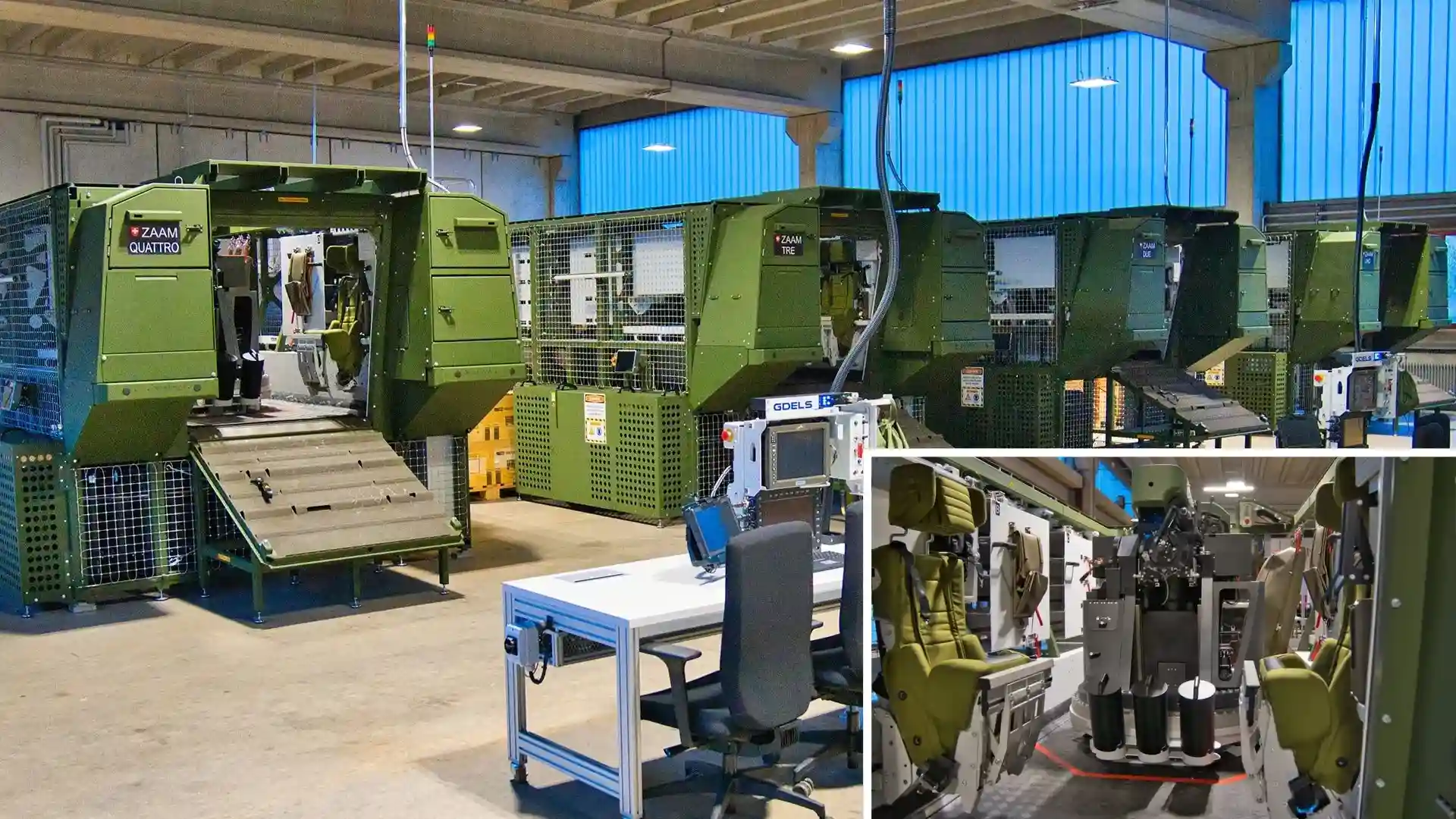
armasuisse, Switzerland’s Federal Office for Defence Procurement, handed over the Modular Subsystem Simulators (MTSS) for the 12 cm Mortar 16 to the Swiss Armed Forces’ Tank and Artillery Training Unit at the Bière military training area in early November 2026, the agency announced on November 13, 2026. The simulators will train the future crews of the 48 Piranha IV-based mortar carriers now entering service and supplement live training on the real system.
The training component moved quickly by Swiss procurement standards. armasuisse signed the MTSS contract in December 2024 and accepted the last subsystem in November 2026, a cycle of less than two years. The parent program followed a slower path. Parliament approved the 12 cm Mortar 16 with the Armed Forces Dispatch 2016, then valued at CHF 404 million for 32 systems in four batteries of eight guns, with deliveries initially planned for 2018 to 2022. A second tranche of 16 systems, worth CHF 175 million, followed under the 2022 dispatch. Deliveries to the troops began only in 2025, after the Cobra mortar module required repeated rework during development.
How the 12 cm Mortar 16 Simulators Divide Crew Training
The MTSS combines two simulators. The Mortar Gun Commander Training System, known by its German acronym GFM, trains up to four gunners together with the instructor and the platoon leader. The Mortar Platoon Training System, or ZAAM, trains the cannon operators and can run in parallel with the GFM or on its own. Together, the two systems cover the complete crew of the 12 cm Mortar 16 with the exception of the vehicle crew.
The modular layout lets the training unit run gun-level drills and platoon-level fire procedures separately or as a combined event. armasuisse highlights one capability that live training cannot deliver: rehearsing extreme situations and reactions to system errors under safe conditions, scenarios that either cannot be practised on the real vehicle at all or only in restricted form. For a semi-automatic weapon with a mechanized ammunition handling chain, fault drills carry operational weight, since a stoppage in a firing position costs time the crew may not have.
Swiss officials also cite secondary benefits: lower noise emissions, greater availability of the real systems for operations rather than instruction, and reduced operating costs. armasuisse did not disclose the MTSS contract value, the number of simulator stations delivered, or the planned annual training throughput.
How GDELS-Mowag, Brunner Elektronik and RUAG Built the MTSS
The MTSS was designed and produced entirely in Switzerland. GDELS-Mowag acted as general contractor, responsible for the simulator as a whole and for the simulation of the weapon compartment. Brunner Elektronik AG developed and produced the simulation of the 12 cm Mortar 16 weapon system and of the ammunition handling system, including its controller. RUAG handled the software simulation of the weapon system and additional IT components.
The industrial split mirrors the real system. The 12 cm Mortar 16 mounts the RUAG Cobra 120 mm semi-automatic mortar on the GDELS-Mowag Piranha IV 8×8 wheeled armored personnel carrier. Publicly available specifications indicate a rate of fire of up to 10 rounds per minute and a carrier measuring 7.95 m long, 2.9 m wide, and 2.64 m high, roughly 3 m longer than the M113-based 12 cm Mortar 64/91 it replaces. That predecessor left service in 2010, leaving the Swiss Armed Forces without medium-range indirect supporting fire for more than a decade.
The all-domestic approach aligns with the Federal Council’s Armament Policy Strategy of June 20, 2025, which seeks to keep security-relevant key technologies and industrial core capabilities inside Switzerland and aims, where possible, to transact 60% of total defence procurement volume within the country.
Analysis: The MTSS is a modest contract, but it targets the main constraint on the program’s next phase: turning delivered vehicles into qualified batteries. With 48 systems arriving in stages and live firing in Switzerland bounded by noise limits and range availability, simulator capacity will shape how fast crews certify. Pairing a two-year simulator build with a weapon system that took nearly a decade from approval to first delivery illustrates the trade-off embedded in Bern’s 60% domestic target: Swiss firms can deliver niche subsystems quickly, while complex platform integration remains slower and costlier. For a non-NATO army rebuilding indirect fire capacity, that balance between sovereignty and speed will remain a central procurement question.
Deliveries of the 12 cm Mortar 16 continue in stages, with the second tranche of 16 systems scheduled from 2026 under earlier planning. armasuisse has not said when the first batteries will reach full operational capability. The next markers to watch are the first battery certifications at Bière and any update to the project completion date, which armasuisse moved from 2026 to 2029 in 2023 after adding ammunition and other material to the program.