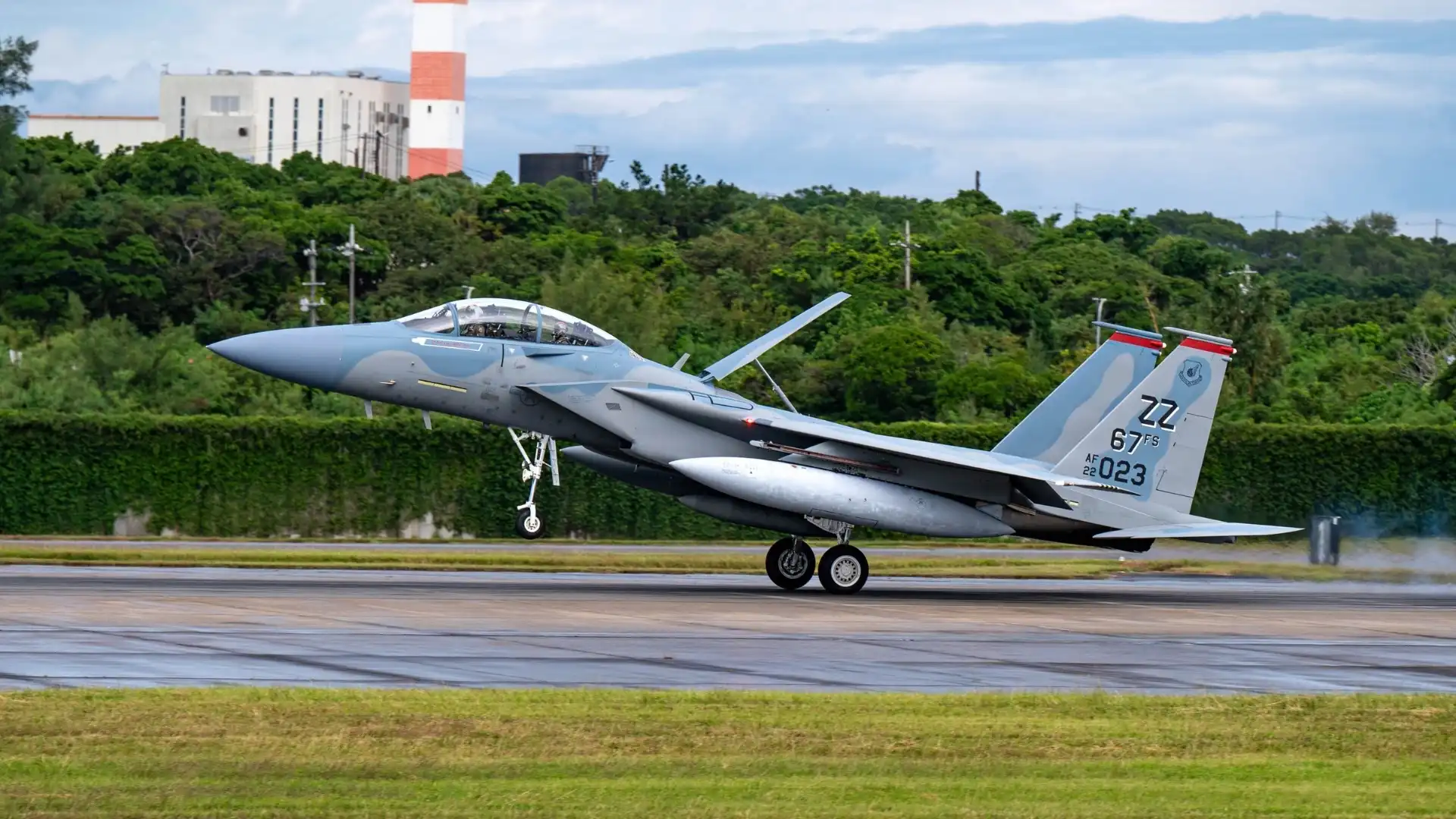
The first U.S. Air Force F-15EX Eagle II permanently assigned to Kadena Air Base, Japan, arrived on November 15, 2026, opening the replacement of the 18th Wing’s retired F-15C/D fleet with a smaller, more heavily armed force of 36 Boeing-built fighters. Kadena becomes the first overseas Air Force installation to receive combat-coded F-15EX aircraft and the second location to field the type, after the Oregon Air National Guard’s 142nd Wing at Portland Air National Guard Base.
The arrival closes a gap that opened in November 2022, when the Air Force began withdrawing Kadena’s F-15C/D Eagles after more than four decades on Okinawa. On July 3, 2024, the Department of Defense confirmed that 36 F-15EX jets would replace the 48 legacy Eagles. Rotational deployments of fourth- and fifth-generation fighters have covered Kadena since then. The first permanent jets were originally expected in spring 2026, but a machinists’ strike at Boeing’s St. Louis plant from August to November 2025 pushed deliveries back. The first Kadena-earmarked airframe, EX-22, left St. Louis on August 28, 2026, staging through Portland.
Kadena F-15EX Transition: Two Squadrons and Years of Preparation
Brig. Gen. John Gallemore, 18th Wing commander, said in the wing’s official announcement that the jets “strengthen our ability to deter aggression, respond to emerging threats, and defend Japan alongside our allies and partners.” The F-15EX will equip both of the wing’s longstanding fighter units, the 44th and 67th Fighter Squadrons. Ahead of delivery, 67th Fighter Squadron aircrew traveled to Eglin Air Force Base, Florida, and to Portland to maintain flying proficiency and complete aircraft qualification training. Lt. Col. Ajay Dua, the squadron commander, said the focus now shifts to integrating the aircraft into flying operations and “learning how to get the most out of its capabilities.”
Maintainers from the 18th Aircraft Maintenance Squadron followed a parallel track, working with Boeing and Air Force teams at Eglin and Portland to build technical proficiency. They also supported F-15E Strike Eagle operations at Seymour Johnson Air Force Base, North Carolina, and Mountain Home Air Force Base, Idaho, keeping skills current on a closely related airframe.
Production remains the constraint. The program’s selected acquisition report, released in August 2026, described the strike-driven slip as “unrecoverable delays,” projecting only six of 12 Lot 3 jets delivered by the end of 2026 and placing first overseas fielding no earlier than the first quarter of fiscal 2027. The November arrival falls inside that window. Air Force Secretary Troy Meink told the Senate Armed Services Committee on May 21, 2026, that the transition should be complete by 2028 or 2029.
APG-82, EPAWSS and Payload: What the Eagle II Adds Over the F-15C
The two-seat F-15EX derives from Boeing’s Advanced Eagle export baseline, with digital fly-by-wire flight controls, a large-area-display cockpit and the Advanced Display Core Processor II mission computer. Publicly available specifications indicate two General Electric F110-GE-129 afterburning turbofans rated at about 29,500 lbf each, a Mach 2.5-class top speed and a maximum takeoff weight of roughly 81,000 lb. Kadena’s F-15Cs flew on Pratt & Whitney F100 engines.
The primary sensor is the Raytheon AN/APG-82(V)1 active electronically scanned array radar, which pairs the APG-63(V)3 antenna with the processor of the F/A-18E/F’s APG-79. Self-protection comes from the BAE Systems AN/ALQ-250 Eagle Passive/Active Warning and Survivability System (EPAWSS), a fully digital electronic warfare suite that replaces the legacy Tactical Electronic Warfare System. The Air Force cites advanced avionics, modernized electronic warfare and increased weapons-carrying capacity as the core gains.
Capacity is the defining difference. Boeing rates the F-15EX for up to 12 AIM-120 AMRAAMs, against a typical air-superiority load of eight missiles on the F-15C. In the counterair role assigned to Kadena, that magazine depth allows the Eagle II to act as a forward missile carrier alongside low-observable F-22s and F-35s, while supporting bilateral readiness with the Japan Air Self-Defense Force.
Analysis: The Kadena plan trades airframes for magazine depth. Thirty-six F-15EXs represent 25 percent fewer jets than the 48 F-15C/Ds they replace, but each carries up to 50 percent more air-to-air missiles, a digital electronic warfare suite and a new-build structure. The open question is tempo, not quality. The program now targets 267 aircraft under the FY2027 budget request, with 120 under contract after a September 29, 2026 award, yet only half of Lot 3 will be delivered by year-end. With Kadena competing for jets against the F-15E recapitalization, rotational fighters will likely stay in the mix for some time at a base roughly 400 miles from Taiwan.
Next steps are further Lot 3 deliveries and a gradual drawdown of rotational units as the inventory grows. Boeing says it is working with the Air Force to raise production to two aircraft per month. The 18th Wing marks its centennial in 2027, 100 years after its activation as the 18th Pursuit Group at Wheeler Field, Hawaii, on January 21, 1927.