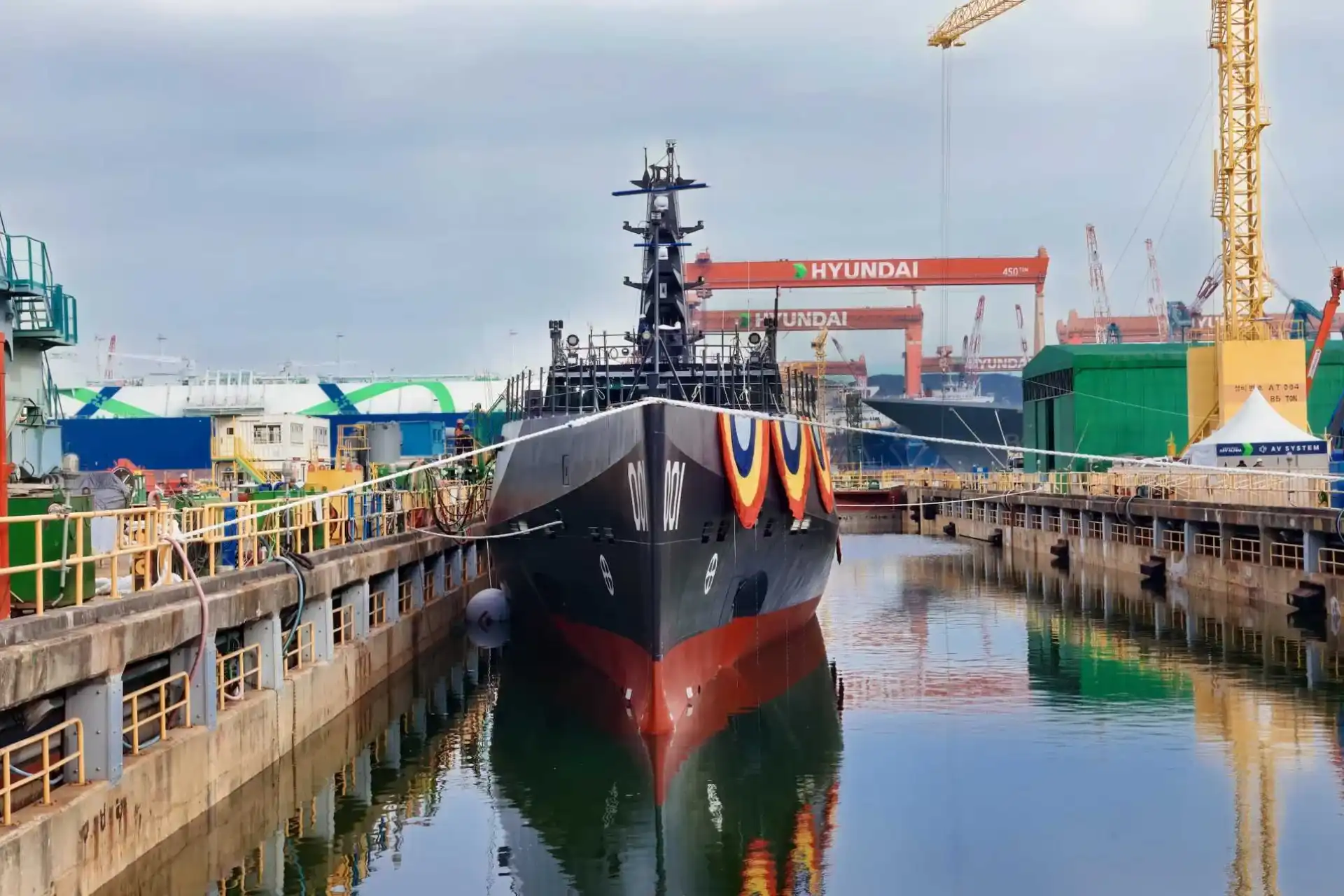
South Korean shipbuilder HD Hyundai and US defense technology firm Anduril Industries launched their first jointly developed autonomous surface vessel (ASV), a 600-ton uncrewed warship prototype, at HD Hyundai Heavy Industries’ shipyard in Ulsan on November 12, 2026. The partners completed the vessel roughly one year after signing their development agreement and are positioning it for the next round of US Navy unmanned surface vessel procurement.
The launch comes six weeks after the Navy awarded production other transaction authority (OTA) agreements for 30 Medium Unmanned Surface Vessels (MUSV) on September 29, 10 hulls each to Galliano Marine Services, Huntington Ingalls Industries (HII) and Saronic Technologies, at an average cost of $40 million per vessel. HD Hyundai and Anduril were not part of that first phase and funded their prototype without a Navy order. Their target is the follow-on market: the Navy opened an MUSV Phase II Call for Solutions on September 23 to widen the pool of eligible designs and suppliers.
VAone and Lattice: How the Autonomous Surface Vessel Runs Without Crew
The ASV splits autonomy into two layers. Platform autonomy comes from VAone, developed by HD Korea Shipbuilding & Offshore Engineering (HD KSOE) and built on HiNAS Prime, the navigation suite of HD Hyundai subsidiary Avikus. VAone follows planned routes and avoids obstacles. Mission autonomy comes from Anduril’s Lattice, an AI-enabled command-and-control platform that relays operational orders and manages reconnaissance, surveillance and weapons tasks.
The distinguishing feature is machinery and hull management rather than navigation. A manned vessel of this class typically carries about 50 personnel. VAone monitors critical equipment, detects anomalies and triggers automated responses to equipment failures and hull damage, a prerequisite for long-duration operations with no one aboard. HD Hyundai says the vessel is designed to meet US Navy requirements for extended uncrewed missions, starting with reconnaissance, surveillance and maritime intelligence gathering.
Weapons employment is automated up to the point of release. When the system detects a hostile vessel, it identifies the contact, passes the data through Lattice and enables remote weapons operation. According to HD Hyundai, a human operator makes the final decision to launch a missile; once approved, the engagement sequence can proceed automatically. An HD Hyundai source said fully automated attack is technically possible.
One-Year Build and Modular Payload Aim at Follow-On MUSV Orders
HD Hyundai has not released dimensions, speed, range or propulsion output. A visual comparison with the 170-meter Aegis destroyer Dasan Jeong Yak-yong, moored nearby, suggests a hull roughly one-third that length, or about 55 to 60 meters; that figure is an estimate, not an official specification. The company has confirmed an electric propulsion system but not its configuration.
The deck carries a container-type mission module approximately 12 meters long. Depending on its contents, the vessel can be configured for reconnaissance and surveillance or as an armed platform, letting navies swap sensors and weapons without redesigning the hull. That architecture tracks the Navy’s MUSV requirements. Phase I called for 2,500 nautical miles at 25 knots in sea state 4 and payloads up to 25 metric tons across at least two 40-foot containers. Phase II allows vessels up to 90 meters long, requires at least 10 days of unmanned operation and a minimum of two 20-foot containers. Whether the Ulsan prototype meets each threshold has not been disclosed.
Build speed is the other selling point. HD Hyundai reversed its usual sequence, ordering the long-lead electric propulsion system first and designing the hull around it, then allocating about three months each to design, hull block fabrication and outfitting. The vessel follows an October 2026 demonstration off Long Beach, California, where the partners ran VAone and Lattice aboard a modified 368-ton former US Navy test ship through autonomous navigation, mission changes, formation sailing and simulated machinery failures over about 3.5 hours.
Analysis: The prototype tests whether Korean shipbuilding speed paired with US autonomy software can break into a market so far held by domestic yards. The MUSV effort rewards affordable hulls delivered in quantity, and a self-funded 600-ton vessel built in a year speaks directly to that demand. The binding constraint is industrial rather than technical: US law requires Navy vessels to be built domestically. HD Hyundai’s planned HD Kiewit Shipbuilding joint venture, with construction targeted for 2027 and full operations for 2029, is the likely production base, placing any US-built hulls well behind the first MUSV deliveries due before the end of fiscal 2027.
The vessel will undergo about three months of sea trials and final outfitting off Ulsan before moving to the United States for further testing in early 2027. Open questions include official performance data, the payload modules Anduril plans to integrate and whether the partners will formally enter MUSV Phase II.