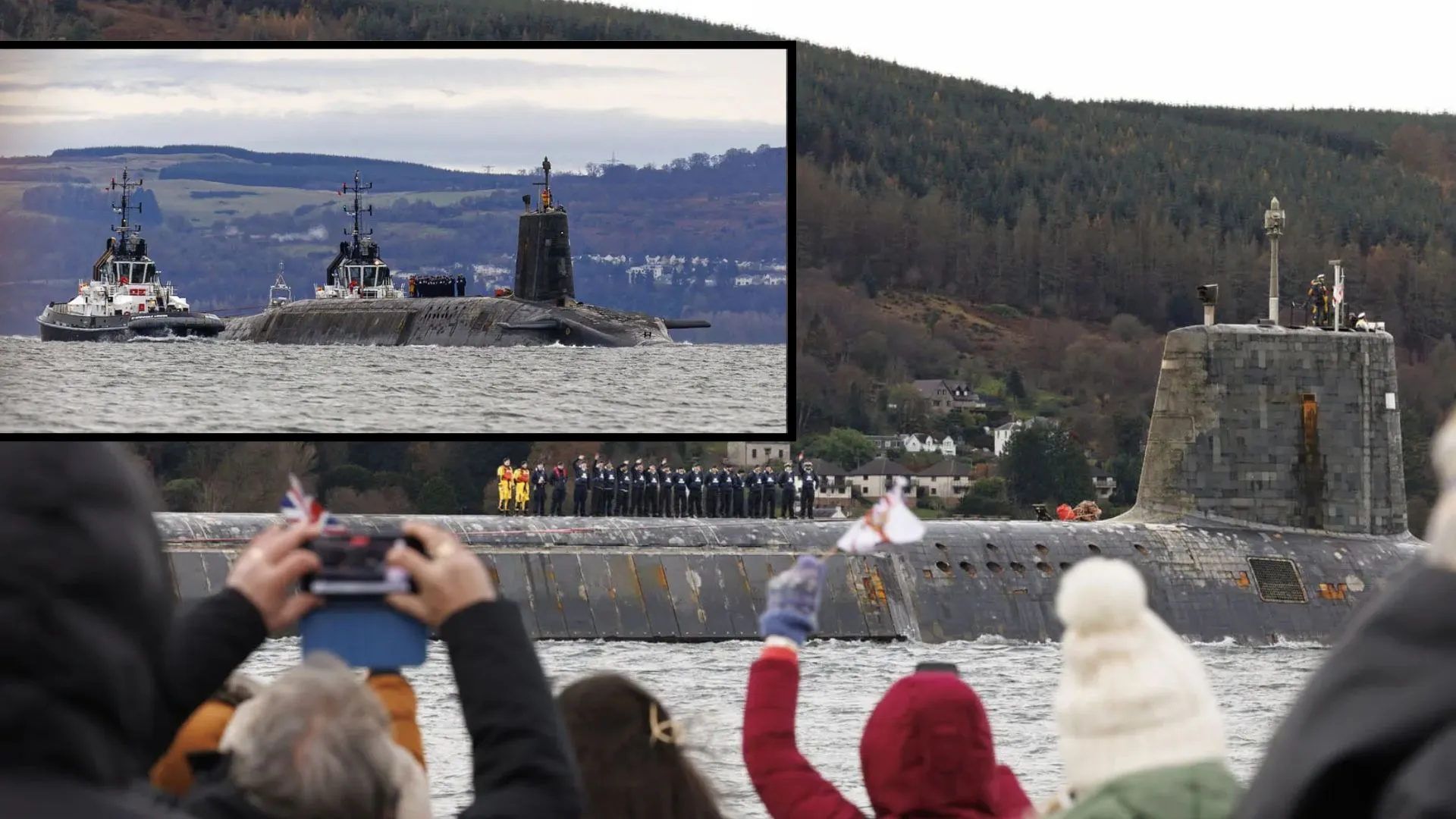
A Royal Navy Vanguard Class submarine returned to HM Naval Base Clyde at Faslane on November 15, 2026, after a Continuous At Sea Deterrent (CASD) patrol, the Royal Navy announced on November 16. The 15,000-tonne boat and its crew of around 140 submariners came home only after the next Vanguard Class submarine in the deterrent cycle was confirmed safely at sea.
In line with standing policy, the Royal Navy did not name the submarine or disclose the length of its patrol. Open-source reporting identifies the boat as HMS Vengeance (S31), which defence observers estimate sailed on April 12, placing the deployment at roughly 217 days. That would exceed the 205-day patrol completed by HMS Vanguard in spring 2026 and stand as the longest deterrent patrol on public record. The Sun reported on November 8 that HMS Vanguard, the boat expected to relieve Vengeance, had been unable to do so because of a defect, which extended the patrol further.
Inside the Vanguard Class Submarine Deterrent Cycle
Defence Secretary Wes Streeting joined the submarine at sea for the final leg of its transit home. He was accompanied by First Secretary Louise Haigh, Chief of the Defence Staff Air Chief Marshal Sir Richard Knighton, First Sea Lord General Sir Gwyn Jenkins, Chief of Defence Nuclear Madelaine McTernan and Director Submarines Rear Admiral Andy Perks. Streeting described the deterrent as “the cornerstone of our national security” and pointed to the government’s commitment of more than £63 billion over the next four years to the Defence Nuclear Enterprise.
The mission, designated Operation Relentless, has been maintained without a break since 1969, first by the Resolution Class and since the 1990s by the four Vanguard Class boats: HMS Vanguard, HMS Victorious, HMS Vigilant and HMS Vengeance. All four were built at Barrow-in-Furness and commissioned between 1993 and 1999. Publicly available specifications indicate a length of 149.9 metres, a beam of 12.8 metres and a submerged displacement of around 15,900 tonnes, with propulsion from a Rolls-Royce PWR2 pressurised water reactor. Each boat has 16 missile tubes for the Trident II D5 submarine-launched ballistic missile. Limits set in 2010 and reaffirmed in 2015 capped each patrolling submarine at eight operational missiles and 40 warheads, but since the 2021 Integrated Review the UK no longer publishes deployed missile or warhead numbers.
Recent patrols have routinely exceeded 200 days, a pattern linked to lengthened deep maintenance periods that leave fewer hulls available to share the rotation.
Dreadnought Class and Clyde Transformation Programme Investment
The Vanguard Class will be replaced by four Dreadnought Class ballistic missile submarines, Dreadnought, Valiant, Warspite and King George VI, now under construction at BAE Systems in Barrow and expected to enter service during the 2030s. At 153.6 metres long and around 17,200 tonnes submerged, with a crew of about 130, the Dreadnought will be the largest submarine built for the Royal Navy. It will be powered by a Rolls-Royce PWR3 reactor and carry Trident II D5 in a Common Missile Compartment developed with the United States. The government released around £8.4 billion for the programme’s fourth delivery phase on July 30, 2026, including £5.9 billion for BAE Systems.
After leaving the submarine, the delegation toured an Astute Class attack submarine at Clyde and received updates on the Clyde Transformation Programme (CTP), which plans £15.1 billion of investment over ten years to prepare the base for the next generation of submarines. “As we prepare for the arrival of the Dreadnought Class, I have complete confidence that the next generation of submariners will also live up to the same weight of responsibility,” the First Sea Lord said.
Analysis: Patrols of more than 200 days are a sign of strain, not surplus capacity. CASD rests on a four-boat rotation in which only one submarine needs to be on patrol, but that model assumes the other three move through maintenance, work-up and training on schedule. When one boat is held in deep maintenance and a relief suffers a defect, the patrolling crew absorbs the shortfall. Each additional month at sea accelerates wear on hulls now 27 to 33 years old and adds pressure on crew retention in a specialist workforce that is hard to regenerate. The £63 billion and £15.1 billion commitments address the 2030s; the credibility of the UK deterrent, which is also committed to the defence of NATO, depends in the near term on keeping an ageing fleet available.
The Royal Navy has not said when the returning submarine will enter its next maintenance period or how long the current patrol is planned to last. The next markers are the reliability of the boat now at sea, the Ministry of Defence’s next annual update to Parliament on the Defence Nuclear Enterprise, and progress toward delivery of the first Dreadnought Class boat in the early 2030s.