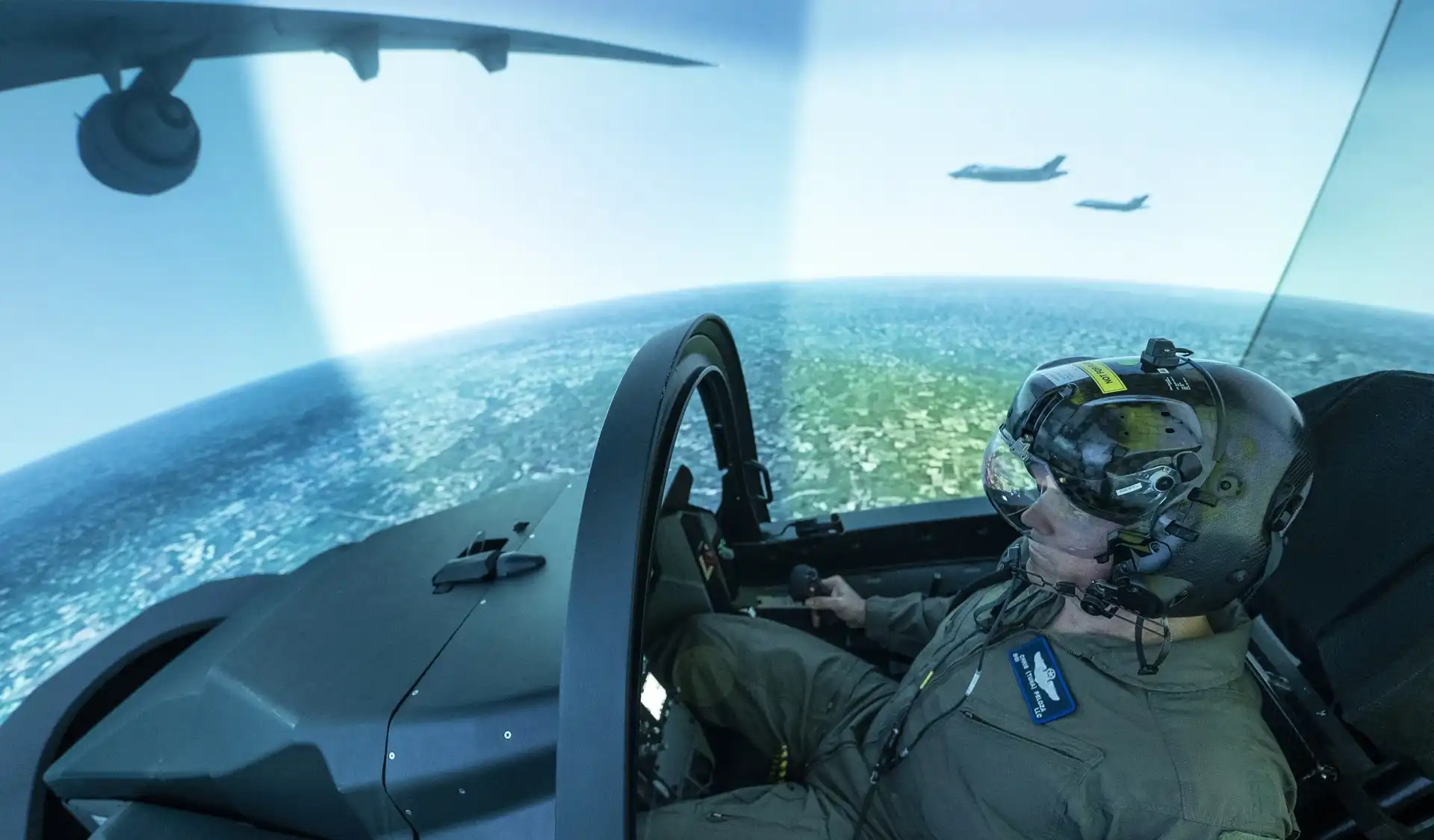
Four F-35 simulators at Naval Air Station (NAS) Lemoore, California, have connected in real time with six F/A-18 aircraft in flight, Lockheed Martin announced on November 17, 2026. The demonstration ran over the U.S. Navy’s Continuous Training Environment (NCTE) and Link Inject-to-Live (LITL) ground station systems, and the company presents it as a first in joint training between airborne strike fighters and ground-based F-35 cockpits.
The event comes two months after Lockheed Martin linked 16 F-35 full mission simulators at Marine Corps Air Stations Yuma, Miramar and Iwakuni and NAS Lemoore with F-18 simulators and an E-2D Hawkeye controller from NAS Oceana for a two-hour multidomain rehearsal announced on September 21, 2026. That exercise was entirely synthetic; Lemoore adds aircraft actually flying. For the Navy, which bases its West Coast strike fighter community and its F-35C fleet replacement squadron, Strike Fighter Squadron 125 (VFA-125), at Lemoore, blending live, virtual and constructive (LVC) forces is a direct response to the cost, airspace and security limits of training fifth-generation pilots against a high-end threat.
How F-35 Simulators Linked With Airborne F/A-18s at Lemoore
According to Lockheed Martin, the four full mission simulators and six aircraft shared one mission environment, letting pilots engage virtual adversaries alongside both live and simulated aircraft. The company has not released the date or duration of the event, the scenario flown, the F-35 variant modeled in the simulators, or the exact F/A-18 version involved. Because LITL is fielded on the F/A-18E/F Super Hornet and EA-18G Growler, the live jets were most likely drawn from that fleet, although this has not been confirmed.
Both enabling networks are existing Navy infrastructure. NCTE is the service’s persistent training network linking simulators, ranges and computer-generated threat systems. In August 2021, the Advanced Naval Technology Exercise (ANTX) 21 used NCTE to connect fleet and test F/A-18 and EA-18G aircraft, an F/A-18 simulator, a destroyer, the Joint Semi-Automated Forces (JSAF) system and the Next Generation Threat System in one event.
LITL, developed by the Naval Aviation Training Systems and Ranges program office (PMA-205) and the F/A-18 and EA-18G program office (PMA-265), injects high-fidelity simulated air-to-air and surface-to-air targets directly into Super Hornet and Growler weapon systems, so aircrews see synthetic threats on their own sensors and displays. The Navy has fielded it aboard aircraft carriers and logged hundreds of events and thousands of sorties in 2022. Lockheed Martin has not detailed how data passed between the simulators and the aircraft in flight.
Why LVC Training Matters for F-35C and Super Hornet Crews
The F-35 full mission simulator replicates the aircraft’s hardware and software inside a 360-degree visual display, reproducing sensor warnings and weapons employment. Its main value is access to what open ranges cannot offer: F-35 functions and tactics that would reveal too much to adversaries if used in the open, and threat densities that live ranges cannot reproduce. What simulators cannot provide is physical load. Lockheed Martin frames the combination as complementary, pairing repeatable simulator scenarios with the physical demands of high-G flight.
That pairing maps directly onto how the Navy now deploys. Carrier air wings increasingly combine F-35C squadrons with F/A-18E/F squadrons and EA-18G electronic attack aircraft, which places a premium on rehearsing the handoff between fifth-generation sensors and fourth-generation shooters. LITL already reduces the need for live adversary support, cutting travel to detachment sites for adversary support, along with fuel and maintenance costs. Adding F-35 simulators to that environment lets fourth-generation crews fly against or alongside fifth-generation participants without committing F-35 airframes to the sortie.
Ken Garrett, Lockheed Martin vice president of F-35 Training and Logistics, said: “When we connect live aircraft, high-fidelity simulators and virtual adversaries, we can build more realistic scenarios, test decision-making under pressure and get pilots better prepared for the moment it matters.”
Analysis: The technical step is modest; the integration step is not. The F-35 training enterprise and the Navy’s NCTE and LITL infrastructure were developed on separate tracks, by different program offices. Bridging them at a master jet base shows the networks can interoperate in practice, which matters more for carrier air wing readiness than any single simulator upgrade. The caveats are real. Four simulators and six jets at one base is a demonstration, not a fielded capability. Neither Lockheed Martin nor the Navy has addressed how classified F-35 simulator data is separated from the range and datalink environment the live aircraft operate in, a multi-level security problem that any LVC architecture mixing classified and unclassified systems must solve.
The next decision points are programmatic. Lockheed Martin has not announced a contract, a transition plan or a schedule for routine use at Lemoore. Open questions include whether the capability will extend to carrier-deployed LITL kits, to Marine Corps F-35 simulator sites already linked in September, and to live E-2D and EA-18G participation. Until the Navy publishes requirements or funding lines, the Lemoore event stands as a proof of concept for blended fifth- and fourth-generation training.