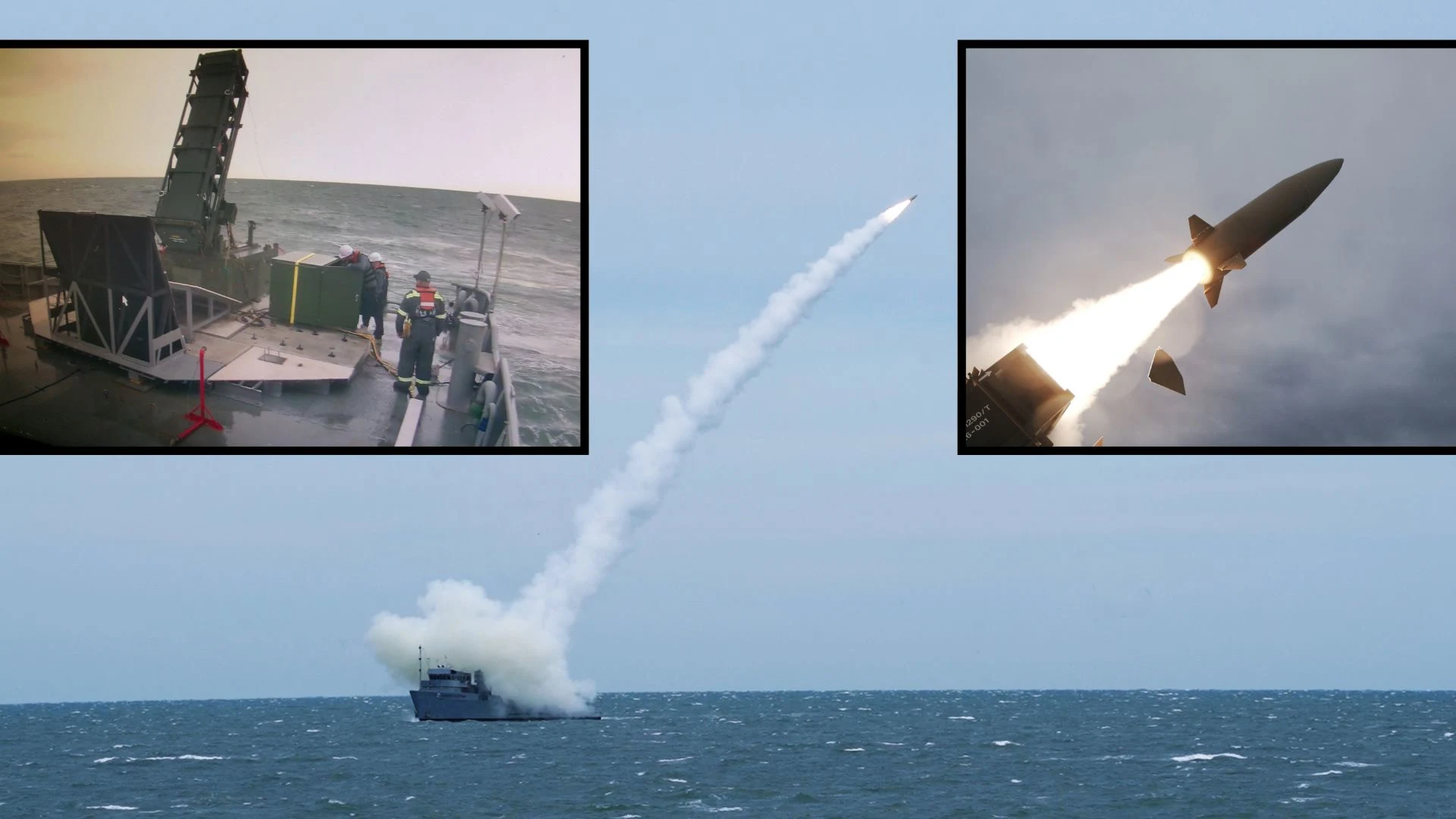
Hanwha Defense USA (HDUSA) and its parent company, Hanwha Aerospace, test-fired a Chunmoo missile from a palletizable launcher at sea off the Mississippi coast on Sunday, November 15, 2026. The launch closed a two-missile campaign meant to validate maritime-based weapon system operations and took place aboard a missile test range vessel operated by The Spaceport Company (TSC), a Mississippi-based offshore launch provider, the company announced on November 17.
The campaign extends the K239 Chunmoo, a land-based multiple launch rocket system (MLRS), to sea-based launch. It follows the April 2026 memorandum of understanding between HDUSA and Miami-based Magnet Defense to produce medium unmanned surface vessels (MUSVs) for the Department of War, with a containerized Chunmoo launcher planned for their 38-meter H38 design.
Chunmoo Missile Options for a Palletized Naval Launcher
Hanwha did not identify which Chunmoo munition was fired, nor did it release range, flight profile, or target data. The company described the launcher as a “palletizable, MFOM platform” without defining the acronym. It said the exercise matures the launcher and its electronics to enable precision-guided maritime strike from a wide range of crewed and uncrewed vessels.
Publicly available specifications indicate the Chunmoo family spans three fielded or developed tiers. The 239mm CGR-080 guided rocket reaches roughly 80 km, with six rounds per pod. The CTM-MR tactical ballistic missile is credited with about 160 km. The 600mm CTM-290, carried one per pod, reaches approximately 290 km, placing it in the same class as the longest-range ATACMS variants at 300 km. Guidance across the family relies on GPS-aided inertial navigation. Hanwha has also presented a coastal anti-ship derivative of the CTM-MR under its Chunmoo 3.0 roadmap.
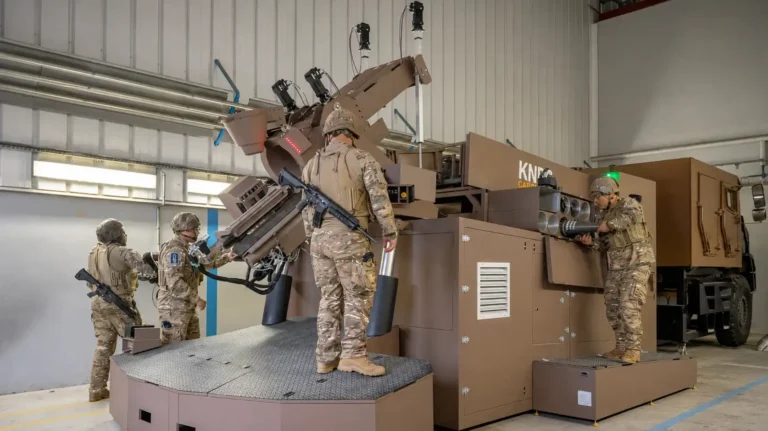
The pod architecture is what makes the naval transfer plausible. The land-based K239 carries two pods on a trainable launcher. For the H38, Hanwha’s containerized launcher holds two pods in each 20-foot container, and the deck can take up to four such containers, for eight pods per hull, though Hanwha has not confirmed the full missile load. A pallet or container approach decouples the strike payload from the ship, avoiding the cost and schedule of integrating a vertical launch system into a small hull.
The limits are equally clear. A GPS-aided inertial missile can hold fixed coastal and land targets at risk, but engaging a maneuvering warship requires a terminal seeker and an offboard targeting chain. Hanwha’s release addressed neither.
Spaceport Company Range and the Magnet Defense MUSV Pathway
TSC, which says it has conducted more than 10 launches from mobile launch pad ships, barges, and semi-submersible platforms, opened an offshore hypersonic test range in the Gulf of Mexico in August 2024, about 30 miles south of the Mississippi coastline, with Defense Innovation Unit funding. Its services cover vehicle preparation at sea, range surveillance and clearing, and tracking and telemetry. Its known launch platform is a 180-foot former Navy vessel, though Hanwha did not name the ship used for this test. Magnet Defense tracked and evaluated the launch from its Magnet Research Vessel.
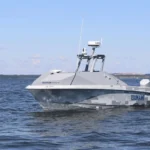
Publicly released figures describe the H38 as a 38-meter twin-hull catamaran with a 75-tonne payload allowance, a 28-knot top speed, and a range of 5,800 nautical miles at 15 knots. Hull cost has been reported at about $15 million, excluding weapons and combat systems. Payload testing on the H38 is planned for January 2027.
“By pairing Hanwha’s flagship Chunmoo missile and its palletized platform with next generation crewed and uncrewed vessels, we can deliver capabilities for the Navy at scale and a fraction of the cost of other systems,” said Kevin Schoonover, HDUSA executive vice president for missiles. The company has not published cost figures to support that comparison, and neither the H38 nor Magnet’s larger M48 holds a Navy production contract. On March 26, 2026, the Navy replaced its Modular Attack Surface Craft approach with a recurring MUSV Marketplace; Hanwha and Magnet were not among the seven companies selected for testing in its first round. On September 29, the Navy ordered 30 MUSVs from three of those seven, Galliano Marine Services, HII, and Saronic Technologies, at an average cost of about $40 million per vessel, after publishing a Phase II solicitation on September 23.
Analysis: The test targets a real Navy constraint. Strike capacity in the surface fleet is concentrated in a finite number of vertical launch cells that cannot be reloaded at sea, and distributed maritime operations depend on adding magazine depth without adding large crewed combatants. A containerized launcher firing a munition already in serial production for South Korea and Poland offers a credible industrial base for that role. The Chunmoo’s range tier, however, positions it as a littoral and land-attack complement rather than a substitute for long-range fires, and its value against ships hinges on seeker and targeting work still unproven at sea. The demonstration also fits HDUSA’s wider maritime push, which includes a $269 million award, made through vessel construction manager TOTE Services, to build a Navy and Marine Corps medium landing ship at Hanwha Philly Shipyard, a design subcontract to Vard Marine US on the Navy’s Next Generation Logistics Ship program, and ongoing talks to acquire Austal USA.
Key unknowns remain: which munition flew, what range and accuracy were achieved, and whether the launcher will pass shock and environmental qualification for continuous shipboard use. The next public milestone is H38 payload testing in January 2027, followed by Phase II and later MUSV Marketplace rounds that will determine whether the Navy funds a missile-armed MUSV built around Chunmoo.