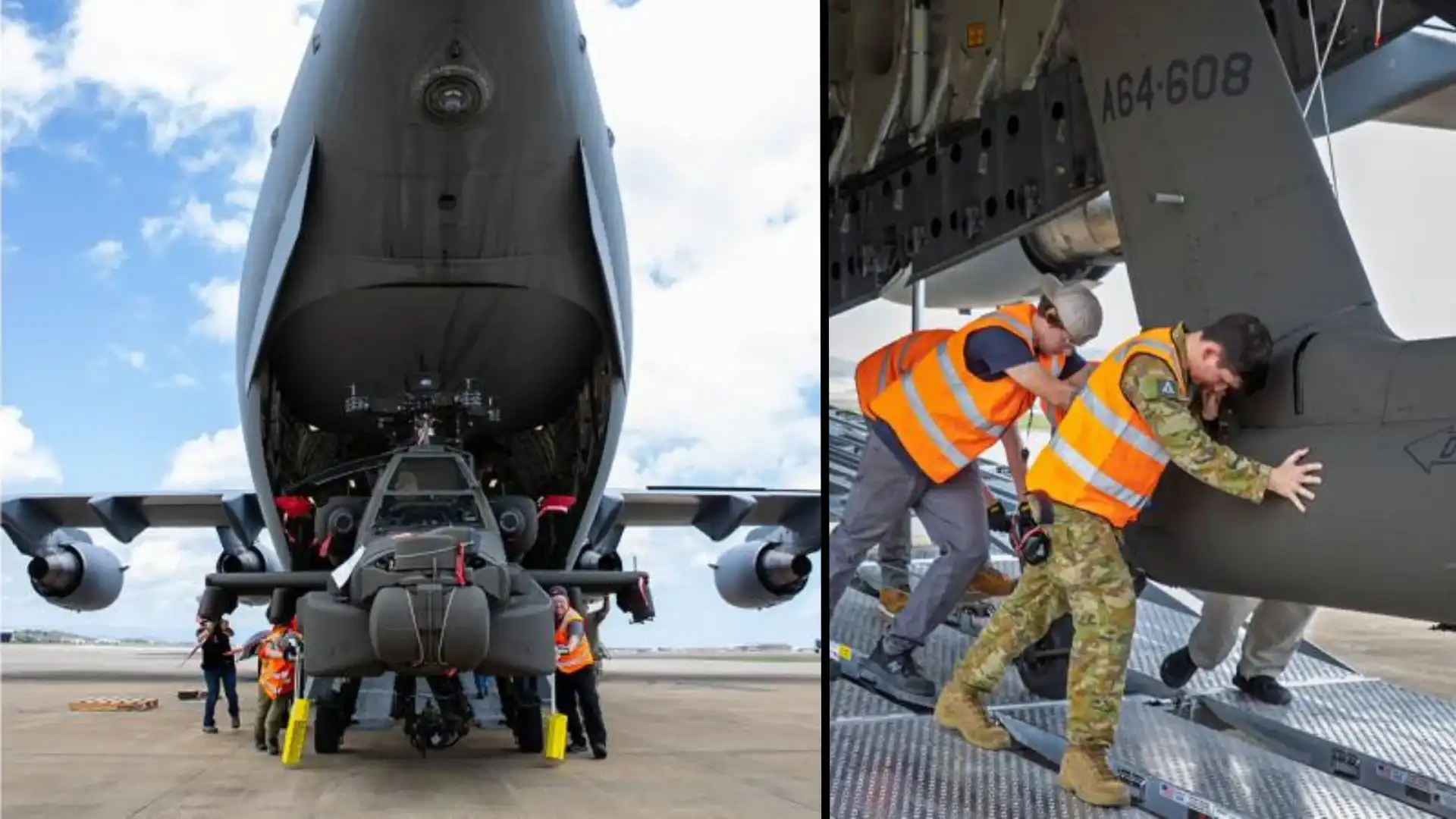
The Australian Army has taken delivery of its seventh and eighth Boeing AH-64E Apache attack helicopters, which arrived at RAAF Base Townsville, Queensland, aboard a US C-17A Globemaster III on November 2, 2026. The airframes will join the 1st Aviation Regiment as the unit opens its second live-fire campaign of the year, the November iteration of Exercise Possum Guns.
The delivery brings the Army to eight of the 29 AH-64Es it is acquiring through a US Foreign Military Sales case under Project LAND 4503, with the full fleet due by 2029. It also comes weeks after the Army ended flying operations of its 22 Airbus Tiger Armed Reconnaissance Helicopters (ARH) in Darwin in September 2026, a withdrawal the 2026 National Defence Strategy brought forward from the 2027 to 2028 window. The Apache is now the Army’s only attack helicopter, and its fleet is still being built.
Australian Army Apache Fleet Builds Toward 29 Airframes by 2029
Deliveries began when the first pair of AH-64Es reached Townsville on September 28, 2025. A second pair followed in November 2025, and the fifth and sixth airframes arrived aboard a Royal Australian Air Force C-17A in May 2026. US civilian contractors unloaded the latest two alongside 1st Aviation Regiment personnel.
The 1st Aviation Regiment fields two Apache squadrons and sits within the 16th Aviation Brigade, co-located in Townsville with the Army’s CH-47F Chinook heavy-lift fleet. In a Department of Defence report published on November 17, Commander 16th Aviation Brigade Brigadier Fern Thompson said the type’s introduction had been carefully managed. “The AH-64E Apache only entered Australian Army service last year, and already we have it baring its teeth,” she said.
Thompson said Army pilots and ground crew trained in the US and the UK so the force could fly and sustain the helicopters as soon as the first airframes landed. “Now, only a year after the first AH-64E Apaches were delivered, we have received a quarter of our fleet and have shown we can employ them with the full range of live munitions and sensors using our own people,” she said.
The delivery arithmetic is tight. Eight airframes arrived in roughly 13 months; meeting the 2029 target requires the remaining 21 to arrive at about seven per year. Defence has not published the annual delivery schedule.
Possum Guns Live-Fire and the AH-64E Sensor and Weapons Package
The first Possum Guns iteration, announced on July 17, 2026, delivered the Army’s first in-country Apache live-fire at Townsville Field Training Area, including the first live Hellfire missiles loaded and fired in Australia. Pilots qualified on the 30mm gun, rockets and Hellfire by day and night, and Australian instructors and aviation gunnery specialists were certified to deliver and sustain live-fire training independently, so the Army no longer depends on US-based instruction to run it. The November serial will certify more pilots and, according to Thompson, test the regiment’s ability to deploy the Apache from a simulated field environment.
The June 3, 2021 US notification for the sale, valued at US$3.5 billion, covered 29 AH-64Es, 64 T700-GE-701D engines (58 installed, six spares), 29 AN/ASQ-170 Modernized Target Acquisition and Designation Sight and AN/AAR-11 pilot night vision sensors, 29 AN/APR-48B Modernized Radar Frequency Interferometers, 16 AN/APG-78 Longbow fire control radars and 2,000 Advanced Precision Kill Weapon System (APKWS) guidance sections. Boeing builds the Australian aircraft to the AH-64E Version 6 standard.
Publicly available specifications indicate each 701D engine produces roughly 2,000 shaft horsepower, and the aircraft carries an M230 30mm chain gun with up to 1,200 rounds plus up to 16 Hellfire missiles or 70mm rocket pods across four wing stations. The radar count shapes employment: with 16 Longbow units for 29 airframes, only about half the fleet can carry the mast-mounted sensor at once. The APG-78 includes a maritime targeting mode, relevant to the littoral manoeuvre role the 2026 strategy assigns to the Army. Australian aircrew have said the Apache fires the same munition types as the Tiger, but its digital Hellfire link, sensor suite and cockpit interface give it a clear edge.
Analysis: By retiring all 22 Tigers before the Apache fleet reached even a third of that number, the Army has accepted a thin attack helicopter force through at least 2027. Eight airframes split across two squadrons, with training and maintenance demands on top, leave few aircraft for operational tasking. That makes the field-deployment element of the November exercise more consequential than the additional gunnery certifications. Proving the 1st Aviation Regiment can arm, refuel and sustain Apaches away from Townsville is a precondition for employing the type across northern Australia and the littoral approaches, and for operating alongside US Army and US Marine Corps units that rotate through northern Australia.
The next markers are the results of the November Possum Guns serial and the cadence of the next delivery pairs. Brigadier Steven Cleggett, Director General Army Aviation Systems, said in March 2025 that the fleet is expected to reach initial operational capability in 2028, and Defence has flagged future integration of crewed and uncrewed systems for the Apache. Whether deliveries reach the seven-per-year pace needed for 2029 will determine how long the Army operates with a partial attack helicopter capability.