The State Department approved a possible $210 million sale of two M142 High Mobility Artillery Rocket Systems (HIMARS) and 72 Guided Multiple Launch Rocket System (GMLRS) rockets to Albania on November 17, 2026. The Foreign Military Sale (FMS), with Lockheed Martin as principal contractor, also covers a fires command-and-control package. Tirana will pay with Foreign Military Financing (FMF) loan funds, and the sale would give the Albanian Land Force a ground-based long-range precision-strike capability, with GMLRS rockets reaching beyond 70 km, that it does not currently field.
The notification, Transmittal 27-02, arrives as Albania tries to turn rising budgets into hard capability. A July budget amendment lifted the 2026 defense budget to 69.2 billion lek, about $840 million, and total defense-related spending to 2.6% of GDP, while parliament fast-tracked a $302 million FMF direct loan from Washington, repayable over up to 12 years. Last week, Prime Minister Edi Rama acknowledged that the NATO summit Tirana expected to host will not be held in Albania in 2027, after reports of U.S. reluctance and allied unease over Albanian spending.
Inside the Albania HIMARS Package: Launchers, GMLRS, and IFATDS
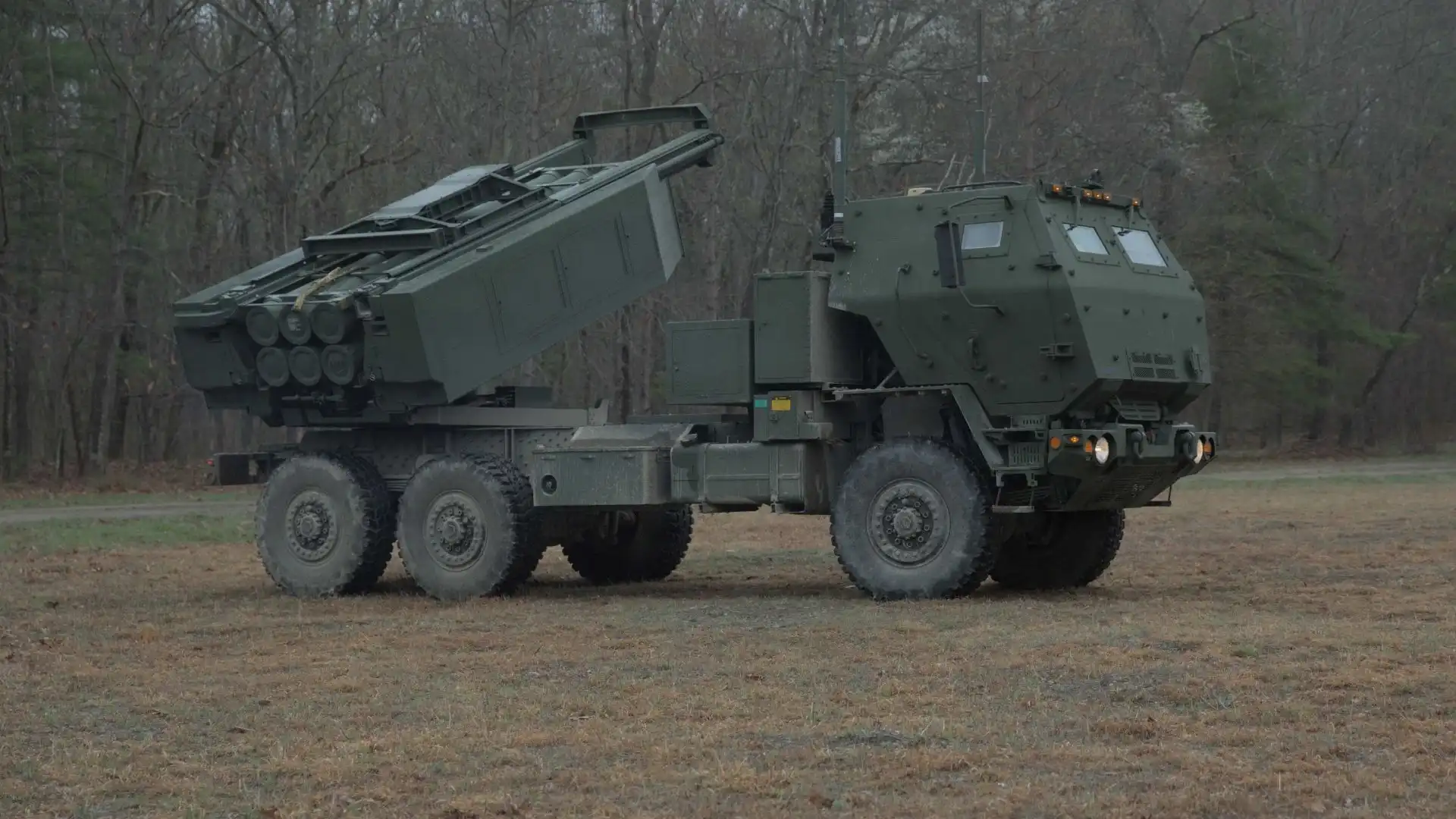
The M142 is a wheeled launcher built on a five-ton Family of Medium Tactical Vehicles (FMTV) 6×6 chassis, operated by a three-person crew from an armored cab and transportable by C-130 aircraft. Publicly available specifications indicate a combat weight of about 16.2 tonnes, a road speed of 85 km/h, and a cruising range of roughly 480 km. The launcher carries a single pod of six GMLRS rockets or one Army Tactical Missile System (ATACMS) missile.
Albania requested six M31A2 GMLRS Unitary pods and six M30A2 GMLRS Alternative Warhead (AW) pods, all fitted with the Insensitive Munitions Propulsion System (IMPS), for 36 rockets of each type. Both use GPS-aided inertial guidance and engage targets from about 15 km to beyond 70 km. The Unitary round carries a 200-pound-class high-explosive warhead for point targets, while the AW variant uses preformed fragments instead of cluster submunitions to cover area targets without leaving unexploded bomblets. IMPS motors are designed to reduce the risk of sympathetic detonation if a vehicle or storage site is hit.
The architecture extends well beyond the launchers. Albania asked for eight International Field Artillery Tactical Data Systems (IFATDS), the export version of the U.S. Army’s automated fire support command-and-control system, which coordinates fires from mortars and rockets to close air support. The package adds AN/PRC-158, AN/PRC-160, and AN/PRC-167 radios, GMR-1000 gateway mission routers, BAE Systems NavGuide satellite navigation, two M1152A1 Humvees, an M1084A2 resupply vehicle, and reduced-range practice rocket pods. Ammunition depth is modest: 72 rockets equal six loads per launcher, and the request excludes ATACMS, the Precision Strike Missile (PrSM), and the 150 km Extended Range GMLRS that Estonia and Lithuania have sought.
Croatian HIMARS, Serbian PULS, and the Western Balkans Fires Balance
The State Department assesses that the sale “will not alter the basic military balance in the region,” and two launchers would not on their own. Still, the request places Albania inside a regional long-range fires buildup. Croatia, which signed a military cooperation declaration with Albania and Kosovo in Tirana on March 18, 2025, received U.S. approval for eight HIMARS valued at $390 million in August 2024 and now expects deliveries by late 2027 or early 2028 under an accelerated schedule. Zagreb then signed a €411.8 million contract with Hanwha Aerospace on September 10, 2026, for 18 K239 Chunmoo launchers, adding range brackets its GMLRS-only HIMARS order does not cover. Croatia’s 2024 notification listed 48 GMLRS pods, or 288 rockets, the same 36 per launcher as Albania’s request, while Croatian media reported 394 rockets in the contract Zagreb signed later that year.
Serbia has moved in parallel. Belgrade ordered the Elbit Systems PULS modular rocket launcher, rated for targets out to 300 km, together with Hermes 900 drones in a package signed in late 2024 and reported at $335 million. In April 2026, President Aleksandar Vučić called the regional security situation more complex, citing the Zagreb-Tirana-Pristina alignment. Albania’s order is small by comparison but ties Tirana to the same launcher, munitions, and fire-control architecture its Croatian partner is fielding.
Analysis: The ratio inside the package matters more than the launcher count. Eight IFATDS terminals and a full radio and router layer for two launchers indicate that Albania is buying the digital fires backbone first: the targeting, deconfliction, and sensor-to-shooter links that let a small artillery element plug into NATO joint fires. For a Land Force that does not yet field long-range rocket artillery, two HIMARS serve as a training and doctrine nucleus that can scale if budgets allow, not as a standalone deterrent. The financing also matters: Washington is steering a small ally toward U.S. equipment through repayable credit rather than grants, as Tirana’s spending record faces allied scrutiny.
Congress now has the 15-day review the Arms Export Control Act sets for NATO allies before a Letter of Offer and Acceptance can be negotiated. Implementation would send up to 15 U.S. government and 15 contractor representatives to Albania about twice a year for program reviews, fielding, and training. No delivery schedule has been disclosed; Croatia’s timeline is the nearest benchmark. Open questions include a follow-on buy of Extended Range GMLRS, deeper rocket stocks, and the launchers’ basing.