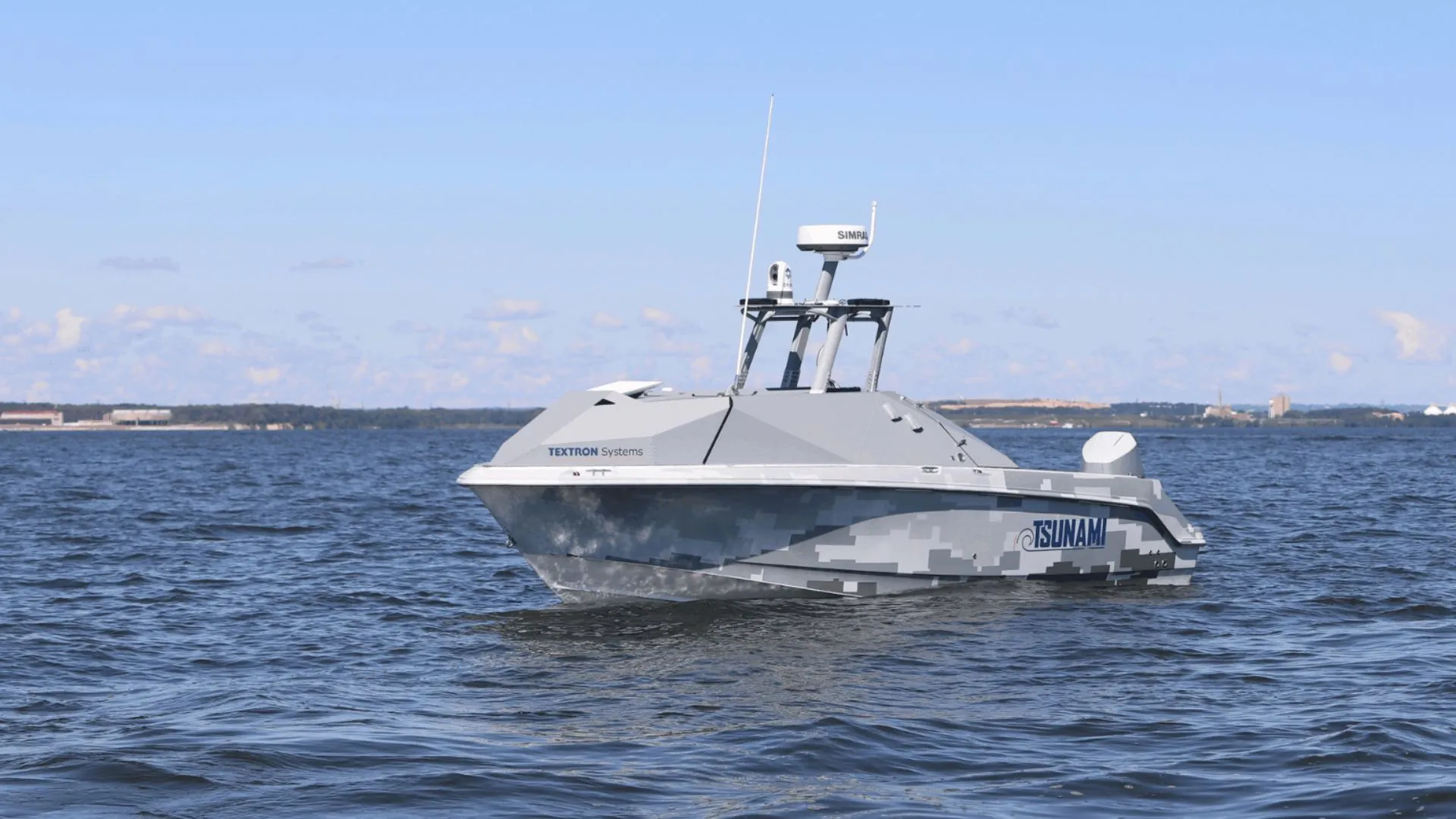
Textron Systems will convert its TSUNAMI USV into an autonomous fuel distribution system for a U.S. Army prototype under a subcontract from Neya Systems, the company announced on November 18, 2026. The work uses the TSUNAMI 25, a 25-foot uncrewed surface vessel (USV) rated above 40 kt with a maximum weight capacity of 3,642 lb. Army Contracting Command (ACC) issued the prime award to Neya, a wholly owned subsidiary of Applied Research Associates (ARA), and the program is the first Army contract for the TSUNAMI platform.
The award came out of the pitch competition at the Defense Industrial Base Accelerator (DIBX) 2026, held August 25-27 in Philadelphia by the Pentagon’s industrial base policy office. The competition targeted three gap areas: strategic and critical materials, expeditionary manufacturing of electronics, and fuel distribution. Neya’s proposal was down-selected from nearly 200 submissions and addresses the services’ fuel distribution gap through decentralized, attritable autonomous delivery. The solicitation, run by Army Contracting Command-Rock Island, called for fixed-price prototypes awarded through Other Transaction Agreements (OTAs) with a period of performance capped at two years. Neither company has disclosed the value of the award.
TSUNAMI USV Specifications and the Fuel Payload Question
TSUNAMI is not a clean-sheet naval hull. Textron builds the family on Brunswick Corporation commercial boats and integrates an autonomy control system derived from its Common Unmanned Surface Vehicle (CUSV), the U.S. Navy’s first small USV program of record, fielded in the mine countermeasures role. The vessels are compliant with the Navy’s Unmanned Maritime Autonomy Architecture (UMAA) and ship with electro-optical/infrared (EO/IR) cameras, maritime radar, and line-of-sight and beyond-line-of-sight communications as standard equipment.
Manufacturer data indicates the TSUNAMI 25 uses the Boston Whaler Outrage/Justice 250 hull, measuring 25 ft 5 in with a 9 ft beam. A single 400 hp gasoline outboard drives it to a top speed above 40 kt, and Textron lists an approximate range of 275 nautical miles on baseline fuel. Maximum weight capacity is 3,642 lb. The wider family spans hulls from 21 to 42 ft, with engine kits from 115 hp to 2,400 hp.
That weight capacity frames the mission. At roughly 7 lb per gallon, 3,642 lb corresponds to about 500 gallons of diesel-type fuel before deducting autonomy hardware, sensors, and transfer equipment, a DefenseWarroom estimate rather than a company figure. Neither firm has described the tank configuration, pumping system, or transfer method the Army configuration will use. The arithmetic explains the concept: a TSUNAMI-based system moves fuel in small lots across many hulls, not in bulk aboard a single tanker, which matches the decentralized, attritable model in the award description.
The Army program also shifts the platform into a new mission set. The U.S. Navy’s Fourth Fleet operated the TSUNAMI 25 Long Dwell Interceptor variant during Fleet Experimentation (FLEX) 2026 for surveillance and interdiction support.
Neya’s MPMS and the Eleven-Vessel Refueling-at-Sea Option
The subcontract includes a potential follow-on effort with options for up to eleven TSUNAMI vessels to perform autonomous refueling at sea, orchestrated by Neya’s Mission Planning and Management System (MPMS). The software lets a single operator manage multiple crewed and uncrewed assets in real time, and Neya pairs it with its Virtual Integration and Simulation Environment (VISE) to rehearse multi-robot missions digitally before physical testing.
Neya brings Army ground autonomy experience to the maritime problem. MPMS originated in Army Small Business Innovation Research (SBIR) work on mission planning for unmanned ground vehicles, and in 2023 the company was one of three firms selected by the Army and the Defense Innovation Unit (DIU) to prototype autonomy kits for the Oshkosh Palletized Load System under the Ground Expeditionary Autonomous Retrofit System (GEARS) project. Textron supplies the autonomy-ready hull, the CUSV-derived control system, and a commercial production base through Brunswick.
“This award provides an important opportunity to demonstrate the TSUNAMI vessel’s versatility and ability to rapidly adapt to evolving mission requirements,” said Ryan Schaffernocker, Senior Vice President, Air, Land & Sea Systems at Textron Systems.
Analysis: The award shows the Army treating last-mile maritime fuel delivery as a fleet orchestration problem rather than a hull problem. Individual TSUNAMI craft carry modest loads, so operational value depends on how many vessels MPMS can coordinate, how cheaply they can be replaced, and whether fuel can be transferred safely without crews aboard. Transfer at sea is the hardest engineering element and the least documented in the announcement. The contract path is equally telling: a commercial-derivative Navy USV entered an Army sustainment program through a same-day OTA pitch format, a route that compresses the usual requirements cycle for nontraditional autonomy concepts.
Key unknowns remain the award value, the demonstration date and location, the vessels or units that would receive fuel, and the transfer hardware. The next decision point is whether the Army exercises options for up to eleven TSUNAMI vessels within the OTA’s two-year performance window.