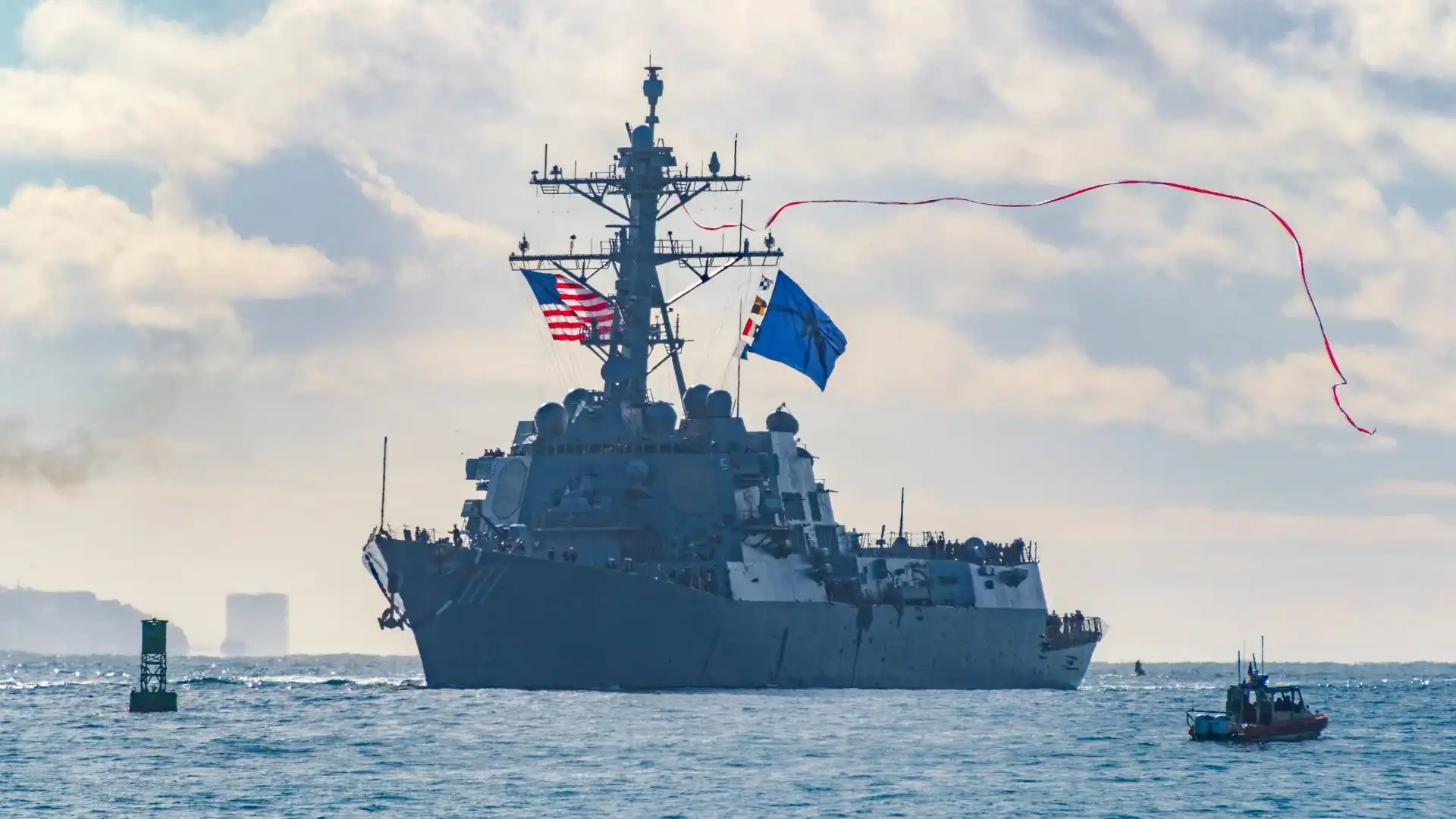
The U.S. Navy has awarded a combined $7,125,820,000 multiple-award contract to 28 companies for the Surface Electronic Warfare Improvement Program (SEWIP) Family of Systems, the Department of War announced on November 19, 2026. The indefinite-delivery/indefinite-quantity (IDIQ) vehicle covers the block upgrades that modernize the AN/SLQ-32(V) shipboard electronic warfare suite and runs through November 2036 if all options are exercised.
The figure is a shared ceiling, not an obligation. The announcement lists no funds committed at award, and work will flow through individual orders placed against the vehicle. What changes immediately is the competitive structure of a program that, since 2003, has been built largely through block-specific contracts held by a handful of primes. The award comes as the surface fleet absorbs lessons from the Red Sea, where U.S. destroyers engaged Houthi anti-ship missiles and drones from late 2023, and as the Navy pushes electronic attack beyond its largest combatants.
Inside the $7.1 Billion SEWIP Contract and Its 28 Awardees
According to the contract announcement, the SEWIP Family of Systems consists of several block upgrades that, when combined, create variants installed on surface ships for early detection, signal analysis, threat warning, and protection from anti-ship missiles. The vehicle serves Navy, Coast Guard, and allied ships. It allows five contract types: firm-fixed-price, fixed-price incentive (firm-target), cost-only, cost-plus-fixed-fee, and cost-plus-incentive-fee. That mix lets the Navy buy mature hardware on fixed terms while funding development and engineering on cost-type orders.
Naval Sea Systems Command first framed the requirement in March 2025 as an IDIQ for SEWIP AN/SLQ-32(V) full rate production, design agent engineering, and integration, intended to support current and future variants from design and prototyping through test, maintenance, and support. The solicitation closed in April 2026 after several amendments. The Navy received 31 offers. Program Acquisition Executive Mission Systems in Washington, D.C., is the contracting activity.
The awardee list combines the program’s incumbents with a broad bench of integrators and specialists. General Dynamics Mission Systems, Lockheed Martin in Liverpool, New York, and Northrop Grumman in Linthicum Heights, Maryland, all hold places, as does Raytheon through its Goleta, California, site. BAE Systems, CAES, HII Mission Technologies, Leidos, CACI, ManTech, Amentum, General Dynamics Information Technology, and Ultra Electronics Ocean Systems are also on contract. Eleven of the 28 awardees are small businesses, including Distributed Spectrum, Frequency Electronics, Innovative Defense Technologies, Simventions, and PCI Aviation.
From Block 1 to Block 3: The AN/SLQ-32 Upgrade Path
SEWIP is an evolutionary upgrade program for the AN/SLQ-32(V), originally a Raytheon system fitted across U.S. combatants and auxiliaries. General Dynamics has served as lead systems integrator for Block 1 since 2003. Block 1A introduced the Improved Control and Display console and electronic surveillance enhancements, Blocks 1B1 and 1B2 added Specific Emitter Identification (SEI), and Block 1B3 brought a high gain/high sensitivity receiver for improved situational awareness.
Block 2, developed by Lockheed Martin under a design contract awarded in September 2009, replaced legacy hardware with an upgraded electronic support antenna, a digital receiver, and an open combat system interface. Designated AN/SLQ-32(V)6, it entered full rate production in September 2016 and now equips dozens of Arleigh Burke-class destroyers. Japan became its first foreign customer through Foreign Military Sales.
Block 3, the AN/SLQ-32(V)7 built by Northrop Grumman, upgrades the electronic attack mission: active jamming of anti-ship missile seekers and targeting radars. Northrop won engineering and manufacturing development in 2015, the first system went aboard USS Pinckney (DDG 91) in 2023, and the company is now under contract for up to 24 systems, including the first aircraft carrier shipset. A $312.3 million option exercised in June 2026 extended production of the Hemisphere and Quadrant subsystems. Northrop is also prototyping Scaled Onboard Electronic Attack (SOEA) for ships too small for a full Block 3 installation, and a fourth block upgrade is planned.
Analysis: The award moves SEWIP from a sequence of block-specific franchises toward a standing competitive pool. For the Navy, that means leverage: design agent engineering, integration work, and future increments such as smaller-ship electronic attack can be competed among holders rather than negotiated with a single incumbent. That matters as seeker technology and threat libraries evolve faster than traditional block cycles. The breadth of the bench, which includes test, modeling, and simulation specialists, points to a service that wants to insert hardware and software at the subsystem level rather than wait for a new block. Incumbents keep real advantages in installed base and design agent knowledge, and a place on the vehicle guarantees no awardee a single order. The burden of integrating subsystems from multiple vendors also shifts further toward the government.
The next indicators are the first orders and their values, which the announcement does not disclose, and whether existing production lines, such as Northrop’s Block 3 work scheduled through 2029, migrate onto the new vehicle. The scope and timing of the planned fourth block remain unannounced, as does the path for SOEA out of prototyping. Northrop’s first Block 3 aircraft carrier configuration, which the company expects to deliver around 2028, will offer an early read on how quickly the fleet can field new electronic attack capacity.