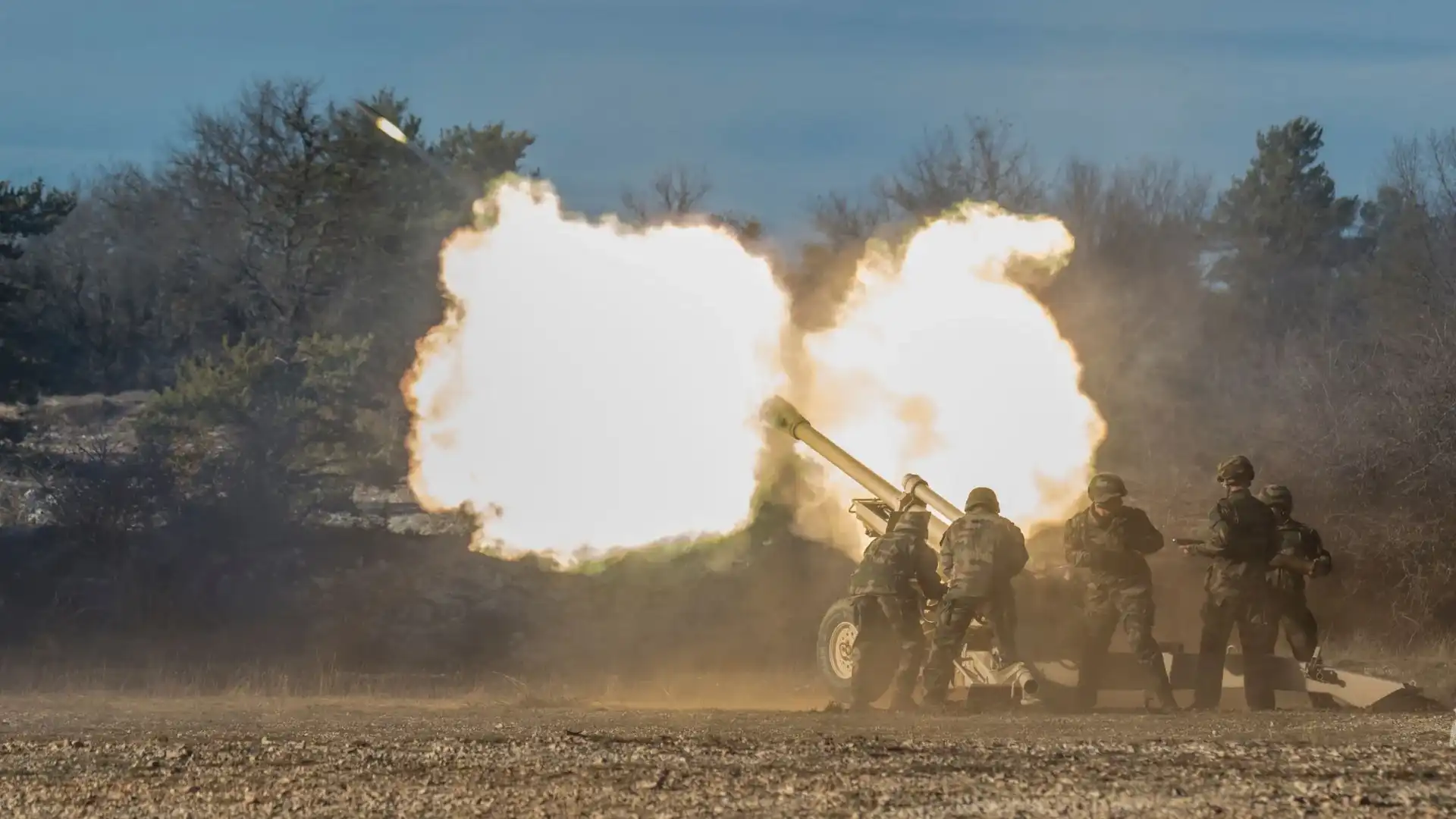
The government of Malaysia has handed KNDS a Letter of Intent (LoI) for the procurement of 36 105LG light gun systems for the Malaysian Army, KNDS announced on November 19, 2026. The document was delivered during the official visit of French President Emmanuel Macron to Kuala Lumpur on November 16 and 17, which Catherine Vautrin, French Minister of the Armed Forces and Veterans Affairs, also attended. Neither side disclosed a contract value or a delivery schedule.
The LoI follows the Roadmap on Bilateral Defence Capabilities and Defence Industrial Partnerships, exchanged on November 17 by Vautrin and Malaysian Defence Minister Mohamed Khaled Nordin as Paris and Kuala Lumpur raised their relationship to a strategic partnership. It is the third artillery step between Malaysia and KNDS in eight years: an order for 18 105LG guns signed in April 2018, then an order for 18 CAESAR 155mm/52-caliber truck-mounted howitzers formalized on June 16, 2026, at Eurosatory in Paris. If converted into a contract, the new request would take the Malaysian Army’s 105LG fleet from 18 to 54 guns.
Malaysia 105LG Light Gun Requirement and Industrial Terms
The LoI is not a contract. According to KNDS, it opens negotiations with Malaysian authorities on the terms and conditions of the proposed acquisition and on the associated industrial cooperation package. Talks will cover local company participation, technology transfer, and the maximization of local content through the Industrial Collaboration Programme (ICP), the offset mechanism that serves the objectives of Malaysia’s National Defence Industry Policy (NDIP).
Advanced Defence Systems Sdn Bhd (ADS), founded in 2005 and KNDS’s industrial partner in the country, is slated to assemble all 36 guns and integrate them with an Integrated Fire Control System. ADS assembled the original 18 guns at its local plant. KNDS has not identified the supplier or architecture of the fire control system, nor confirmed whether the new guns will match the Mk III configuration of the 2018 batch.
The 2018 guns equip the 1st Royal Artillery Regiment (Para) of the 10th Parachute Brigade, Malaysia’s rapid deployment formation. Open-source reporting indicates the Malaysian Army has sought 36 new lightweight 105mm guns to modernize its artillery regiments, and ADS has previously said further 105LG orders could equip another two or three regiments. The 105LG is expected to replace OTO Melara Model 56 105mm pack howitzers, of which roughly 100 are estimated to remain in service.
Amaury de Poncins, International Business Development Director at KNDS, said the LoI “demonstrates KNDS’s commitment to working alongside the Malaysian authorities and local industry to develop sustainable sovereign capabilities.”
Weight, Range and Digital Laying: The 105LG Technical Profile
The 105LG, listed as the 105 LG1 in the current KNDS catalogue and supplied to Malaysia in its digitized Mk III standard, is a 105mm/30-caliber towed gun designed for airmobile and rapid reaction forces. Manufacturer data gives a weight of 1,650 kg, rising to 1,660 kg with the inertial navigation unit (INU) and fire control panel, or 1,550 kg with goniometer-only laying. The gun measures 5.32 m long, 1.97 m wide and 1.34 m high, and can be served by a minimum crew of three.
The 105LG fires US M1-type 105mm ammunition to 11 km and reaches 17 km with the KNDS ERG3 extended range round. KNDS quotes a rate of fire of 12 rounds per minute, a 36-degree (640-mil) on-carriage traverse, direct fire out to 2,000 m, and 30 seconds to come into or out of action. A combined GNSS and INU navigation and laying system lets each gun self-locate and lay without surveyed positions, including in GPS-denied environments. Malaysia’s 2018 package included ERG3 ammunition and the BACARA compact ballistic computer for battery-level fire direction.
Mass is the system’s main discriminator. Publicly available specifications list the British Army’s L118 Light Gun at 1,858 kg with a 17.2 km maximum range. The 105LG therefore matches L118-class reach with ERG3 at roughly 200 kg less weight, a margin that widens helicopter lift options for parachute and jungle units. Against the Model 56’s range of about 10 km, it adds some 7 km of reach and a digital laying chain.
Analysis: Malaysia is building a two-tier tube artillery structure around one European supplier and one domestic integrator. CAESAR provides 40 km-class 155mm fires, while the 105LG covers airmobile and jungle-terrain units where helicopter lift and road limits rule out heavier guns. Concentrating assembly, spares, training and fire control integration at ADS lowers through-life support costs and builds the sovereign maintenance base the NDIP targets. The trade-off is continued reliance on KNDS for ordnance, ammunition and key subsystems, an exposure the ICP negotiations are designed to narrow. Regionally, the move reinforces a KNDS artillery footprint that already includes the 105LG and CAESAR in Indonesia and Thailand.
The next milestone is conversion of the LoI into a firm contract, which will fix price, ICP commitments and delivery phasing. Open questions include funding under Malaysia’s defence budget, the configuration and origin of the fire control system, whether ERG3 ammunition production will be localized, and which regiments will field the guns first.