The U.S. Air Force has awarded The Boeing Co. an $11,743,132 VC-25B contract modification to repair unique parts on the next Air Force One jets, the Pentagon announced on November 23, 2026. The cost-plus-fixed-fee and cost-reimbursable-no-fee modification, P00194 to contract FA8625-16-C-6599, raises the contract’s cumulative face value from $4,508,429,742 to $4,520,172,874.
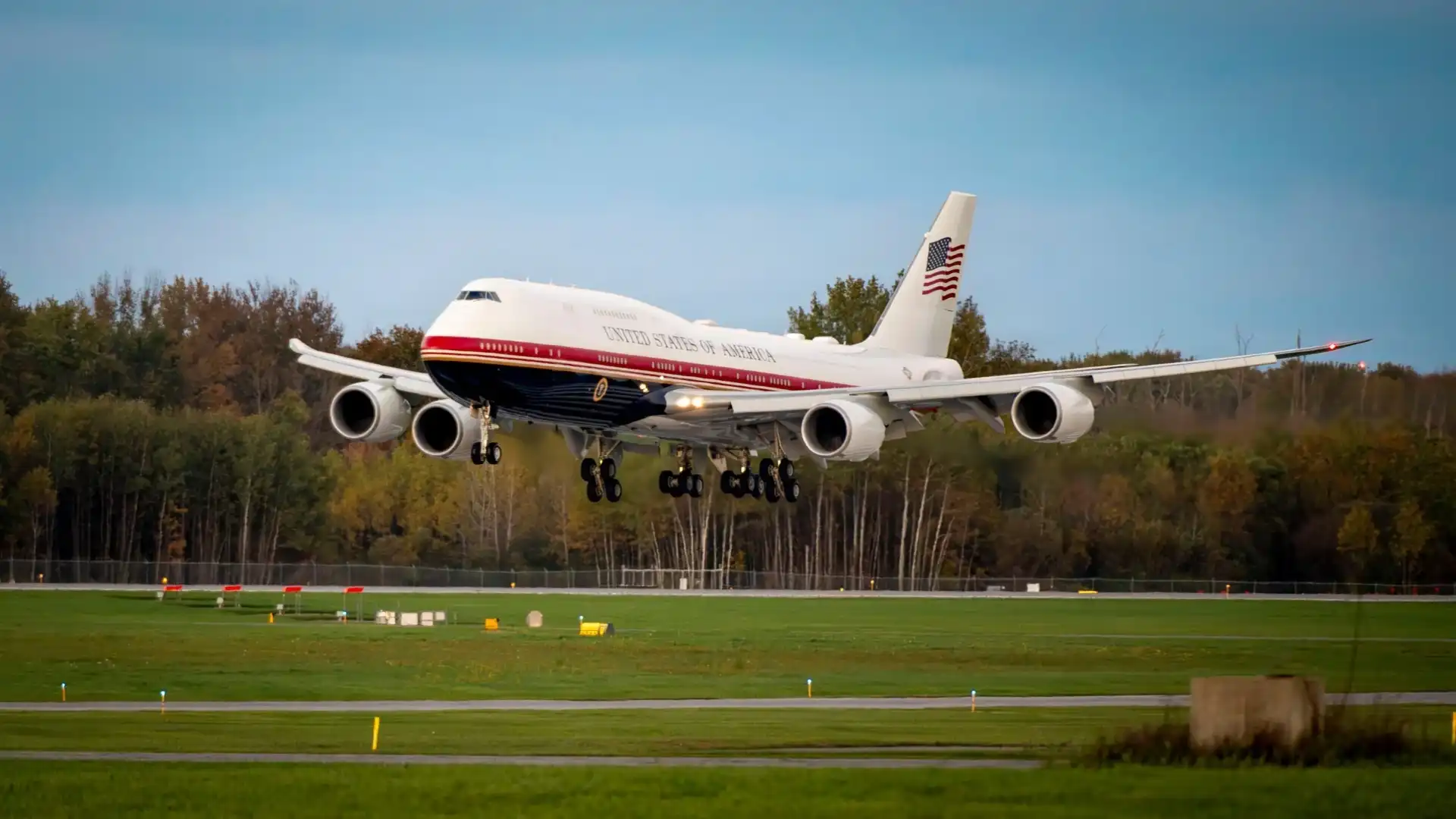
The award comes days after the interim VC-25B Bridge aircraft, a Qatari-donated Boeing 747-8 converted by L3Harris, flew President Donald Trump nonstop from Shenzhen, China, to Joint Base Andrews, Maryland, on November 19, 2026. The White House called the roughly 15-hour flight the longest nonstop Air Force One sortie to date. The Boeing-built VC-25Bs remain in conversion in Texas, about four years behind the original 2024 delivery target.
Inside the P00194 VC-25B Contract Modification and Its Funding
Work will be performed at Joint Base San Antonio, Texas, where Boeing is converting both airframes, and is expected to be completed before delivery of the aircraft. The Air Force Life Cycle Management Center (AFLCMC) at Wright-Patterson Air Force Base, Ohio, is the contracting activity. Only $750,000 in fiscal 2027 research, development, test and evaluation (RDT&E) funds was obligated at award.
Boeing performs the core VC-25B engineering and manufacturing development effort under a firm-fixed-price agreement signed in 2018 and valued at $3.9 billion at the time, which leaves cost overruns on the company’s books. This modification uses cost-type terms instead: the government reimburses Boeing’s allowable costs, with a fixed fee on part of the work. The announcement does not identify which parts need repair, why they need it, or how the work splits between the fee and no-fee portions.
The award follows a $15.5 million modification in December 2025 to expand the aircraft’s communications capability, and two 2026 modifications worth up to $125 million and $75 million to buy initial spare parts for both jets. Separately, the Air Force agreed in December 2025 to buy two used Lufthansa 747-8s for $400 million, one for training and one as a spare parts source.
Stringer Cracks, Power-On, and the Road to 2028 Delivery
The two airframes were built for Russian carrier Transaero, which collapsed before taking delivery. Modification began on the first aircraft in February 2020 and on the second in June 2020. The conversion adds an electrical power upgrade, dual auxiliary power units usable in flight, a mission communication system, military avionics, a self-defense system, an executive interior, and autonomous enplaning and deplaning. The aerial refueling requirement was dropped in 2017 to cut costs.
Structural work has compounded the delays. Air Force figures reported in late July 2026 cited roughly 300 stringer cracks on each aircraft, in the same areas flagged on commercial 747-8s, where the Federal Aviation Administration (FAA) linked cracking to improperly shimmed stringer splice gaps from manufacturing. Officials expected those repairs to be completed in 2026. A Pentagon report released in August 2026 also flagged a shortage of certified cockpit windshields, with a PPG replacement design still awaiting certification, and GKN struggling to meet defect limits on passenger window assemblies.
Boeing booked a $280 million charge on the program in the second quarter of 2026 for additional production and certification resources, pushing its cumulative VC-25B losses past an estimated $3 billion. The Air Force expects power-on of the first aircraft before the end of 2026, first flight in 2027, and first delivery in mid-2028.
Analysis: The fixed-price label on the VC-25B has never meant zero government exposure. Through modifications for communications upgrades, initial spare parts, and now parts repair, the government keeps adding funded scope while Boeing absorbs overruns on the core effort; the cumulative face value, which also covers pre-2018 risk-reduction work, now stands at $4.52 billion. Paying directly for discrete repair tasks gives the Air Force a tool to keep work moving toward the 2028 date without reopening the fixed-price baseline.
The next milestone is power-on of the first VC-25B, ahead of a first flight in 2027. Open questions include the scope of the parts repair and whether further cost-type modifications follow. The legacy VC-25As remain in service until the replacements arrive.