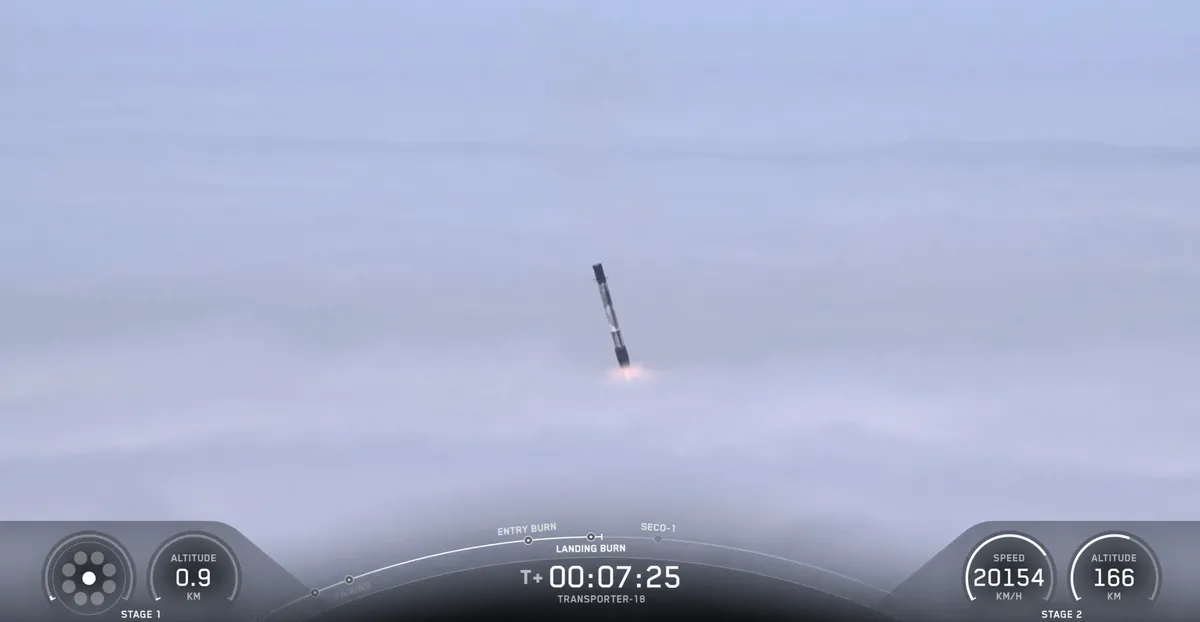
Rheinmetall and Italian space company Argotec placed the first satellite of their new strategic partnership in orbit on October 1, 2026, aboard a SpaceX Falcon 9 launched from Vandenberg Space Force Base, California. Developed through the German group’s Rome-based subsidiary, Rheinmetall Italia S.p.A., the spacecraft is designed to detect ground-based indicators of emerging airborne threats and feed early warning data directly into national air defense systems.
The launch opens a third line of effort in Rheinmetall’s space strategy. On December 18, 2025, Germany’s Federal Office of Bundeswehr Equipment, Information Technology and In-Service Support (BAAINBw) awarded Rheinmetall ICEYE Space Solutions approximately €1.7 billion for exclusive access to a synthetic aperture radar (SAR) constellation under the SAR Space System for Persistent Operational Tracking Stage 1 (SPOCK 1) program. In June 2026, Rheinmetall and OHB founded OHB Rheinmetall Space Networks GmbH in Bremen to pursue the SATCOMBw Stage 4 military satellite communications program. Both efforts follow German Defense Minister Boris Pistorius’s September 2025 pledge of €35 billion for space-related defense projects by 2030.
How the Rheinmetall Argotec Satellite Feeds Air Defense Networks
Rheinmetall frames the mission around intelligence generation rather than conventional mapping of ground objects. The satellite’s sensors are tasked to identify ground-based indicators that precede airborne threats. The company has not specified those indicators; the description is consistent with monitoring launch sites, forward airfields, and unmanned aircraft staging areas, where preparation for a missile or drone strike becomes visible.
Collected data and imagery are processed with artificial intelligence (AI) support and pushed directly into national defense and air defense systems. The architecture layers space-based observation, ground-based nodes, and tactical networks, managed through what Rheinmetall calls an advanced Command and Control Post. “Integrating space-based data into existing defence architectures is a critical step,” said Armin Papperger, CEO of Rheinmetall AG.
The choice of Rheinmetall Italia as program lead follows from its portfolio. The former Oerlikon Contraves S.p.A. is the group’s designated radar center of excellence, with more than 50 years of experience in air surveillance and tracking radars from L-band to W-band. Its X-band X-TAR3D tactical acquisition radar detects, tracks, and classifies low-altitude air targets for short-range and very short-range air defense. Ground radars, however, cannot see past the horizon. A space layer that flags threat preparation before launch pushes warning beyond that physical limit, giving fire control more time to cue sensors and position effectors.
Key parameters remain undisclosed. Neither company has released the satellite’s designation, mass, bus, sensor type, resolution, or orbit. The only Falcon 9 to fly from Vandenberg on October 1 was Transporter-18, a dedicated rideshare to sun-synchronous orbit carrying about 130 payloads, which indicates the spacecraft operates in sun-synchronous low Earth orbit. The companies have not confirmed the mission name.
Argotec’s HAWK Production Line and the Road to a Constellation
Argotec, founded in Turin in 2008, builds satellites of up to 200 kg and says SpacePark, the automated Turin facility it opened in 2024, can produce more than 50 per year. Its flight heritage includes LICIACube and ArgoMoon, two microsatellites it operated simultaneously in deep space in 2022 during NASA’s Double Asteroid Redirection Test (DART) and Artemis I missions.
The company’s product line centers on the HAWK platform. Publicly available specifications indicate the HAWK for Earth Observation (HEO) satellite built for Italy’s IRIDE constellation weighs 65 kg, carries a multiband payload with sub-3 m ground sampling distance, and hosts a payload data processor pairing an x86 quad-core CPU with a GPU and a neural processing unit rated at up to 4 tera-operations per second. The newer HAWK PLUS bus has a 75 kg dry mass and accepts up to 30 kg of payload, with an expandable version reaching 130 kg. If the Rheinmetall spacecraft draws on that architecture, which neither company has confirmed, onboard processing would let it downlink detections rather than raw imagery, cutting latency in a mission where minutes decide whether a warning is actionable.
Rheinmetall describes a medium- to long-term program built on a modular approach. The October 1 launch is meant to validate operational functionality in orbit and secure subsequent funding phases. A second satellite launch is fixed in the roadmap for 2028, after which the space segment is to expand into a broader constellation. Rheinmetall says it is working in close coordination with institutional stakeholders but has not named a customer, contract value, or funding source.
Analysis: The satellite matters less as a sensor than as a signal of intent. Rheinmetall already sells short-range air defense systems such as Skynex; adding a space-based cueing layer lets it pitch European customers an integrated chain from orbit to effector, closing a gap with Leonardo and Thales, which already pair space and air defense businesses. Capability claims warrant caution, however. A single satellite in low Earth orbit passes over any given area only intermittently and cannot deliver persistent early warning. That requires a constellation, and the next launch is not scheduled until 2028.
The next markers are on-orbit validation results, the identity of the institutional customer, and confirmation of the funding phases the launch was meant to unlock. Rheinmetall has not disclosed the constellation’s planned size or a date for operational capability. Until 2028, the system remains a single-satellite demonstrator, and its performance against real threat indicators will decide whether it becomes a standing layer in national air defense architectures.