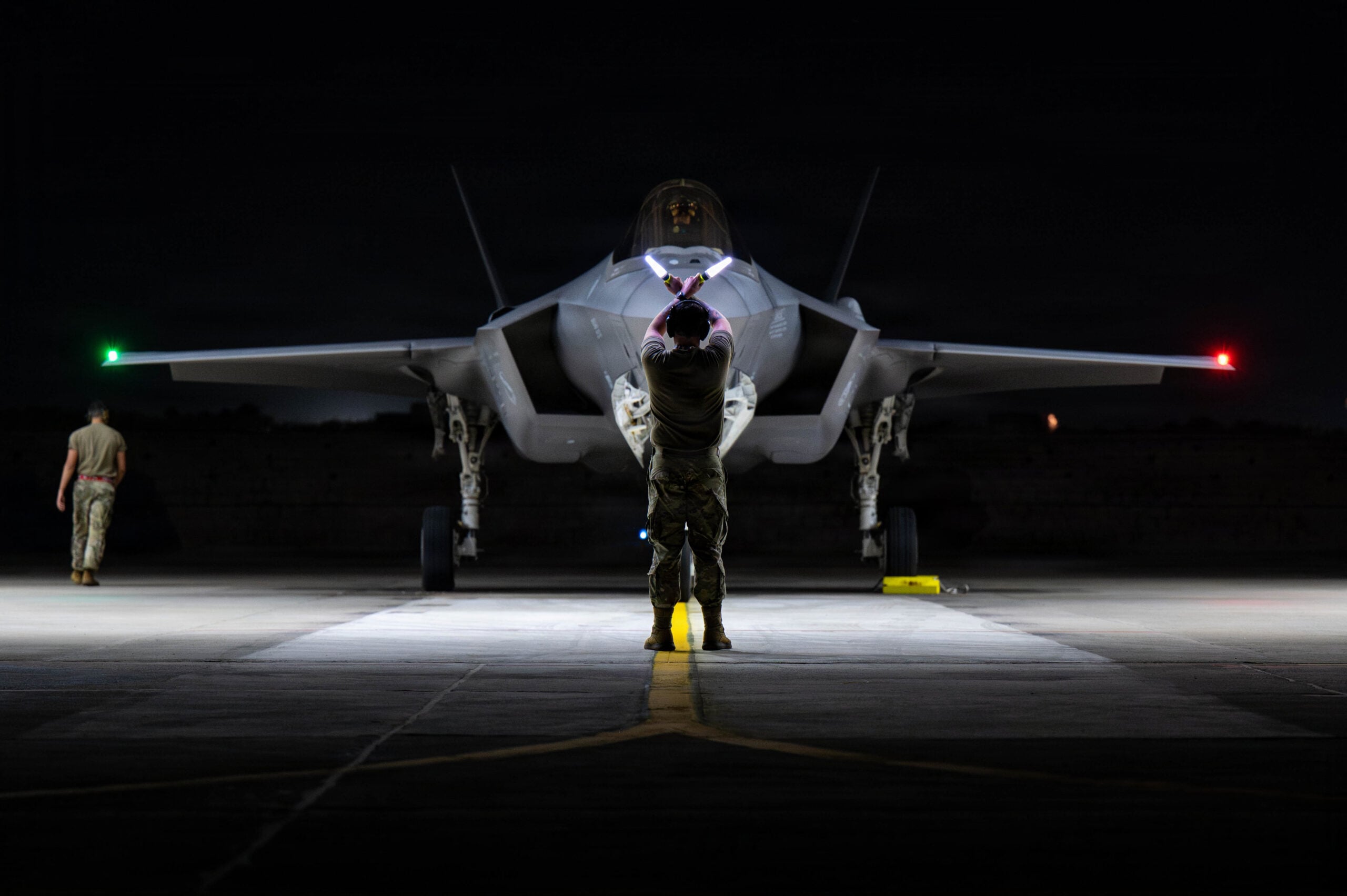
Six U.S. Air Force (USAF) F-35A Lightning II fighters and more than 200 Airmen arrived at Air Force Station (AFS) Jodhpur, Rajasthan, on September 26, 2026, for Exercise Tarang Shakti 26, the Indian Air Force (IAF) exercise running through October 12, according to the U.S. Embassy in New Delhi. It is the first USAF F-35 deployment to India for an exercise rather than an air show.
The second edition of Tarang Shakti, themed “Power in Partnership,” brings seven foreign air forces to Jodhpur, from Australia, Bangladesh, France, Germany, Sri Lanka, the United Arab Emirates and the United States, per India’s Ministry of Defence, with 32 nations observing. Mission sets span counter-air, air defense, reconnaissance, air-to-air refueling, dynamic targeting and combat search and rescue, the IAF’s first event of this scale since Operation Sindoor in May 2025. The jets arrived two weeks after Russian President Vladimir Putin held defense talks in New Delhi around the BRICS summit.
How the F-35 India Deployment Differs From Earlier Visits
The F-35 is not new to Indian soil. Two USAF F-35As landed at AFS Yelahanka in Bengaluru on February 13, 2023, for Aero India, one from the Hill Air Force Base demonstration team and one from Eielson Air Force Base for static display; Indian military officials described it as the type’s first landing in India. The F-35A returned to Aero India in February 2025, parked on the same ramp as Russia’s Su-57E. On June 14, 2025, a Royal Navy F-35B from HMS Prince of Wales diverted to Thiruvananthapuram International Airport in bad weather, then sat grounded with a hydraulic fault until a UK engineering team cleared it to leave on July 22.
Jodhpur differs in kind. Those were displays or an emergency recovery; Tarang Shakti puts F-35As into a multinational flying program with IAF Su-30MKIs and Rafales. The USAF brought A-10s and F-16s to the 2024 edition, and has flown F-15s, F-16s and, in 2023, B-1B bombers in the Cope India series.
The jets come from the 13th Fighter Squadron “Panthers” of the 35th Fighter Wing at Misawa Air Base, Japan, which received its first F-35As on March 28, 2026, under a plan to replace Misawa’s 36 F-16s with 48 F-35As. The wing’s specialty is suppression of enemy air defenses (SEAD), the Wild Weasel mission it flew for decades in the F-16. A KC-135R Stratotanker from the 909th Air Refueling Squadron at Kadena Air Base deployed alongside them. Six months after conversion, the squadron is operating more than 6,000 kilometers from home station.
F-35A Sensor Suite and SEAD Profile Alongside Su-30MKI and Rafale
Publicly available specifications credit the F-35A’s Pratt & Whitney F135-PW-100 with about 43,000 pounds of thrust in afterburner, a top speed of Mach 1.6 and a combat radius above 590 nautical miles on 18,250 pounds of internal fuel, with a 9g airframe. Its sensor core fuses the Northrop Grumman AN/APG-81 active electronically scanned array (AESA) radar, the AN/AAQ-37 Distributed Aperture System, the AN/AAQ-40 Electro-Optical Targeting System and the BAE Systems AN/ASQ-239 electronic warfare suite, which passively detects and geolocates radar emitters. That passive geolocation is what makes the F-35A a natural SEAD platform. Four internal stations carry weapons such as the AIM-120 air-to-air missile and the 2,000-pound GBU-31 guided bomb without degrading signature; six external pylons lift total payload to 18,000 pounds when stealth is traded for load. A 25 mm GAU-22/A cannon is mounted internally.
For IAF crews, the value lies in planning large force packages around a very-low-observable aircraft with a fifth-generation sensor-fusion architecture the IAF will not field until the indigenous Advanced Medium Combat Aircraft (AMCA) enters service. Their own frontline backbone remains the Russian-designed Su-30MKI, with its N011M Bars passive electronically scanned array radar and thrust-vectoring AL-31FP engines. Integration has limits: the F-35’s Multifunction Advanced Data Link (MADL) links only F-35s to one another, and neither government has said which IAF types can exchange data with the jets over Link 16. Nor has either side disclosed whether the F-35As will fly dissimilar air combat training against IAF fighters, or carry the Luneburg lens radar reflectors USAF F-35s commonly fit outside combat to mask their true signature.
Analysis: The deployment measures Washington’s risk tolerance, not a sales prospect. The United States removed Türkiye from the F-35 program in July 2019 over its Russian S-400 purchase; India operates the same system under a 2018 contract and flies a Russian-origin fighter backbone, yet Pacific Air Forces has based a freshly converted SEAD squadron there for over two weeks. That is a bet on operational trust, not a procurement opening. President Donald Trump floated an F-35 sale in February 2025; little followed. On October 1, 2026, Defence Secretary Rajesh Kumar Singh said India has taken no decision to acquire any foreign fifth-generation fighter and that the AMCA remains its path, weeks after Kremlin spokesman Dmitry Peskov said BrahMos upgrades and Su-57 supply proposals were under discussion. New Delhi is banking the training value of both relationships without committing to either jet.
Tarang Shakti 26 continues at Jodhpur through October 12. Watch whether the IAF or Pacific Air Forces release details of F-35A roles in large force packages, whether the 13th Fighter Squadron returns for the next Cope India, and how fast the AMCA request for proposals moves after vendors sought more time. No formal F-35 offer to India has been made public, and the Su-57 proposal remains open.