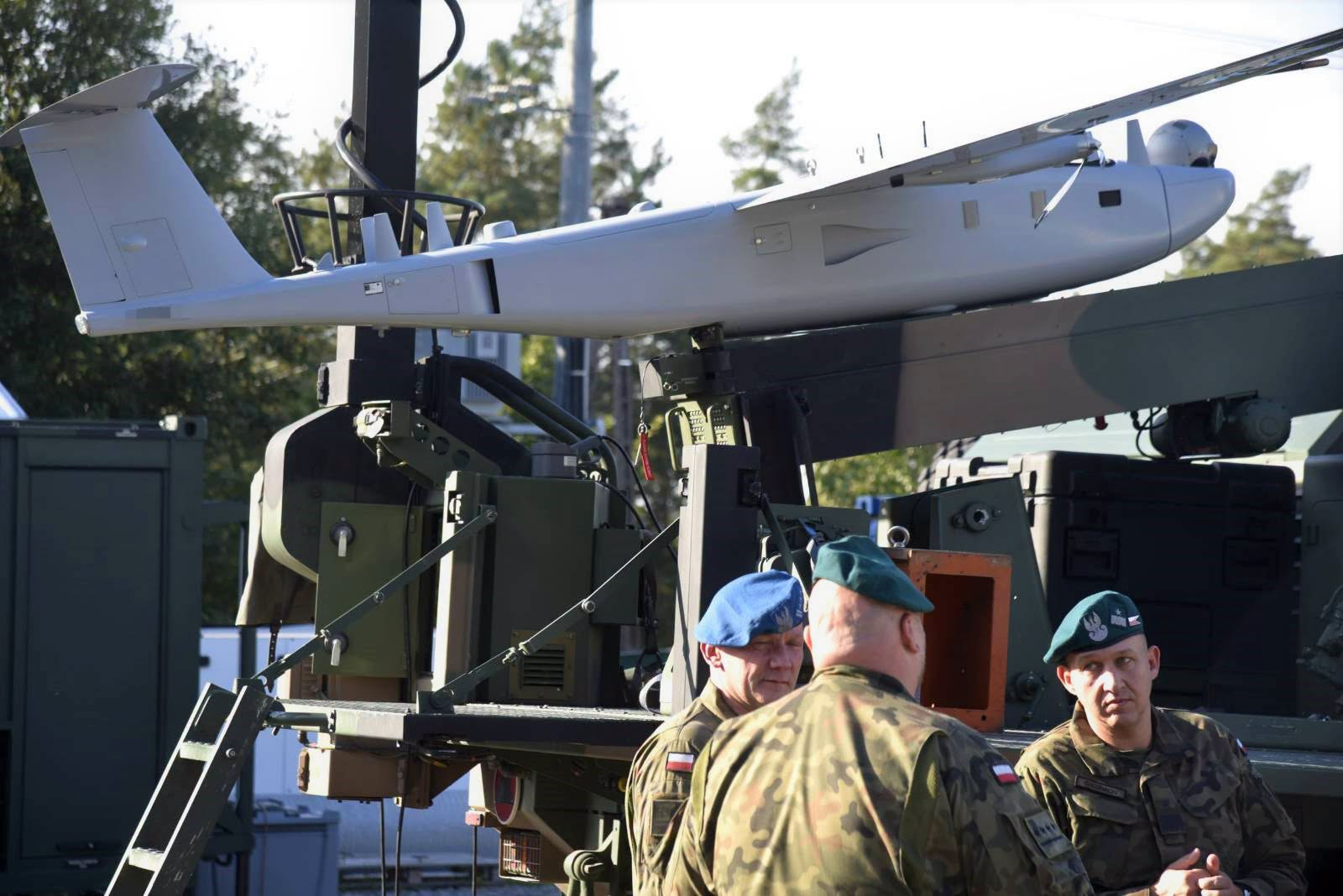
Poland’s Armed Forces Operational Command is trialing Smart Border (Inteligentna Granica), an artificial intelligence system that analyzes drone, camera and sensor imagery, with troops of Operation Safe Podlasie on a Belarus border sector several dozen kilometers long. At Task Force Podlasie, its chief of staff, Brig. Gen. Jarosław Chojnacki, was briefed on implementation progress and on how the system performs during live border tasks.
The update follows Deputy Prime Minister and Defense Minister Władysław Kosiniak-Kamysz’s July 24, 2026 announcement that the system would enter operational use in August. Operation Safe Podlasie, one of the Polish Army’s heaviest standing commitments, began on August 1, 2024, folding the earlier Gryf operation and the Rengaw forward training presence into a single mission under Operational Command control. The 12th Mechanized Division assumed its fifth rotation on July 30, 2026, relieving the 18th Mechanized Division.
How Poland’s Smart Border System Processes Drone and Sensor Imagery
The software comes from the Artificial Intelligence Implementation Centre (CISI), stood up in 2025 within the Cyberspace Defence Forces Component Command (DK WOC) under Maj. Gen. Karol Molenda as part of a Ministry of National Defence (MON) AI strategy running to 2039. Smart Border is among its first operational products and was co-developed with the Polish Border Guard (Straż Graniczna).
According to MON, the system’s algorithms automatically analyze imagery from unmanned aerial platforms, fixed cameras and other sensors. The software recognizes objects, assesses their activity and flags events that require an operator’s attention. The Cyberspace Defence Forces describe the core benefit as removing the time-consuming work of continuous observation: the AI filters incoming feeds and surfaces only the elements that warrant scrutiny, shortening imagery analysis time and accelerating the response cycle. Operators still make the decisions; the system cues, it does not act.
Responsibilities are split along ministerial lines. The Border Guard deploys, maintains and supervises the sensor infrastructure and supplies the camera and observation data, while the military provides the AI layer and employs it within Operation Safe Podlasie. The architecture builds on tools the Border Guard already runs on its electronic barrier to filter alarms and classify detections as people, vehicles or animals. The Operational Command says robotics and autonomous systems are being trialed alongside the AI on the same sector.
Key technical parameters remain undisclosed. Officials have not identified the uncrewed platforms feeding the system, the number of sensors involved, whether processing runs at the edge or in a central node, classification accuracy, false-alarm rates or program cost. The operation already flies Bayraktar TB2 medium-altitude drones for round-the-clock border monitoring, but MON has not said whether TB2 feeds are routed into Smart Border.
Operation Safe Podlasie and East Shield: Shifting From Sentries to Sensors
The manpower case is direct. Operation Safe Podlasie covers the 418-kilometer border with Belarus, and about 17,000 troops took part when it launched in August 2024. Static sentry duty on the border strip has been the most labor-intensive and least efficient form of service in the operation, absorbing the largest share of personnel. Every hour of continuous visual observation that software absorbs is an hour returned to patrols, quick-reaction teams or training.
Border pressure has fallen but not disappeared. The Ministry of Interior and Administration (MSWiA) said on July 13, 2026 that protection of the Belarus border reached 100% effectiveness in the first half of the year, with zero successful illegal crossings, crediting PLN 3 billion in investment and citing a 65-fold drop in incidents. The Podlaskie governor’s office nevertheless recorded more than 280 attempted illegal crossings between January and late July 2026, showing that pressure persists at lower volume. Both sets of figures are government-reported and have not been independently verified.
Smart Border sits inside a wider build-out. East Shield (Tarcza Wschód), the national deterrence and defense program adopted in 2024, commits about PLN 10 billion through 2028 to roughly 700 kilometers of frontier with Belarus and Russia’s Kaliningrad exclave, combining fortifications, counter-drone systems and detection and early warning networks. MON has described East Shield as separate from, but complementary to, the interior ministry’s border barrier. In May 2026, MSWiA also formed a dedicated AI team tasked with bringing image recognition, biometrics and automated detection of border violations into Border Guard workflows.
Analysis: Smart Border matters less for algorithmic novelty than for force-employment arithmetic. Two years of border rotations have tied down mechanized divisions that NATO planners count on for high-intensity operations on the eastern flank. If AI-cued, exception-based surveillance lets the Operational Command thin out static observation without losing coverage, Warsaw recovers training time and readiness. The pipeline also carries wartime value: the Podlasie sector abuts the Lithuanian border near the Suwałki Gap, where a persistent, machine-assisted picture would feed East Shield’s early warning layer. The main structural risk is the seam between ministries, with sensors owned by the interior ministry and analysis run by the defense ministry.
Three markers will show whether Smart Border scales: a decision to extend it beyond the test sector toward the full Belarus frontier; integration with East Shield’s detection and early warning networks ahead of the 2028 completion target; and publication of detection and false-alarm rates, which neither MON nor the Border Guard has released. The results will matter to Lithuania, Latvia, Estonia and Finland, all hardening their own frontiers with Russia and Belarus.