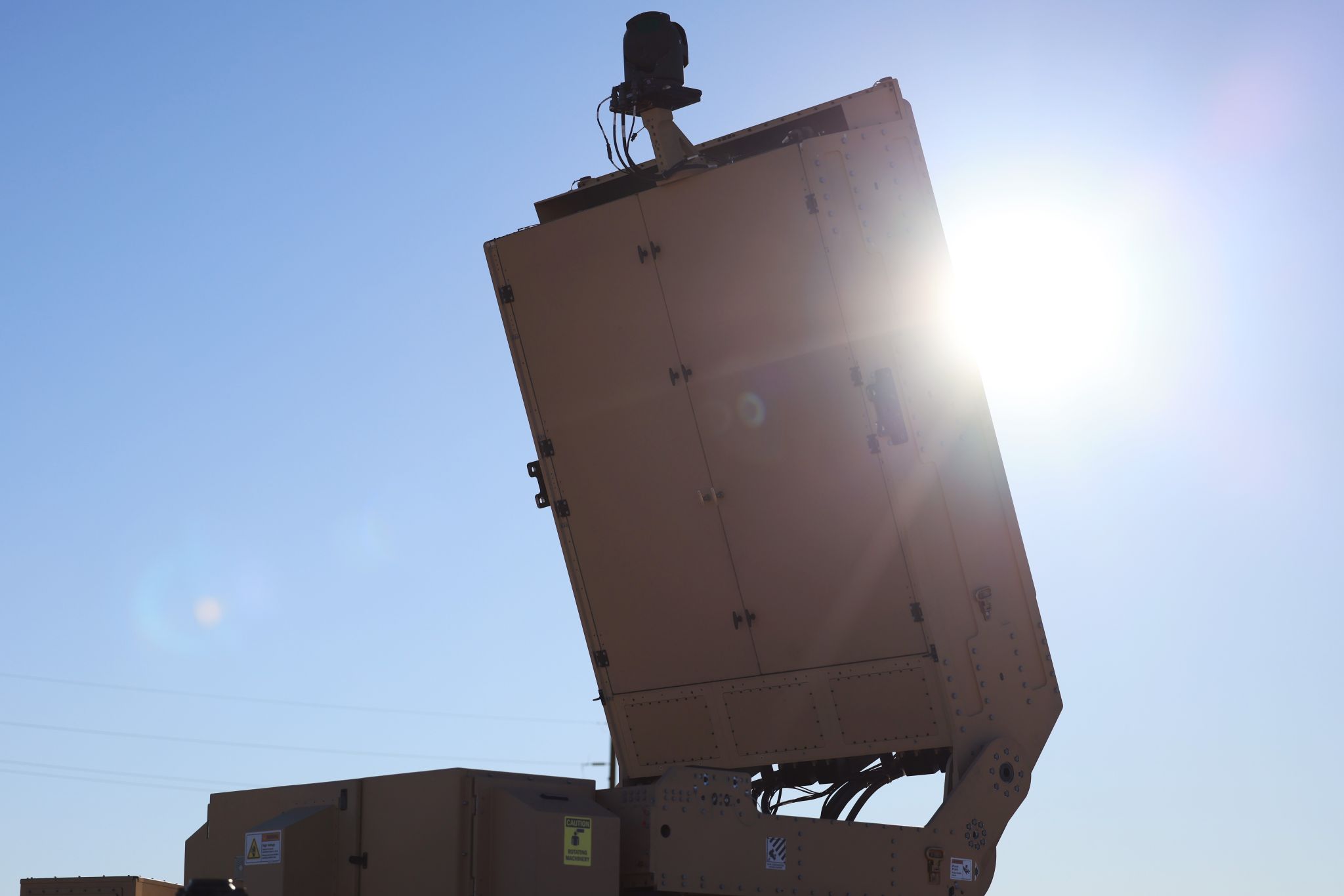
Epirus has integrated its Leonidas high-power microwave (HPM) counter-drone weapon into a broader U.S. Army command-and-control (C2) architecture during Operation JAILBREAK FALCON FURY, a service effort to accelerate the integration of Army and industry systems through open architectures. The Los Angeles-based company said this week that Leonidas demonstrated it can fuse sensors and its HPM effector inside a wider C2 ecosystem, letting operators match a specific weapon to a specific drone threat.
The event belongs to Operation Jailbreak, the first sprint of the Army’s Right to Integrate (R2I) initiative, which requires vendors to expose documented application programming interfaces (APIs) so sensors, effectors and C2 nodes from different manufacturers share data in real time. The opening sprint ran at Fort Carson, Colorado, from early May to June 6, 2026, drawing roughly 600 engineers from more than 50 companies, with air and missile defense and counter-unmanned aircraft systems (C-UAS) as the first priority. The driver is operational: during Operation Epic Fury, the campaign against Iran launched February 28, 2026, Army air defenders neutralized more than 1,200 ballistic, cruise and drone threats, according to the commander of U.S. Army Space and Missile Defense Command.
How Epirus Leonidas Plugs Into the Army’s Open C2 Architecture
Epirus framed the demonstration around a layered-defense principle: no single technology can address every threat, and effective counter-drone defense fuses sensors, C2 and multiple effectors.
Epirus has not said when or where FALCON FURY took place, which C2 system Leonidas connected to, or whether live drones were engaged. Nor is it confirmed whether the event corresponds to Jailbreak 2.0, the follow-on R2I iteration that participating vendors say was hosted at U.S. Central Command (CENTCOM) headquarters in Tampa, Florida. In the first sprint, the validation environment used Anduril’s Lattice for Air Defense as the landing zone for the Integrated Battle Command System-Maneuver (IBCS-M).
Integration is precisely where the Army found Leonidas lacking. Developmental testing of the first prototypes validated the effector but exposed usability gaps. In October 2024, the Army’s Rapid Capabilities and Critical Technologies Office (RCCTO) awarded Epirus a contract modification of nearly $17 million for an upgraded sensor suite and a closed-loop fire control system designed to cut engagement latency. An HPM weapon is unusually dependent on external cueing: it needs early track data to orient its beam and a C2 layer that deconflicts friendly drones and emitters inside its footprint. Documented interfaces turn Leonidas from a standalone emplacement into a node commanders can task alongside guns, interceptors and electronic warfare.
IFPC-HPM Gen II Specifications: Range, Power and GaN Architecture
Leonidas is a solid-state, software-defined HPM system. Publicly available specifications indicate its flat-panel aperture houses an array of gallium nitride (GaN) amplifiers, replacing the bulky magnetron tubes of earlier microwave weapons, with software shaping and steering the beam across an arc of roughly 60 degrees. The pulse overloads onboard electronics, defeating navigation, datalinks or motor controllers. Because the beam covers a volume rather than a point, one shot can down several closely spaced drones, and the magazine is limited only by power. Epirus has not published a maximum effective range.
RCCTO selected Leonidas for the Indirect Fire Protection Capability-High-Power Microwave (IFPC-HPM) effort in January 2023 through a $66.1 million other transaction authority agreement for four prototypes, all delivered by March 2024. In July 2025, the office ordered two Generation II systems for $43.5 million. Epirus claims Gen II more than doubles Gen I’s maximum effective range and adds about 30% more power, with roughly 80% of its 150,000 parts redesigned. At a company-run demonstration at Camp Atterbury, Indiana, on August 26, 2025, a first-generation unit disabled all 61 drones flown across five scenarios, including a 49-drone swarm defeated with a single pulse.
The comparison with lasers defines the niche. A high-energy laser such as the 50-kilowatt Directed Energy Maneuver-Short Range Air Defense (DE M-SHORAD) must dwell on one target at a time. An HPM aperture services an area, trading reach and selectivity for one-to-many engagement at the final layer.
From Stryker to Leonidas GV: The GDLS Mobility Roadmap
Mobility is the second line of effort, run with General Dynamics Land Systems (GDLS). The partners unveiled Stryker Leonidas in 2022, then mounted the effector in October 2025 on the GDLS 10-ton Tracked Robot (TRX), a robotic combat vehicle with a published range above 300 miles and a top speed of 45 mph. On March 24, 2026, GDLS, Epirus and Kodiak AI revealed the Leonidas Autonomous Ground Vehicle, a self-driving truck integrated by GDLS.
Epirus will now show Leonidas GV, a new mobile HPM variant built with GDLS that the company describes as able to engage many drones at once, at the Association of the United States Army (AUSA) Annual Meeting in Washington, D.C., on October 12 to 14, 2026. No specifications have been released. A maneuver-capable HPM would let the Army push swarm defense forward with brigade formations rather than confine it to fixed-site protection.
Analysis: The microwave matters less than the interface. Epic Fury exposed the cost-exchange problem in base defense, as Patriot and Terminal High Altitude Area Defense (THAAD) interceptor inventories fell sharply against massed Iranian missiles and drones. A power-limited magazine is the logical answer to cheap drones at the inner layer, but only if a shared C2 picture can route close-in swarms to the HPM and reserve costly interceptors for ballistic threats. By writing documented APIs and modular open-systems requirements into future contracts, R2I lowers the integration barrier that has kept nontraditional effector suppliers like Epirus at the prototype stage.
AUSA is the next marker, where the Leonidas GV reveal should clarify vehicle, power and range data. Larger unknowns remain: the Gen II delivery schedule, the measured results of FALCON FURY, and whether the Army moves IFPC-HPM from rapid prototyping to a program of record with production funding. Until the Army details which C2 nodes Leonidas joined and what it engaged, the demonstration stands as an integration claim rather than a validated operational capability.