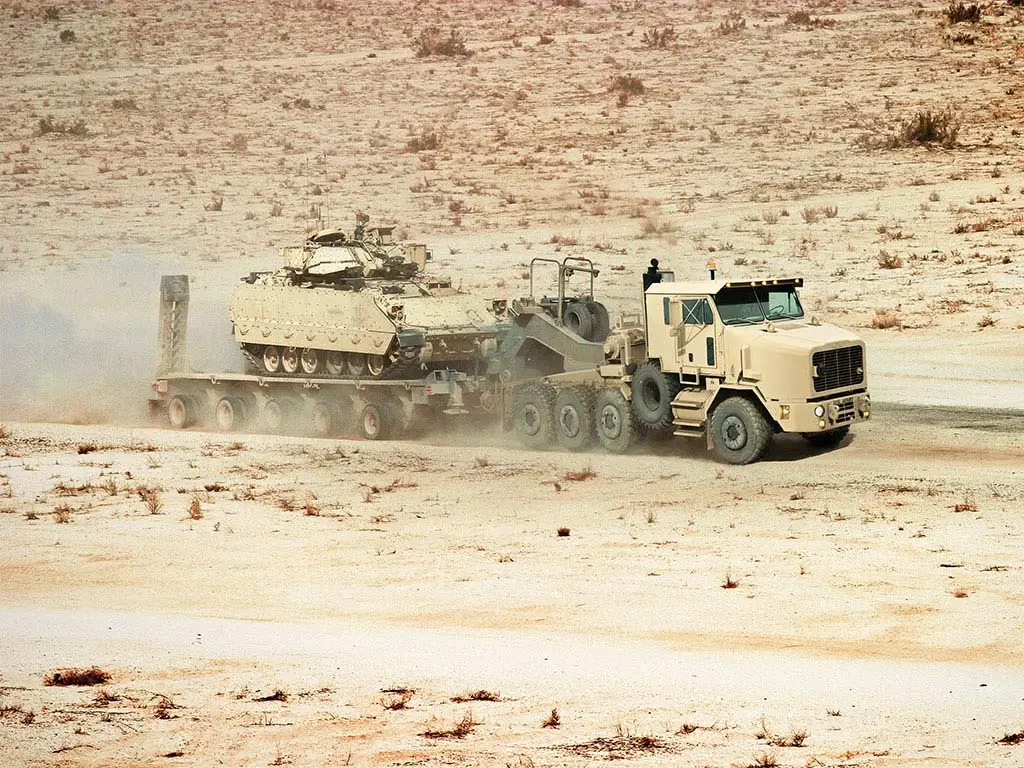
Oshkosh Defense has received a second Direct Commercial Sales (DCS) order for the Royal Moroccan Armed Forces covering 50 Heavy Equipment Transporter (HET) A1 tractors and 50 MN573 heavy-duty trailers, the company announced on October 5, 2026. The order was placed by Optimum Vehicle Logistics (OVL), a Milwaukee, Wisconsin-based distributor that serves as Oshkosh’s exclusive channel into the Kingdom, and includes spare parts, services, and training. Oshkosh did not disclose the contract value or a delivery schedule.
The follow-on order builds on a first DCS contract announced on September 11, 2024, which the company tied at the time to Morocco’s M1 Abrams modernization effort. That initial tranche, whose quantity was never made public, has now been delivered and is operational, according to Oshkosh. Rabat’s Abrams fleet is substantial: it received more than 200 M1A1 Special Armor (SA) tanks through the US Excess Defense Articles program following a 2012 approval, and in November 2018 the State Department cleared an estimated $1.259 billion package to bring 162 additional Abrams to the M1A1 SA, M1A2M, or US Marine Corps configuration.
Oshkosh HET A1: Powertrain, Mobility, and the Abrams Lift Requirement
The HET A1, designated M1070A1 in US Army service, is the second-generation version of the 8×8 tractor Oshkosh has built for the Army since the early 1990s. US fielding began in 2011. The A1 replaced the original M1070’s 500-horsepower Detroit Diesel 8V92TA with a 700-horsepower Caterpillar C18 engine, mated to an Allison 4800SP automatic transmission and a single-speed Oshkosh 30000 Series transfer case, according to manufacturer specifications. Publicly available specifications indicate the A1 also introduced AxleTech 5000 Series axles, anti-lock braking with traction control, and a central tire inflation system (CTIS) that lets the crew adjust tire pressure for highway, cross-country, or soft-ground conditions.
The tractor is sized around the 70-ton M1 Abrams. Its four axles include steerable front and rear lines, tightening the turning radius on narrow roads and in garrison areas, and two 55,000-pound (24,948-kilogram) winches allow crews to load disabled or non-running vehicles without separate recovery assets. The air-conditioned cab seats six, enough to carry a tank crew alongside the drivers. The design is compliant with the US Army’s Long-Term Armor Strategy (LTAS) for add-on armor kits, though Oshkosh has not said whether Moroccan vehicles include them. A three-axle Global HET variant, rated for 72 tons, targets European road regulations; Morocco’s order specifies the four-axle A1.
Long tracked road marches burn fuel and accelerate wear on road wheels, track shoes, and the AGT1500 gas turbine, driving up maintenance hours and parts consumption. Wheeled transport preserves track life for combat and delivers crews to their vehicles rested. Oshkosh has not stated which Moroccan platforms the new systems will carry, but the 2024 order’s explicit link to the Abrams program makes the tank fleet the most likely primary load.
Broshuis MN573 Trailer Replaces the 635NL in Morocco’s Second Tranche
The most visible change between the two orders is the trailer. Where the 2024 contract specified Oshkosh 635NL trailers, the new tranche pairs each tractor with an MN573 heavy-duty semi-trailer designed and manufactured with Broshuis B.V., the Dutch specialty trailer builder founded in 1885. Oshkosh describes the MN573 as a next-generation heavy transport solution for international customers but has released no payload rating, axle count, deck length, or loading height for the design.
Broshuis is an established partner in Oshkosh’s military trailer business. The Dutch firm builds the M1302 trailer for the US Army’s Enhanced Heavy Equipment Transporter System (EHETS), under orders for 170 units in 2019 and 466 in 2022, and partners with Oshkosh on the $342 million Medium Equipment Trailer (MET) contract awarded in November 2023 for an estimated 557 six-axle trailers. Oshkosh credits Broshuis with the PL2 pendular axle system fitted to its HET trailers. Pendular axles let each axle line oscillate independently, keeping wheel loads even across uneven ground and reducing stress on both trailer and cargo.
The switch has sustainment implications for Rabat. A trailer drawn from the same supplier base and suspension architecture as the US Army’s newest heavy trailers connects Morocco to a production line with US Army deliveries scheduled into 2031, which should support parts availability over the fleet’s service life. Whether the MN573 shares components with the M1302 or the MET has not been disclosed. Pat Williams, Chief Programs Officer at Oshkosh Defense, said the order “reflects the growing demand for our mission-ready, performance-proven mobility solutions.”
Analysis: The follow-on order is a readiness signal more than a capacity headline. After a decade of buying and upgrading heavy armor, Morocco is now funding the enablers that determine how fast it moves. Geography sharpens the requirement: road distances between garrisons in the north and units deployed along the roughly 2,700-kilometer defensive berm in Western Sahara can exceed 1,000 kilometers, where heavy transporters turn a multi-day tracked road march into a wheeled transfer that keeps tanks mission-capable. The DCS channel through OVL, typically more flexible on terms and timelines than Foreign Military Sales, also gives Rabat a commercial route to US-built logistics vehicles that other Abrams operators could follow.
The size of the first tranche, and therefore the total Moroccan HET A1 fleet, remains undisclosed. Markers to watch include the first MN573 deliveries and any specification release from Broshuis, the pace at which upgraded Abrams enter Moroccan service, and whether Rabat places further DCS orders for Oshkosh heavy tactical vehicles.