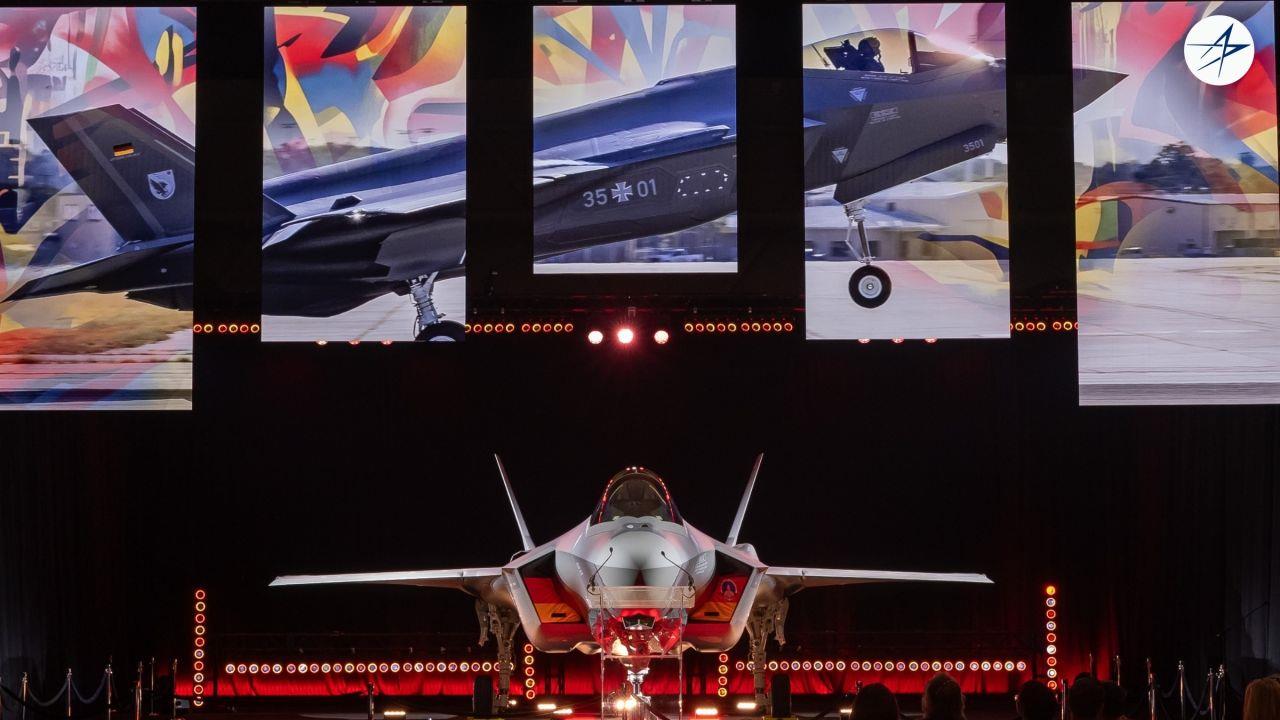
Germany received its first F-35A Lightning II on September 18, 2026, when Lockheed Martin formally handed over the aircraft to the German Ministry of Defence during a ceremony at the manufacturer’s production facility in Fort Worth, Texas. German Defence Minister Boris Pistorius accepted delivery, marking the start of a 35-aircraft program worth 10 billion euros that will replace the Luftwaffe’s aging Panavia Tornado fleet.
The delivery formalizes a decision Berlin made in March 2022, weeks after Russia’s invasion of Ukraine prompted then-Chancellor Olaf Scholz’s Zeitenwende defense policy shift within the North Atlantic Treaty Organization (NATO). Germany signed the contract for 35 F-35As that December, choosing the jet primarily to preserve its role in NATO’s nuclear-sharing arrangement. The Tornado is the only aircraft in German service certified to carry the US B61 tactical nuclear bomb, and it is due for retirement by 2030, leaving the F-35A as the only qualified successor for that mission.
Germany F-35A Delivery Anchors NATO Nuclear-Sharing Mission
The F-35A Lightning II is a single-engine, single-seat fifth-generation multirole fighter built around low-observable shaping, internal weapons carriage and radar-absorbent coatings that reduce its detectability against modern air defenses. Publicly available specifications indicate a single Pratt and Whitney F135-PW-100 turbofan rated at more than 40,000 pounds of thrust in full afterburner, a top speed of Mach 1.6 and a combat radius beyond 590 nautical miles on internal fuel. Its sensor suite fuses data from the AN/APG-81 active electronically scanned array radar, the Electro-Optical Targeting System and a Distributed Aperture System of six infrared sensors providing 360-degree spherical coverage around the airframe, a fusion capability Pistorius said lets the jet build a comprehensive real-time picture from large volumes of collected data. The pilot views this fused picture through a helmet-mounted display rather than a head-up display, while the Multifunction Advanced Data Link shares targeting data among stealth aircraft without breaking cover, and Link 16 covers non-stealth allies.
- Internal weapons bays carry up to 18,000 pounds of ordnance across four stations
- Standard air-to-air loadout: two AIM-120 AMRAAM missiles plus an internal 25mm GAU-22/A cannon
- Standard strike loadout adds two 2,000-pound GBU-31 Joint Direct Attack Munition bombs
That internal carriage is central to why Berlin chose the F-35A over other options. The US Air Force completed nuclear design certification for the F-35A to carry the B61-12 guided bomb in 2021, and NATO’s Dual Capable Aircraft program has since moved toward operational certification. By 2030, the F-35A assumes the nuclear strike role from the Tornado at Büchel, carrying the B61-12 internally rather than externally, reducing the delivery aircraft’s own detectability during NATO’s most sensitive mission.
Training at Ebbing Precedes Büchel Basing by 2027
The first aircraft, Luftwaffe serial 35+01 and manufacturer designation MG-01, flew for the first time at Fort Worth on September 8, 2026, ten days before the handover ceremony. It will remain in the United States with the next seven jets, based at Ebbing Air National Guard Base in Fort Smith, Arkansas, where German pilots and maintenance personnel train alongside a Singaporean F-35 detachment. Germany becomes the second nation to base a Foreign Military Sales training presence at Ebbing.
Deliveries direct to Germany begin in the third quarter of 2027, when aircraft start arriving at Büchel Air Base in Rhineland-Palatinate, home to Tactical Air Wing 33. The base is undergoing runway and infrastructure renovation to support F-35 operations and the security requirements tied to its nuclear-sharing role. Lockheed Martin and German officials expect all 35 aircraft delivered by 2029, when full operational capability is due; the Tornado fleet, in Luftwaffe service since the 1980s, retires fully by 2030. Some of the Tornado’s electronic-warfare and air-defense suppression taskings are shifting instead to the Eurofighter’s Electronic Combat and Reconnaissance (ECR) variant, splitting the fleet transition across two aircraft types rather than a one-for-one swap. Lieutenant General Holger Neumann, Chief of the German Air and Space Force, said the F-35’s adoption by 20 nations, including 13 in Europe, would let the Luftwaffe train, exercise and operate more closely with fellow operators of the jet.
Analysis: The handover confirms a decision made more than four years ago; the real significance lies in the technical baseline Germany is buying into. The Pentagon’s own 2025 operational test report found that Technology Refresh 3, the hardware and software base for Block 4, had delivered no new combat capability after a year of testing, and program officials now put full Block 4 fielding at 2031, roughly five years late and billions over budget. Germany’s first F-35As will therefore reach Büchel on a still-maturing software baseline, a limitation every F-35 operator inherits along with the aircraft’s stealth and interoperability. For Berlin, the narrower calculation stands regardless: no other aircraft in German service is certified for NATO’s nuclear-sharing mission once the Tornado retires.
The next milestones are procedural rather than dramatic. Pilot and maintainer training at Ebbing continues through 2027, when the first jets are due at Büchel; full delivery of the 35-aircraft order and initial operational capability follow by 2029, ahead of the Tornado’s final retirement in 2030. Germany has not disclosed a target date for its own operational nuclear certification under the Dual Capable Aircraft program, and Luftwaffe leaders have repeatedly signaled interest in ordering additional F-35As beyond the current 35, though no follow-on contract has been announced.