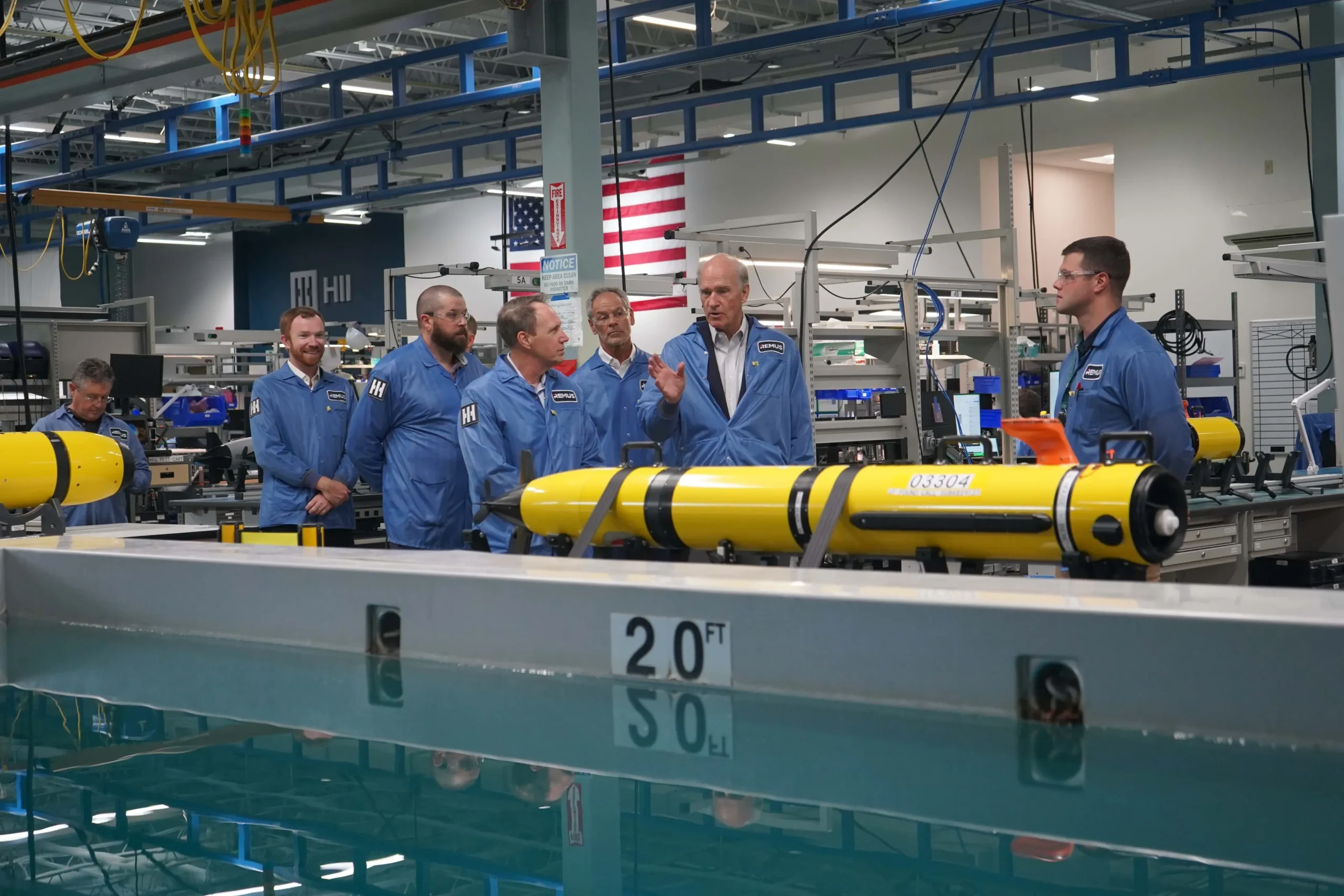
Huntington Ingalls Industries (HII) has expanded its unmanned systems production campus in Pocasset, Massachusetts, by 10,000 square feet, lifting the site from 40,000 to 50,000 square feet, a 25% increase announced on September 22, 2026. The added floor space raises capacity for the U.S. Navy’s Lionfish small unmanned undersea vehicle (SUUV), the REMUS 620 medium unmanned underwater vehicle (UUV) and the integration of HII’s Odyssey Autonomous Control Solutions (ACS) software, including autonomy hardware destined for the company’s ROMULUS unmanned surface vessels (USVs).
The expansion follows the Navy’s decision, announced by HII on July 6, 2026, to exercise an option year for Lionfish production. The five-year program could scale to as many as 200 vehicles with a total contract value exceeding $347 million, according to the company, and HII completed the 42nd Lionfish at Pocasset at the end of 2025, closing out base-year production. The plant opened in 2014; HII acquired REMUS manufacturer Hydroid from Kongsberg Maritime in March 2020. HII employs approximately 300 people at the site and has added 50 in 2026.
HII UUV Production at Pocasset: Lionfish, REMUS 620 and Odyssey
Lionfish derives from HII’s commercial REMUS 300, a two-person-portable, small-class vehicle. Manufacturer specifications list a 305-meter depth rating, up to 30 hours of mission endurance, a top speed of 5 knots and an open architecture that accepts wet or dry payloads. The Navy employs Lionfish for mine countermeasures (MCM), intelligence, surveillance and reconnaissance (ISR), anti-submarine warfare and electronic warfare. HII describes it as the Navy’s first transition from an Other Transaction Authority (OTA) prototype to full-scale production, as well as the only cyber-compliant UUV currently in Navy production. For expeditionary MCM teams, a vehicle two sailors can launch from a small boat reduces reliance on larger platforms for port and harbor clearance.
The REMUS 620 sits one class up. HII’s second-generation medium UUV carries a 600-meter depth rating, up to 110 hours of endurance, a range of 275 nautical miles and a top speed of 8 knots, with modular payload interfaces for MCM, hydrographic survey, intelligence collection and electromagnetic warfare. Against the Lionfish baseline, that is nearly four times the endurance and roughly double the depth rating, which moves the vehicle from harbor clearance toward extended covert survey ahead of a force.
The submarine link carries the most operational weight. On October 6, 2025, HII, Woods Hole Oceanographic Institution (WHOI) and Naval Undersea Warfare Center (NUWC) Division Newport announced the first recovery of a REMUS 620 into a Virginia-class torpedo tube and shutterway test fixture at Seneca Lake, New York, using WHOI’s Yellow Moray launch and recovery technology. The vehicle also demonstrated reverse swimout launch. The test used a fixture, not a submarine at sea, but it puts Pocasset output on the path toward UUVs that attack submarines can launch and recover submerged.
Odyssey Autonomy and the ROMULUS Split Production Model
The second driver is software. The expansion advances Odyssey ACS integration, including simulation and modeling tools and autonomy hardware for ROMULUS USVs. Pocasset does not build ROMULUS hulls. On April 21, 2026, HII announced four ROMULUS 151 vessels for production at Breaux Brothers Enterprises in Louisiana, in addition to one already under construction there. The resulting division of labor places hull fabrication on the Gulf Coast and autonomy integration on Cape Cod.
ROMULUS is a modular family built on a commercial-standard hull and rated above 25 knots, with HII listing lengths of up to roughly 190 feet. HII markets it for ISR, counter-unmanned aircraft defense, strike, MCM and the launch and recovery of REMUS UUVs and drones, aligning it with the Navy’s Modular Attack Surface Craft (MASC) and the Marine Corps’ Long Range Unmanned Surface Vessel (LRUSV) efforts.
Odyssey is the common thread. HII credits the suite with more than 6,000 operational hours across over 35 USV platforms. It uses open standards including the Unmanned Maritime Autonomy Architecture (UMAA) and collision-regulation-compliant navigation that fuses radar, electro-optical/infrared and ship-tracking data. Duane Fotheringham, president of the Unmanned Systems group in HII’s Mission Technologies division, said the site now combines “advanced unmanned platforms, autonomy, integration, simulation and modeling capabilities.” Running undersea and surface vehicles on one control stack simplifies mission planning when a ROMULUS hull carries and recovers REMUS vehicles.
Analysis: The square footage is modest; the signal lies in where HII places value. The Lionfish ceiling of 200 vehicles over five years, with 42 completed by the end of the base period, does not by itself justify a 25% larger plant. The added capacity points toward anticipated REMUS 620 volumes, export demand and a steady flow of Odyssey kits for ROMULUS. HII also works from an installed base of more than 750 REMUS vehicles delivered to over 30 countries, including 14 NATO members, with more than 90% still in service, per the company. That fleet sustains upgrade and support business a new entrant cannot replicate quickly. The open question is output: HII disclosed neither capital cost nor production targets, so floor space should not be read as a proportional rise in deliveries.
Near-term markers include the next Lionfish option decision, any move of REMUS 620 torpedo tube recovery from test fixture to at-sea submarine trials, and delivery of the first production ROMULUS 151 hulls fitted with Pocasset-integrated autonomy. HII has published no timeline for these milestones and has tied the expansion to no new award beyond Lionfish.