US soldiers trained with a firearm-equipped robot dog alongside the Indian Army at Auli, India, in September 2026, the latest sign that quadruped unmanned ground vehicles (UGVs) are moving beyond base patrol into counter-drone, medical, amphibious and armed missions. Exercises in Portugal, Michigan and Saudi Arabia show the same widening pattern.
Tyndall Air Force Base, Florida, set the baseline in November 2020, when the 325th Security Forces Squadron became the first Department of Defense (DoD) unit to use Ghost Robotics Vision 60 quadrupeds for semi-autonomous security patrols. The requirement has since widened. Small drones now threaten bases and field hospitals, and exercises pair the machines with aerial drones, unmanned boats and medics.
How Military Robot Dogs Team With Drones, Boats, and Medics
During a North Atlantic Treaty Organization (NATO) exercise at Troia, Portugal, in autumn 2025, an unmanned surface vessel delivered a quadruped to the beach as a forward patrol. The robot scanned the area before Portuguese marines landed from follow-on craft, which put a machine, not a marine, in the first exposed position.
In 2025, the Naval Information Warfare Center used software to integrate quadrupeds with quadcopter drones so the pairs could complete missions autonomously.
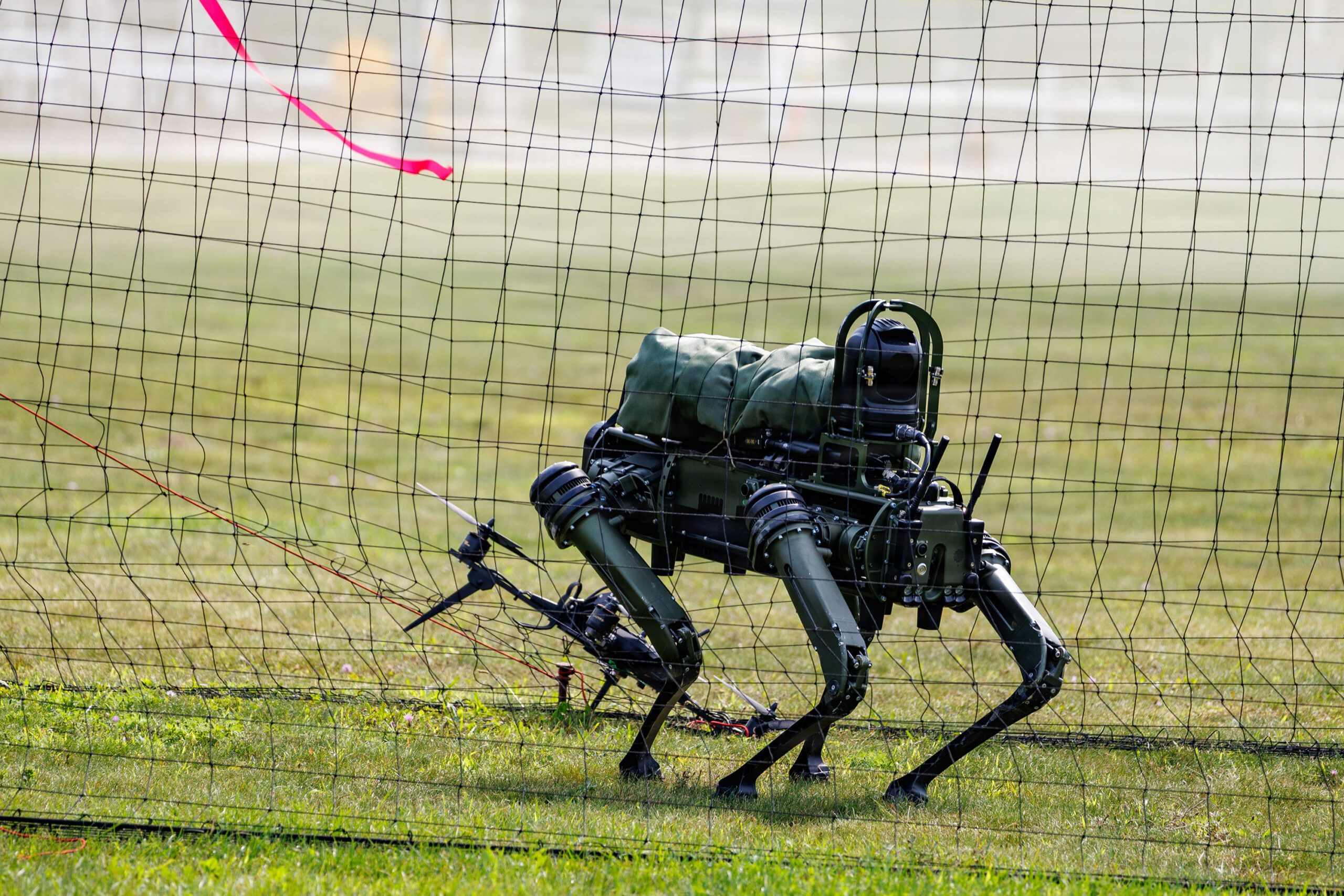
Counter-drone recovery is the sharpest new use. At Northern Strike 26-2 at the Alpena Combat Readiness Training Center in Michigan, Airmen defended a simulated field hospital against drones with anti-drone netting and small-arms fire. On August 10, 2026, a Vision 60 swept for explosives and inspected downed drones so medics could enter the netting area and evacuate patients. More than 100 medics from seven units trained under that drone threat, and the netting concept came from Ukraine.
Explosive detection remains a core task. Operation Emerald Coast III, an explosive ordnance disposal technology event at Hurlburt Field, Florida, from April 27 to May 1, 2026, rotated participants from 22 military units and civilian law enforcement through 12 industry stations, including robot bomb dogs. A pair of robot dogs located a simulated explosive device.
Medical teaming has moved from demonstration toward competition. The Army ran a medic-robot teaming scenario at Fort Detrick, Maryland, in April 2023. From September 26 to October 3, 2025, the Defense Advanced Research Projects Agency (DARPA) Triage Challenge sent uncrewed ground and aerial vehicles through simulated C-130 crash and night ambush courses in Perry, Georgia. The final event is scheduled for fall 2026.
Vision 60 Specifications and the Push Toward Armed Quadrupeds
Publicly available specifications indicate the Vision 60 weighs 51 kilograms, carries up to 10 kilograms, reaches 3 meters per second and runs 3.15 hours in motion or 21 hours on standby with its computer, sensors and radio powered. Maximum range is about 10 kilometers. The chassis is rated IP67 and climbs stairs and crosses rocks, sand and hills. Wi-Fi and 4G LTE radios come standard, and a gigabit switch accepts external radios for longer-range links.
Those figures define the mission envelope. Three hours suits sweeps, inspections and reconnaissance such as the Alpena and Hurlburt Field tasks, while a 10-kilogram payload ceiling forces trade-offs among sensors, radios and weapons. Payload options include thermal cameras, chemical, biological, radiological and nuclear detectors and a six-degree-of-freedom manipulator arm, and onboard NVIDIA computing handles edge processing. A blind-mode control core lets the robot recover from slips and falls when vision sensors degrade, which matters on smoke-filled or dark courses like those DARPA used. An Onyx Industries tail accessory adds swimming, relevant to the amphibious work at Troia. Ghost Robotics reports more than 1,000 robots shipped to over 25 national security customers.
Armed variants are moving from demonstration toward exercise. In September 2024, the US Army tested a Vision 60 fitted with a rifle-type weapon on a rotating turret at the Red Sands Integrated Experimentation Center in Saudi Arabia, where US Army Central said it engaged several static ground targets. At Yudh Abhyas 2026, which began September 15, US soldiers and Indian troops used a firearm-equipped robot dog during counterterrorism drills that included clearing a building with assault teams.
Public information does not specify whether the Auli unit was remotely operated, used autonomous targeting, or which platform it was.
Analysis: Across Troia, Alpena, Hurlburt Field and Perry, the quadruped’s job is the same: enter the space where first exposure is most likely to injure a person, then report back. That makes it a risk-transfer tool rather than a fighting platform, and its practical value is bounded by payload and endurance more than by locomotion. Armed variants change the logic. DoD Directive 3000.09, updated January 25, 2023, requires that autonomous and semi-autonomous weapon systems be designed to allow commanders and operators to exercise appropriate levels of human judgment over the use of force, so drills such as Auli test procedures as much as hardware.
Three markers will show how far the shift goes: the final DARPA Triage Challenge event in fall 2026, any move from experiments such as Red Sands and Auli toward a funded armed-quadruped requirement, and endurance and communications results from the next counter-drone exercises. Until the services disclose how the Auli unit was controlled, the line between remote operation and autonomy in armed quadrupeds remains unresolved.