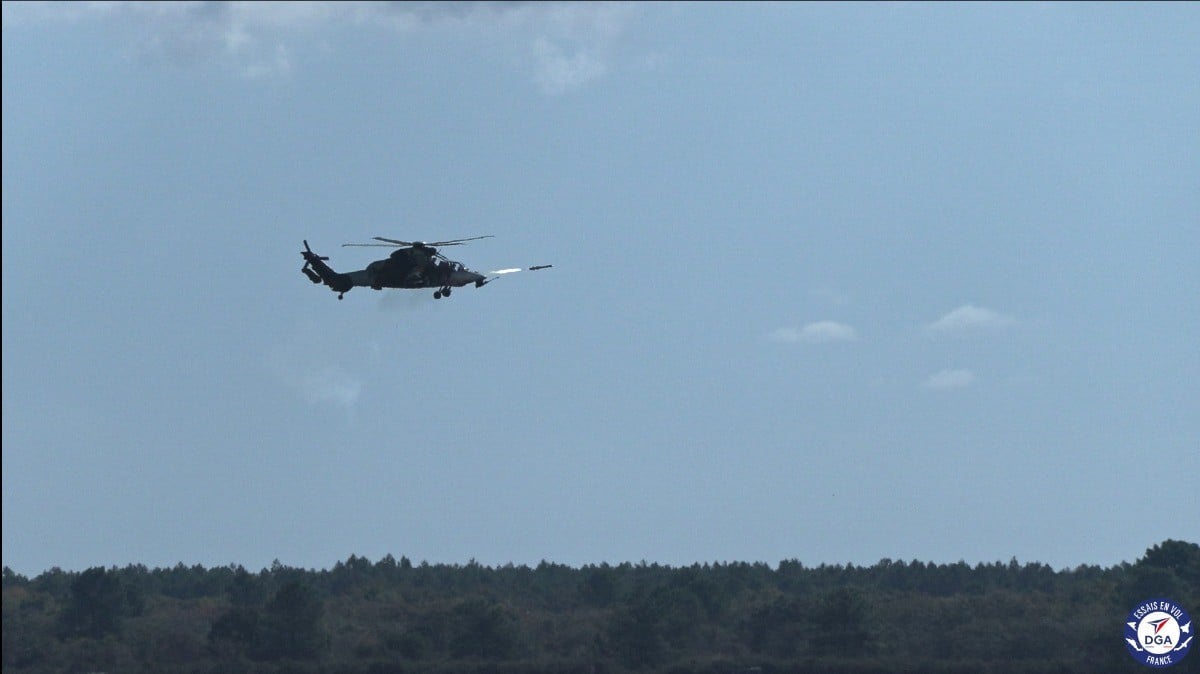
France has completed the fourth successful firing of the Akeron LP air-to-surface missile, launching the weapon from a Tiger attack helicopter at the Direction Générale de l’Armement (DGA) flight test center in Cazaux on September 25, 2026. According to the Organisation for Joint Armament Cooperation (OCCAR), which manages the program, the trial validated missile separation under helicopter-induced and aerodynamic disturbances and the engagement of designated targets with the missile’s imaging guidance chain locked on before launch.
The Akeron LP comes out of the Future Tactical Air-to-Surface Missile program, known by its French acronym MAST-F, under which OCCAR awarded MBDA a development and production contract in December 2020 to replace the AGM-114R Hellfire II on French Army Light Aviation (ALAT) Tigers. It anchors the French weapons package of the Tiger MkIII mid-life upgrade, contracted by OCCAR with Airbus Helicopters and MBDA in March 2022 for 42 French aircraft, with an option for 25 more, and 18 Spanish aircraft. First Akeron LP deliveries are planned for 2028, while the first MkIII is due to reach the DGA in late 2029.
What the Fourth Akeron LP Missile Firing Validated at Cazaux
The September 25 trial addressed two integration risks. The first is separation: a rotorcraft launch exposes the missile to rotor downwash, airframe vibration and crosswind effects at low airspeed, conditions a ground launcher does not reproduce. OCCAR said the round demonstrated separation performance in that environment, building on the first boosted firing from a Tiger test bed at Cazaux on March 19, 2025, which was instrumented to assess that phase.
The second is the guidance chain. The imaging seeker was activated before release in a Lock-On Before Launch (LOBL) configuration, meaning the missile acquired and locked its target while still on the launcher. MBDA documentation describes LOBL aiming as relying on automatic correlation between the helicopter sight image and the seeker image, a function that must hold up reliably on a vibrating aircraft.
The September shot completes a four-step firing sequence. On February 5, 2025, a prototype fired from a crane launcher at the DGA Essais de Missiles range validated aerodynamics, booster and sustainer thrust, and an 8 km range from the ground. After the March 2025 Tiger shot, on March 24, 2026, a ground-launched round engaged a sea-borne target at the Île du Levant range, exercising semi-active laser guidance and the missile-to-launcher datalink throughout the flight; MBDA placed that target on a moving barge 6 km away.
OCCAR has not disclosed the engagement range, the target type or whether the round carried a live warhead, and it identified the launch aircraft only as a Tiger helicopter, not a MkIII-standard airframe.
Seeker, Warhead, and Datalink: How Akeron LP Compares to Hellfire II
The Akeron LP derives from the Akeron MP, the fifth-generation land combat missile formerly designated MMP. MBDA data describe the LP variant as a 30 to 40 kg class round measuring 1.8 m in its tactical canister. It carries a tri-mode seeker combining semi-active laser (SAL), television and uncooled infrared channels, with Safran supplying the laser element and Thales the imaging element. A bidirectional radio-frequency datalink returns seeker imagery to the crew in flight, enabling target refresh, retargeting and beyond-line-of-sight (BLOS) engagements on third-party designation.
OCCAR gives a range of more than 8 km from helicopters and up to 20 km from uncrewed aircraft. MBDA credits the multipurpose tandem warhead with defeating more than 1,000 mm of rolled homogeneous armor behind explosive reactive armor, using a top-attack profile against main battle tanks. The missile is carried in twin or quad launchers; MBDA lists a loaded quad at roughly 200 kg, fitted through standard 14-inch lugs and a MIL-STD-1760 interface.
Publicly available specifications put the AGM-114R at about 49 kg, with a rotary-wing range of roughly 8 km and semi-active laser guidance only. Reach from the helicopter therefore improves only marginally. The operational gain lies in the seeker and datalink: a Hellfire crew must keep a laser spot on the target or depend on another designator, while an Akeron LP gunner can lock on before launch, watch the target through the missile and correct or abort in flight. MBDA has also cited a 100 kg weight saving at helicopter level. On the MkIII, Safran’s Euroflir 510 sight will cue the missile.
Analysis: The Akeron LP gives France a European-built replacement for a US-supplied munition in the ALAT’s primary anti-armor role, and its value is doctrinal more than ballistic. In-flight imagery, third-party designation and a 20 km envelope from drones such as the Eurodrone fit the networked, drone-teamed engagement model the MkIII is designed around, in which the helicopter fires from cover at targets its crew may never see. The constraint is sequencing. Missiles due from 2028 depend on a MkIII whose first flight has already slipped from 2025 to a 2026 target, and Spain’s MkIII configuration calls for a separate air-to-ground missile, narrowing the missile’s European footprint from the outset.
OCCAR has not published the remaining trial schedule; air-launched firings exercising lock-on after launch and in-flight retargeting would logically precede qualification and first deliveries in 2028. Airbus Helicopters has targeted 2026 for the first MkIII flight, with the first upgraded aircraft due to the DGA in late 2029 and to Spain in 2030. Whether France exercises its option on 25 additional MkIII conversions will determine how many Tigers ultimately carry the missile.