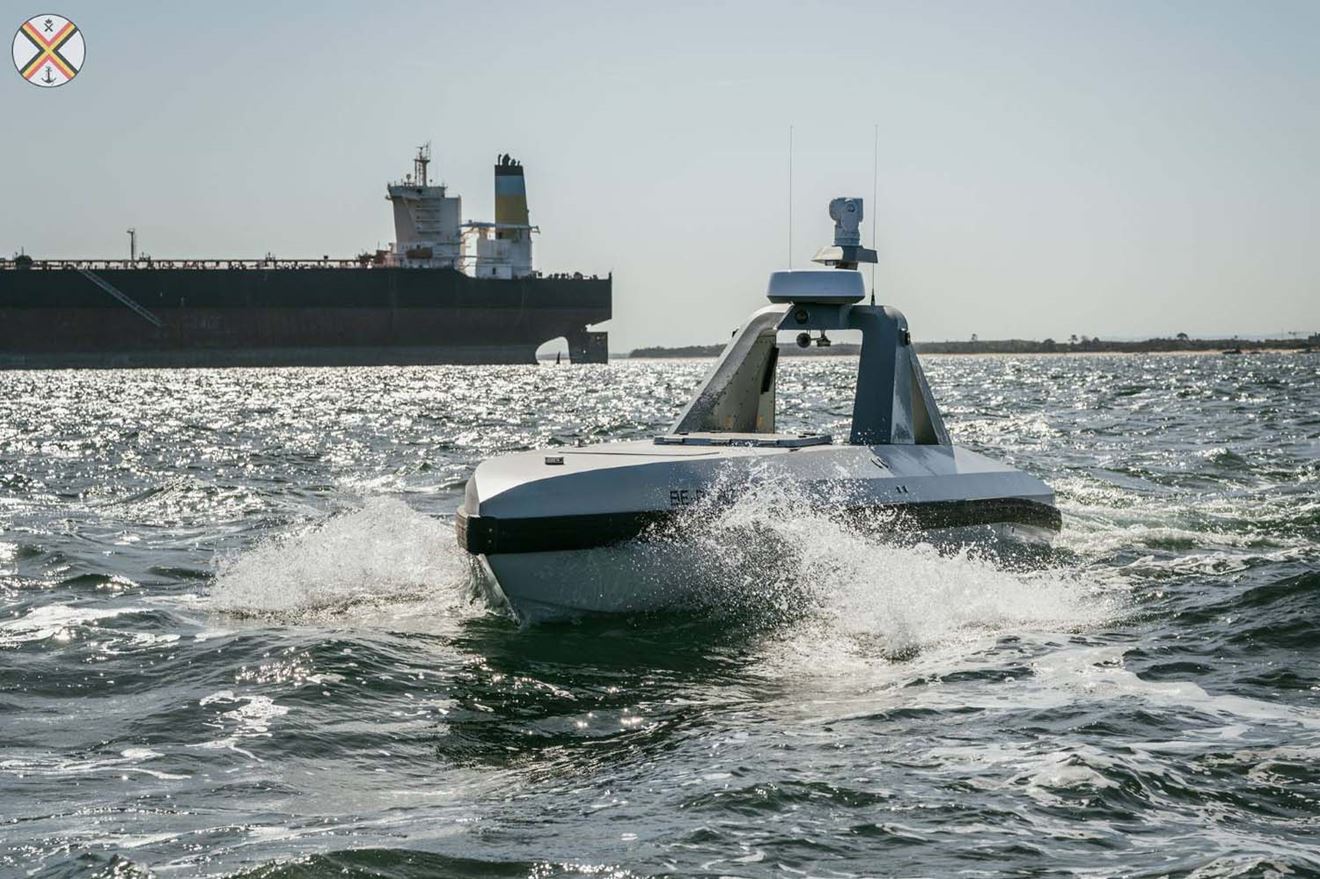
The Royal Navy led the anti-submarine warfare (ASW) component of REPMUS 2026, the NATO-backed maritime autonomy exercise off Portugal, fielding underwater gliders, uncrewed surface vessel (USV) squads and two large autonomous boats to detect and track submarine targets, the service said on October 1, 2026. Around 200 UK sailors, scientists and industry staff deployed to Troia, where the Royal Navy directed trials for a contingent from ten NATO and partner nations.
REPMUS, short for Robotic Experimentation and Prototyping with Maritime Unmanned Systems, ran from August 31 to September 25, 2026, around Troia and Sesimbra, with more than 1,500 participants from 36 navies according to the host Portuguese Navy. For London, the exercise doubled as a live test bed for Atlantic Bastion, the ASW program the Ministry of Defence (MoD) unveiled on December 8, 2025, in response to rising Russian submarine and undersea intelligence activity in the North Atlantic. Drawn from the 2025 Strategic Defence Review, the program pairs autonomous sensors and vessels with frigates, submarines and patrol aircraft.
REPMUS 2026 Glider Network Built a Layered Undersea Sensing Picture
The Royal Navy deployed several types of underwater gliders in a two-tier architecture. Smaller gliders collected oceanographic data and fed real-time assessments to larger sentinel gliders carrying long vertical acoustic arrays to detect and track potential threats. The pairing has a direct operational payoff: sound speed profiles, thermoclines and salinity layers govern how far acoustic energy travels, and a network that measures its own environment can update detection assumptions as conditions shift instead of relying on seasonal averages.
According to Teledyne Marine, 19 Slocum gliders and two Slocum Sentinel gliders from the Royal Navy, the US Navy and the German Navy took part, one Sentinel fitted with a towed array. Manufacturer specifications list the Sentinel at 2.57 meters long and 0.33 meters in diameter, with a 1,000-meter depth rating, a 3.5-kilogram maximum payload and a standard glide speed of 0.75 knots. Integrated thrusters provide bursts of up to 2.5 knots against strong currents. Published endurance ranges from more than 18 months to over two years depending on configuration.
Those parameters define the role. At under one knot, a Sentinel cannot prosecute a contact; it is a persistent, low-signature listening post able to hold a barrier line or choke point for months at minimal cost per sensor-day. That is the function assigned to uncrewed underwater vehicles in Atlantic Net, the first phase of Atlantic Bastion, which seeds key waters to build an intelligence, surveillance and reconnaissance (ISR) network. Teledyne also reported a long-range covert ingress mission by a Royal Navy Gavia autonomous underwater vehicle navigating with seabed transponders, a technique that allows precise positioning without surfacing for satellite fixes.
Autonomous USVs Test Towed Sonar and Sonobuoy Drops for Atlantic Bastion
On the surface, squads of small and medium USVs gathered acoustic data and generated real-time contact reports on submarine targets, a proof of concept for larger squads and vessels. Two autonomous boats, one 12 meters and one 17 meters long, were tested towing sonar, dropping automated sonobuoys and launching gliders.
The Royal Navy did not name the builders. The dimensions match UK firm ZeroUSV’s Oceanus12 and Oceanus17 designs, and Teledyne confirmed an Oceanus17 deployed a Gavia vehicle during the exercise. At REPMUS 2025, the Oceanus12 autonomously launched and recovered a thin-line towed array under a £196,100 MoD contract. Company figures for the Oceanus17 list a 16.97-meter aluminum monohull, a 4-tonne payload, a 20-foot ISO-compatible mission deck, endurance beyond 50 days and range above 5,000 nautical miles, with Level 4 autonomy from MarineAI’s GuardianAI suite.
Combining towing, sonobuoy laying and glider launching on one hull turns the USV from a sensor into a sensor carrier. Royal Air Force P-8A Poseidon aircraft and Royal Navy Merlin HM2 helicopters currently lay sonobuoy fields; a USV doing so for weeks without a crew could pre-position fields and preserve flight hours for prosecution.
Allies filled other layers. Germany, France, the Netherlands and the NATO Centre for Maritime Research and Experimentation (CMRE) provided five support ships. Sweden flew fixed-wing ISR drones, while Portugal operated drones that dropped sonobuoys and relayed data ashore. The Royal Navy also sponsored UK companies to evaluate technologies not yet formally adopted but intended to inform future Atlantic Bastion options. UK Head of Delegation Commander (Retired) Ian Danbury said the effort was adding mass to the battlespace with innovative systems.
Analysis: REPMUS 2026 shows the Royal Navy building ASW as a layered system rather than a platform purchase: gliders for persistence, USVs for mobile sensor delivery, drones for wide-area cueing, and crewed Type 26 frigates, Astute-class submarines and P-8A aircraft for classification and attack. The model targets the service’s central constraint, limited escort numbers against a modernizing Russian submarine force, by buying sensor-days rather than ship-days. Its weak points remain publicly untested: secure data backhaul from dispersed sensors under electronic attack, automated classification of quiet targets, and command authority over fleets that detect but cannot strike. No detection ranges or classification rates were released.
The MoD said in December 2025 that the first Atlantic Bastion sensors would enter the water in 2026; the next test is whether REPMUS results become contracts under the Project Cabot acquisition framework. Open questions include which UK systems move from sponsored trials to funded programs and integration with the Type 26 fleet the UK and Norway will operate under the Lunna House Agreement.